Ciri dan struktur
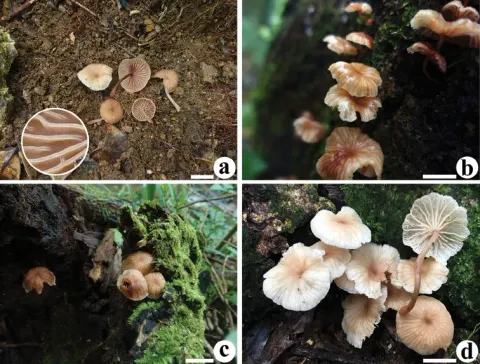
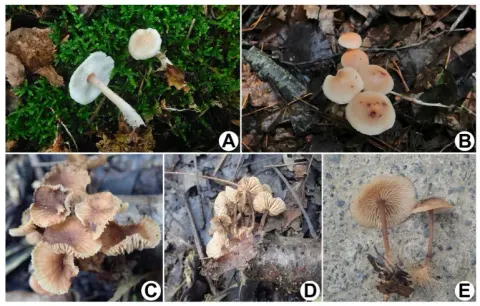
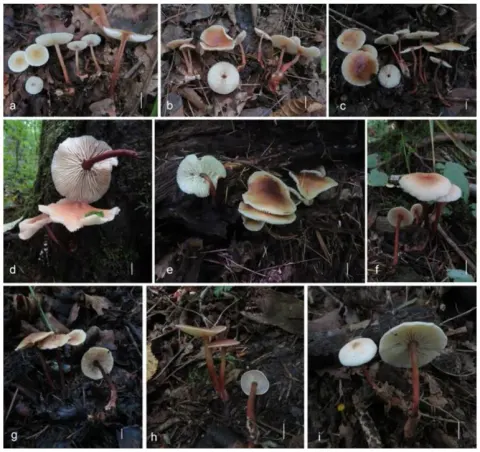
Differs from G. volkertii Murrill in its striate or grooved pileus and smaller basidiospores (4.0–5.5 × 2.5–3 μm). Basidiomata mainly gregarious on decayed wood in broadleaf forest; pileus disc reddish orange to dark brown becoming paler with age; lamellae broad, adnate and ventricose; stipe glabrous. Basidiomata omphalinoid, collybioid or gymnopoid. Pileus 10–40 mm broad, membranous, hemispheric when young, becoming convex, plano-convex to applanate, generally umbilicate to sometimes slightly depressed at the centre, inflexed then straight or reflexed at margin, with a marginal zone often undulating with age, glabrous, radially striate or grooved towards the margin, orange (6B7) or reddish orange (7B7) to brown (7D8) overall when young, somewhat reddish orange (7B7) or dark brown (7F8), then paler towards the margin, white or pale orange (6A3) to light brown (6D4), often greyish orange (6B4) to dark brown (6F8) at the disc. Lamellae adnate, broad, ventricose to broadly ventricose, white when fresh, sometimes with greyish red (7B4) to brown (7E7) tint somewhere, margin entire to split and sometimes grooved, L = 12–17, l = 3–5. Stipe 10–30 mm long, 2–4 mm thick in the middle, central, cylindrical, or compressed, with dense basal mycelium when young that disappears when old, hollow, fibrous, glabrous, slightly longitudinally striate when old, rooting deep in the substrate, but eventually attaches to the stump, dull white to greyish red (7B4) when young, soon darker towards the base, white to reddish orange (7A7) at apex, finally entirely dark brown (7F8). Odour not distinctive.
Habitat dan peran ekologis
Saprotrophic, gregarious or in small clusters, usually rooting around the roots and stumps in broadleaf forests.
- Habitat atau konteks temuan
- hutan
- Substrat
- Informasi belum tersedia pada sumber rilis ini.
- Peran atau konteks
- Pengurai
Reproduksi
Differs from G. volkertii Murrill in its striate or grooved pileus and smaller basidiospores (4.0–5.5 × 2.5–3 μm). Basidiomata mainly gregarious on decayed wood in broadleaf forest; pileus disc reddish orange to dark brown becoming paler with age; lamellae broad, adnate and ventricose; stipe glabrous. Basidiomata omphalinoid, collybioid or gymnopoid. Pileus 10–40 mm broad, membranous, hemispheric when young, becoming convex, plano-convex to applanate, generally umbilicate to sometimes slightly depressed at the centre, inflexed then straight or reflexed at margin, with a marginal zone often undulating with age, glabrous, radially striate or grooved towards the margin, orange (6B7) or reddish orange (7B7) to brown (7D8) overall when young, somewhat reddish orange (7B7) or dark brown (7F8), then paler towards the margin, white or pale orange (6A3) to light brown (6D4), often greyish orange (6B4) to dark brown (6F8) at the disc.
Catatan identitas dan cakupan
- Nama diterima mengikuti Catalogue of Life Base2026-09-11; uraian mempertahankan konsep dan nama sumber aslinya.
- Preserve original treatment localities, hosts and substrate scope. Materials examined describe documented specimens, not the full global range.
- Impor dan terjemahan otomatis belum diperiksa editorial per profil. Struktur reproduktif yang disebutkan tidak membuktikan seluruh siklus hidup diketahui.
- Pengukuran pada uraian mengikuti spesimen, kultur, dan metode sumber; angka tidak diperluas ke semua populasi.
Catatan distribusi dalam narasi mengikuti sumbernya. Dokumentasi spesimen atau foto mengikuti catatan sumber. Bukti wilayah Indonesia dan penilaian konservasi tidak disimpulkan dari gambar.
Melihat dengan konteks
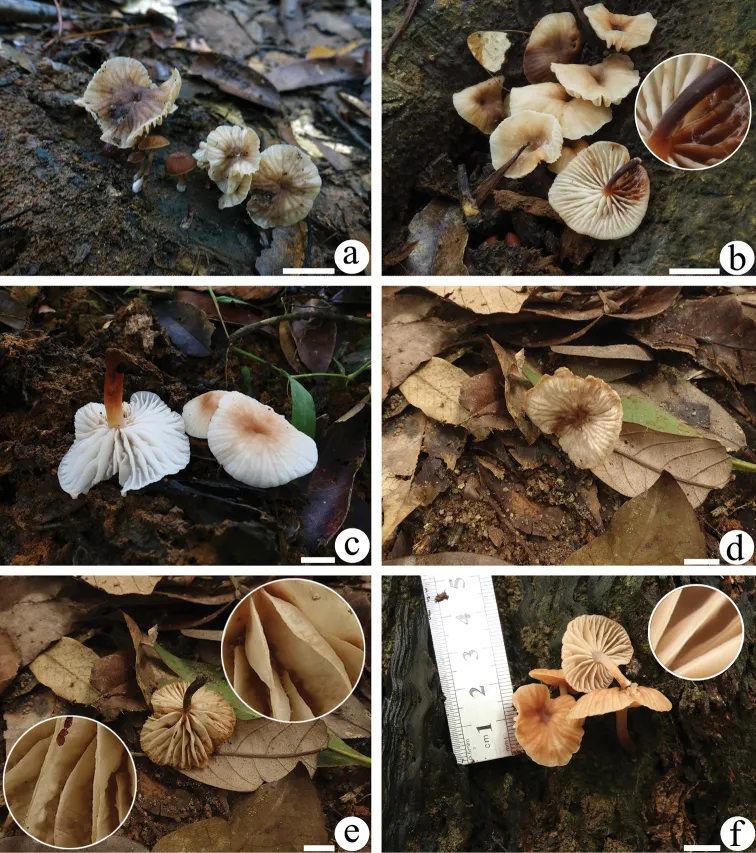
Basidiomata of Gymnopus omphalinoides a GDGM 78483 b GDGM 78318 holotype! (with magnifying slightly longitudinally striate stipe) c KUN-HKAS 107312 d, e GDGM 44411 f HMJU 00506. a photographed by M. Zhang b photographed by L.Q. Wu, c photographed by X.H. Wang d, e photographed by J.P. Li f photographed by J.Z. Xu. For a detailed display, the slightly longitudinally striate stipe is magnified in b, and the split lamellar edge is magnified in e, f. Scale bars: 1 cm.
- Jenis
- Pelat ilmiah
- Kredit
- Ji-Peng Li, Vladimír Antonín, Genevieve Gates, Lu Jiang, Tai-Hui Li, Yu Li, Bin Song, Chun-Ying Deng
- Lisensi
- CC BY 4.0
- Sumber media
- Buka entri sumber
Dokumentasi tambahan
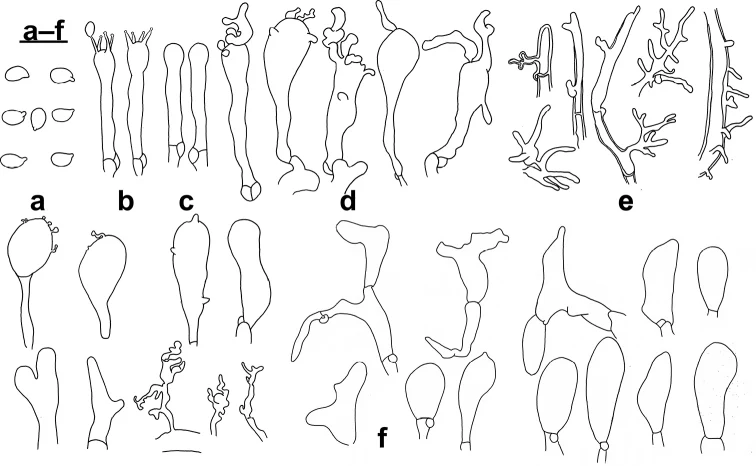
Microscopic features of Gymnopus omphalinoides (GDGM 78318, holotype!) a Basidiospores b Basidia c Basidioles d Cheilocystidia e Stipitipellis f terminal elements of the pileipellis. Drawing by J.P. Li. Sale bars: 10 μm (a–d), 20 μm (e, f).
Kredit dan penggunaan
Ji-Peng Li, Vladimír Antonín, Genevieve Gates, Lu Jiang, Tai-Hui Li, Yu Li, Bin Song, Chun-Ying Deng
Ukuran dan format gambar disesuaikan tanpa pemotongan, retus, atau penambahan skala. Lisensi sumber dipertahankan.
Sumber profil
- [1] Emending Gymnopus sect. Gymnopus (Agaricales, Omphalotaceae) by including two new species from southern China — Gymnopus omphalinoides
- [2] Catalogue of Life Base2026-09-11 — Gymnopus omphalinoides
- [3] Dokumentasi visual — Gymnopus omphalinoides
- [4] Dokumentasi visual — Gymnopus omphalinoides
Rujukan halaman ini
Fungi. Gymnopus omphalinoides. Rilis data fungi-2026-10-12-expansion-2. https://fungi-atlas.mgadib.chatgpt.site/jamur/gymnopus-omphalinoides/.
Status: impor sumber; pemeriksaan editorial per profil belum selesai. Untuk klaim biologis, gunakan rujukan pada bagian terkait dan periksa konteks sumber aslinya.