Ciri dan struktur
Diagnosis: This species is characterized by its garlicky basidiomata, reddish-orange to yellowish-grey pileus disc, white powdery-tomentose stipe with basal mycelium, ellipsoid to oblong basidiospores (4.5–)5–7 × (2.5–)3–4 µm in size and pileipellis lacking incrusted hyphae. Description: Basidiomata: solitary to cespitose. Pileus: 15–35.5 mm in diam., convex to plano-convex, rounded at disc when young, then expanding to plane, slightly and broadly umbonate at disc, margin entire to slightly uneven, hygrophanous at margin, smooth, glabrous, almost reddish orange (7A6) at disc, gradually fading to orange white (6A2) towards margin, occasionally with dark brown (8F8) tinge on the surface somewhere, finally yellowish grey (3B2) at disc, otherwise whitish. Lamellae: very close, free to adnate, very narrow, L = 53–70, l = 4–5, whitish. Stipe: 28–58 mm long, 2.5–5 mm thick at the apex, 2.5–5.5 mm thick at the base, cylindrical, slightly broadened at the apex and sometimes also the base, white powdery-tomentose overall, smooth, hollow, whitish to orange white (6A2) tinted with orange red (8B7), darker to garnet brown (9D8) at the apex, sometimes with brownish red (8C8) to reddish brown (8D8) tinge somewhere, with white basal mycelium at the base. Odour: distinct, garlic-like.
Habitat dan peran ekologis
Type: China, Jilin Province, Dunhua City, Xinxing Forest Farm, 43°5′50″ N, 128°10′18″ E, elev. 725 m, on dead broadleaves, 16 April 2021, J.P. Li, N.G. Pan, X. Wang, HMJAU 60386 (holotype).
- Habitat atau konteks temuan
- hutan
- Substrat
- Informasi belum tersedia pada sumber rilis ini.
- Peran atau konteks
- Belum dikategorikan pada rilis ini.
Reproduksi
Diagnosis: This species is characterized by its garlicky basidiomata, reddish-orange to yellowish-grey pileus disc, white powdery-tomentose stipe with basal mycelium, ellipsoid to oblong basidiospores (4.5–)5–7 × (2.5–)3–4 µm in size and pileipellis lacking incrusted hyphae. Description: Basidiomata: solitary to cespitose. Pileus: 15–35.5 mm in diam., convex to plano-convex, rounded at disc when young, then expanding to plane, slightly and broadly umbonate at disc, margin entire to slightly uneven, hygrophanous at margin, smooth, glabrous, almost reddish orange (7A6) at disc, gradually fading to orange white (6A2) towards margin, occasionally with dark brown (8F8) tinge on the surface somewhere, finally yellowish grey (3B2) at disc, otherwise whitish.
Catatan identitas dan cakupan
- Nama diterima mengikuti Catalogue of Life Base2026-09-11; uraian mempertahankan konsep dan nama sumber aslinya.
- Preserve original treatment localities, hosts and substrate scope. Materials examined describe documented specimens, not the full global range.
- Impor dan terjemahan otomatis belum diperiksa editorial per profil. Struktur reproduktif yang disebutkan tidak membuktikan seluruh siklus hidup diketahui.
- Pengukuran pada uraian mengikuti spesimen, kultur, dan metode sumber; angka tidak diperluas ke semua populasi.
Catatan distribusi dalam narasi mengikuti sumbernya. Dokumentasi spesimen atau foto mengikuti catatan sumber. Bukti wilayah Indonesia dan penilaian konservasi tidak disimpulkan dari gambar.
Melihat dengan konteks
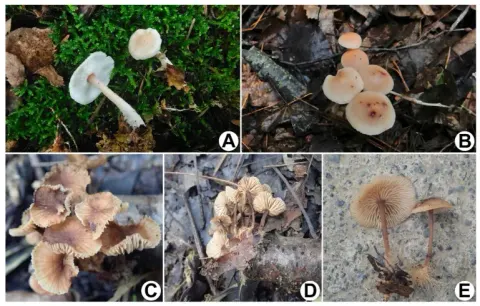
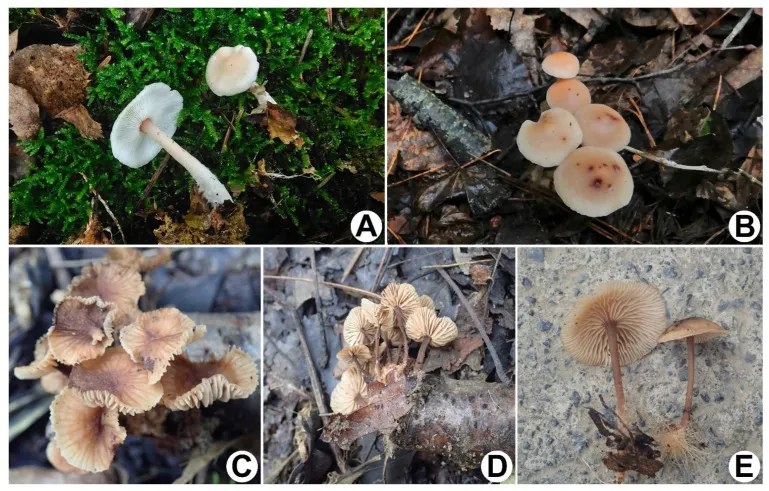
Basidiomata of Gymnopus. (A, B) G. sinopolyphyllus (A) HMJAU 60387; (B) HMJAU 60386 holotype! (C – E) G. strigosipes (C, D) HMAS 295796 holotype! (E) HMAS 295797.
- Jenis
- Pelat ilmiah
- Kredit
- © 2022 by the authors.
- Lisensi
- CC BY 4.0
- Sumber media
- Buka entri sumber
Dokumentasi tambahan
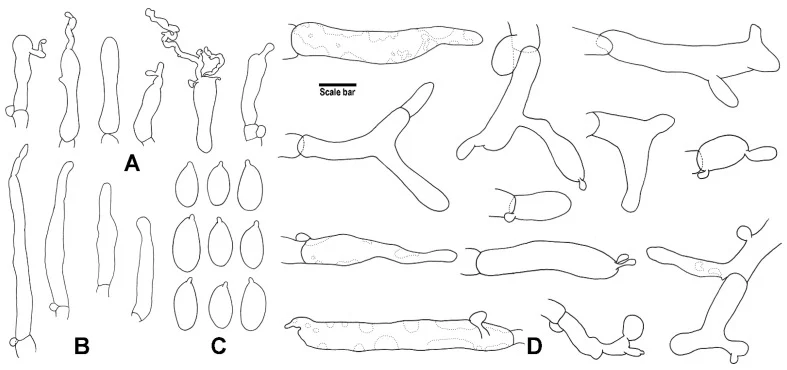
Microscopic features of G. sinopolyphyllus (HMJAU 60386, holotype!). (A) Cheilocystidia; (B) Caulocystidia; (C) Basidiospores; (D) Terminal elements of the pileipellis. Drawing by J.P. Li. Scale bars: 10 μm (A, B, D), 5 μm (C).
Kredit dan penggunaan
© 2022 by the authors.
Ukuran dan format gambar disesuaikan tanpa pemotongan, retus, atau penambahan skala. Lisensi sumber dipertahankan.
Sumber profil
- [1] Morpho-Molecular Evidence Reveals Four Novel Species of Gymnopus (Agaricales, Omphalotaceae) from China — Gymnopus sinopolyphyllus
- [2] Catalogue of Life Base2026-09-11 — Gymnopus sinopolyphyllus
- [3] Dokumentasi visual — Gymnopus sinopolyphyllus
- [4] Dokumentasi visual — Gymnopus sinopolyphyllus
Rujukan halaman ini
Fungi. Gymnopus sinopolyphyllus. Rilis data fungi-2026-10-12-expansion-2. https://fungi-atlas.mgadib.chatgpt.site/jamur/gymnopus-sinopolyphyllus/.
Status: impor sumber; pemeriksaan editorial per profil belum selesai. Untuk klaim biologis, gunakan rujukan pada bagian terkait dan periksa konteks sumber aslinya.