Ciri dan struktur
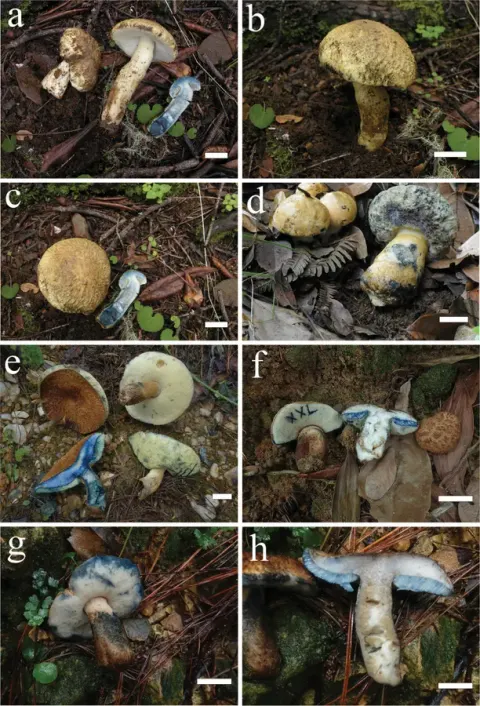
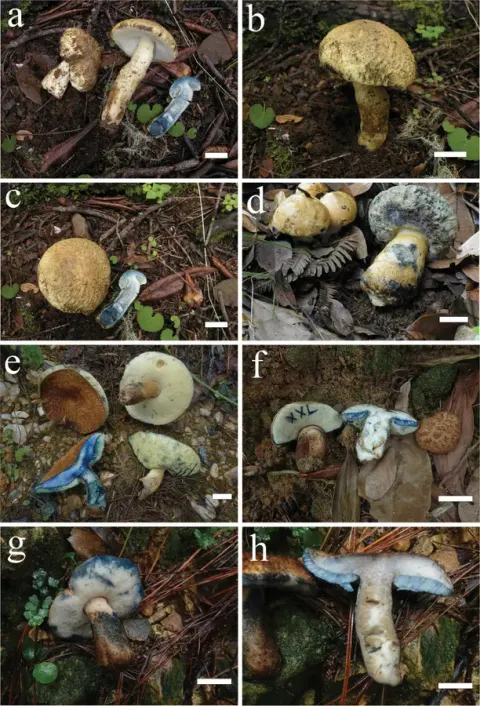
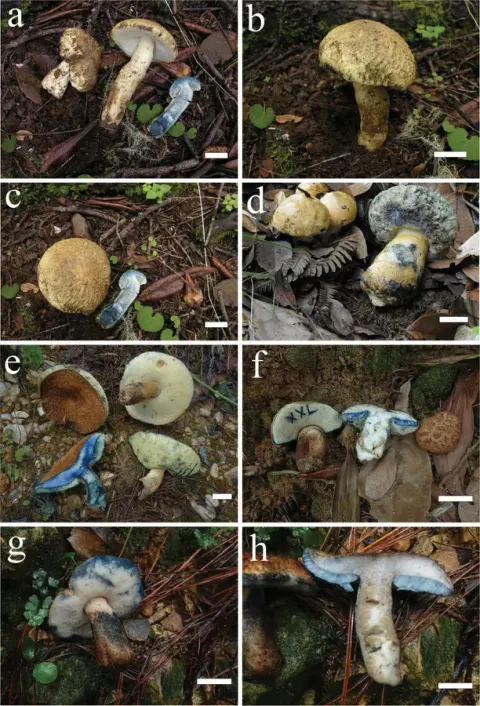
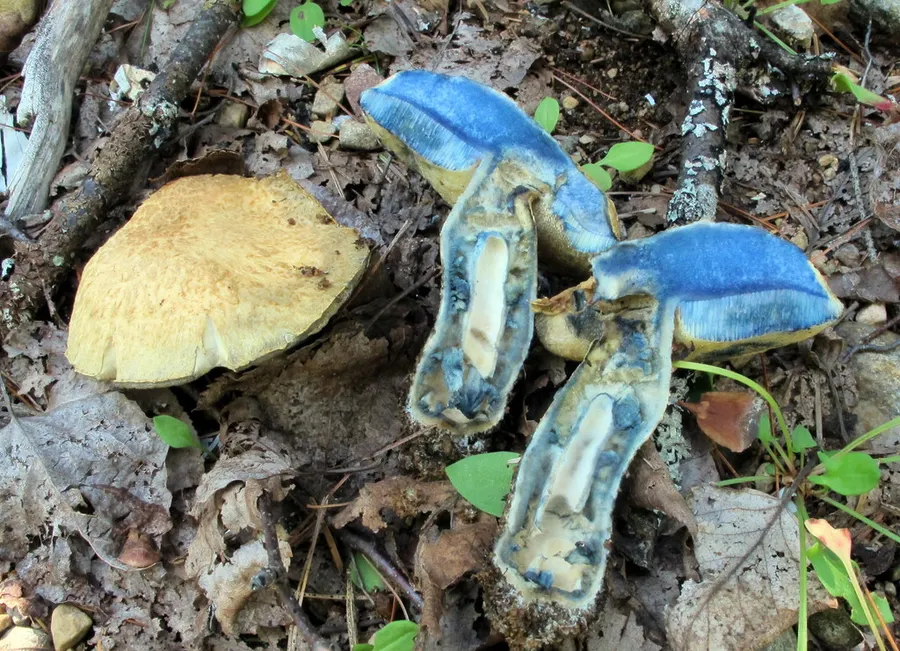
The cap of G. cyanescens is initially convex, but flattens out in maturity, sometimes becoming shallowly depressed; The cap is dry, and ranges in color from buff to yellowish to pale olive, occasionally with darker streaks of color. Its surface is uneven, sometimes with wrinkles and pits. The cap margin is initially curved inward, and sometimes splits in maturity. The flesh is whitish to pale yellow, and has a brittle texture. On the underside of the cap, the pore surface is white to yellowish, sometimes with olive or tan tinges. There are roughly two circular pores per millimeter, and the tubes that comprise the pores are 5–10 mm deep, but depressed around the top of the stem. Injury to the pores will cause them to stain first greenish yellow, then greenish blue or blue. The stem is 4–12 cm long by 1–2.5 cm thick, and is either roughly equal in width throughout its length, or has a basal or middle swelling. The stem tissue is hard and brittle; it is initially stuffed with a soft pith that develops cavities, or becomes entirely hollow in maturity. Roughly the same color as the cap or lighter, the stem surface is dry and lacks reticulations. It is initially covered in coarse hairs that tend to disappear in maturity to leave a relatively smooth surface. All parts of the fruit body stain blue when cut or injured. The variety G. cyanescens var. violaceotinctus is nearly identical in appearance, but stains dark lilac to indigo when bruised. The odor and taste of the fruit bodies is indistinct. The color of the spore print is pale yellow. The spores are ellipsoid, smooth, hyaline (translucent), and have dimensions of 8–10 by 5–6 μm.
Habitat dan peran ekologis
Gyroporus cyanescens adalah spesies ektomikoriza yang memiliki rentang inang yang luas. G. cyanescens var. violaceotinctus telah dilaporkan dari Jepang.
- Habitat atau konteks temuan
- Informasi belum tersedia pada sumber rilis ini.
- Substrat
- Informasi belum tersedia pada sumber rilis ini.
- Peran atau konteks
- Mitra tumbuhan
Reproduksi
The color of the spore print is pale yellow. The spores are ellipsoid, smooth, hyaline (translucent), and have dimensions of 8–10 by 5–6 μm. The basidia (spore-bearing cells) are club shaped, two- to four-spored, and measure 24–30 by 8–10 μm. Pleurocystidia (cystidia on the inner walls of the tubes) are light yellow brown in color, club shaped, infrequent, and measure 25–38 by 5.5-7.2 μm; the cheilocystidia (found on the tube edge) are colorless, numerous, and measure 32–47 by 7–10 μm. Clamp connections are present in the hyphae.
Catatan identitas dan cakupan
- Nama diterima mengikuti Catalogue of Life Base2026-09-11; uraian mempertahankan konsep dan nama sumber aslinya.
- Original geographic, specimen and life-cycle scope retained; source import awaits individual editorial review.
- Impor dan terjemahan otomatis belum diperiksa editorial per profil. Struktur reproduktif yang disebutkan tidak membuktikan seluruh siklus hidup diketahui.
- Pengukuran pada uraian mengikuti spesimen, kultur, dan metode sumber; angka tidak diperluas ke semua populasi.
Catatan distribusi dalam narasi mengikuti sumbernya. Dokumentasi spesimen atau foto mengikuti catatan sumber. Bukti wilayah Indonesia dan penilaian konservasi tidak disimpulkan dari gambar.
Melihat dengan konteks
Dokumentasi Gyroporus cyanescens menurut asosiasi foto pada record takson iNaturalist. Kredit: mycowalt. Identitas mengikuti sumber; bukan penentuan spesimen independen.
- Jenis
- Fotografi
- Kredit
- (c) mycowalt, some rights reserved (CC BY-SA), uploaded by mycowalt
- Lisensi
- CC BY-SA 4.0
- Sumber media
- Buka entri sumber
Dokumentasi tambahan
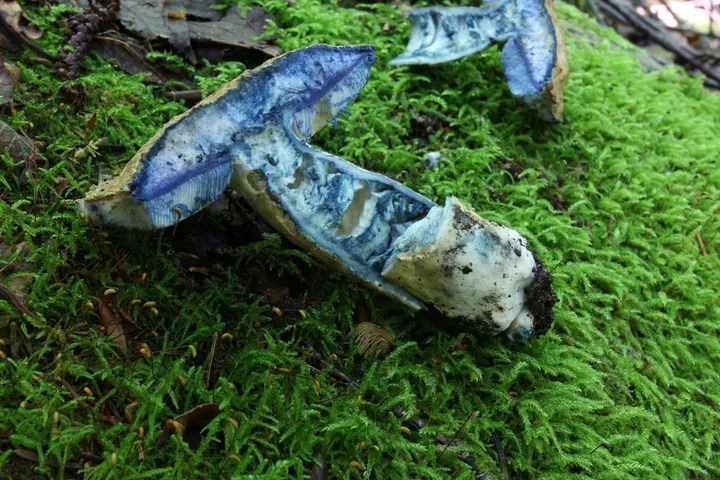
Foto yang diasosiasikan dengan Gyroporus cyanescens pada iNaturalist. Identifikasi mengikuti sumber; bukan penentuan spesimen independen.
Kredit dan penggunaan
no rights reserved, uploaded by Garrett Taylor
Ukuran dan format gambar disesuaikan tanpa pemotongan, retus, atau penambahan skala. Lisensi sumber dipertahankan.
Sumber profil
- [1] Gyroporus cyanescens — Wikipedia (en)
- [2] Catalogue of Life Base2026-09-11 — Gyroporus cyanescens
- [3] Dokumentasi visual — Gyroporus cyanescens
- [4] Dokumentasi visual — Gyroporus cyanescens
Rujukan halaman ini
Fungi. Gyroporus cyanescens. Rilis data fungi-2026-10-12-expansion-2. https://fungi-atlas.mgadib.chatgpt.site/jamur/gyroporus-cyanescens/.
Status: impor sumber; pemeriksaan editorial per profil belum selesai. Untuk klaim biologis, gunakan rujukan pada bagian terkait dan periksa konteks sumber aslinya.