Ciri dan struktur
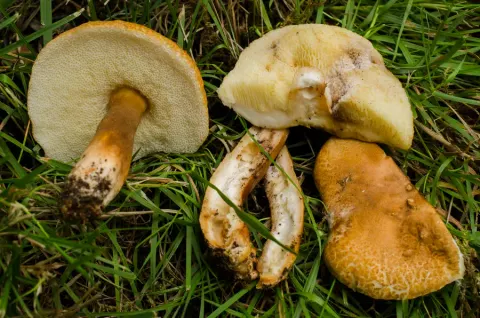
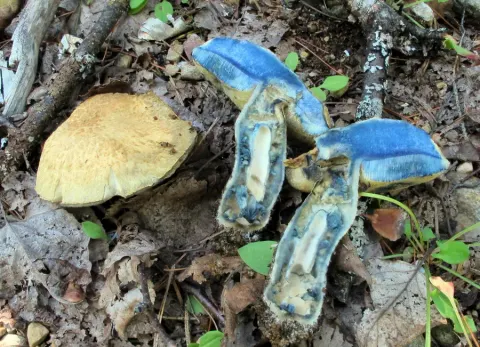
This species differs from other cyanescent species of Gyroporus in its initially ivory yellow to greyish-yellow and then grey-orange to brownish-yellow pileus, scaly to floccose pileal surface, distribution in alpine forests with altitude up to 3800 m, broad basidiospores (5.5–8.5 µm wide) and long and slender basidia measuring 35–55 × 7–12 µm. Pileus 3–6 cm in diam., sub-hemispherical to convex or plano-convex, ivory yellow (4B3) to greyish-yellow (2B3–4) when young, grey-orange (5B5) to brownish-yellow (5C6–7) when mature; surface dry, densely covered with concolorous appressed scaly to floccose squamules, margin always incurved and slightly extended; context whitish (1A1), staining cerulean blue (23C6–7) to dull blue (23E5–6) when bruised. Hymenophore adnate when young, slightly depressed around apex of stipe when mature; surface white (1A1) when young and then cream to yellowish when mature, staining dull blue (23E5–6) when bruised; pores angular to roundish, fine, 2–3 per mm; tubes 3–8 mm long, whitish (1A1), staining dull blue when bruised. Stipe 6–8 × 1.8–2 cm, sub-cylindrical to clavate, white (2A1) when young, yellowish-white (2A2) to concolorous with pileal surface when mature; surface roughened, staining dull blue when bruised; context white to cream or yellowish, spongy when young and then hollow in age, staining cerulean blue to dull blue when bruised. Odour indistinct and taste mild. Basidia 35–55 × 7–12 µm, clavate, 4-spored, hyaline in potassium hydroxide (KOH) and yellowish in Melzer’s Reagent. Basidiospores [60/3/2] (6.5) 7–10 × 5.5–7.5 (8.5) µm, [Q = 1–1.65 (1.72), Q m = 1.27 ± 0.23], smooth, ellipsoid to somewhat broadly ellipsoid, yellowish in KOH and primrose yellow in Melzer’s Reagent.
Habitat dan peran ekologis
Scattered on soil in alpine mixed forests dominated by Abies and Picea (Pinaceae) and Quercus (Fagaceae). Currently known from south-western China.
- Habitat atau konteks temuan
- hutan
- Substrat
- tanah
- Peran atau konteks
- Belum dikategorikan pada rilis ini.
Reproduksi
This species differs from other cyanescent species of Gyroporus in its initially ivory yellow to greyish-yellow and then grey-orange to brownish-yellow pileus, scaly to floccose pileal surface, distribution in alpine forests with altitude up to 3800 m, broad basidiospores (5.5–8.5 µm wide) and long and slender basidia measuring 35–55 × 7–12 µm. Pileus 3–6 cm in diam., sub-hemispherical to convex or plano-convex, ivory yellow (4B3) to greyish-yellow (2B3–4) when young, grey-orange (5B5) to brownish-yellow (5C6–7) when mature; surface dry, densely covered with concolorous appressed scaly to floccose squamules, margin always incurved and slightly extended; context whitish (1A1), staining cerulean blue (23C6–7) to dull blue (23E5–6) when bruised.
Catatan identitas dan cakupan
- Nama diterima mengikuti Catalogue of Life Base2026-09-11; uraian mempertahankan konsep dan nama sumber aslinya.
- Preserve original treatment localities, hosts and substrate scope. Materials examined describe documented specimens, not the full global range.
- Impor dan terjemahan otomatis belum diperiksa editorial per profil. Struktur reproduktif yang disebutkan tidak membuktikan seluruh siklus hidup diketahui.
- Pengukuran pada uraian mengikuti spesimen, kultur, dan metode sumber; angka tidak diperluas ke semua populasi.
Catatan distribusi dalam narasi mengikuti sumbernya. Dokumentasi spesimen atau foto mengikuti catatan sumber. Bukti wilayah Indonesia dan penilaian konservasi tidak disimpulkan dari gambar.
Melihat dengan konteks
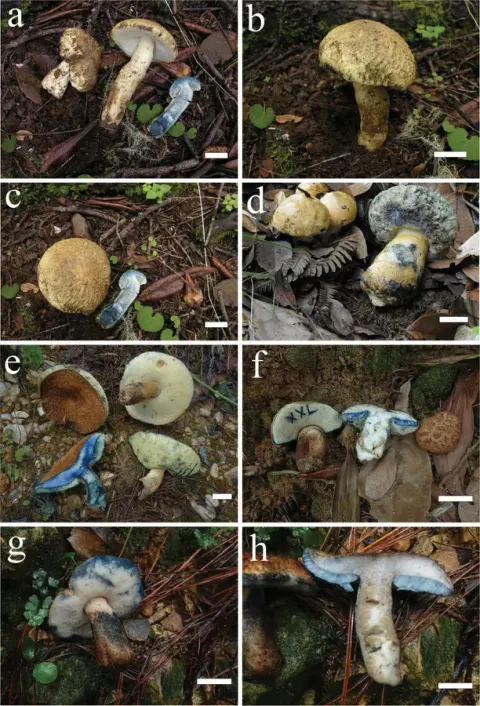
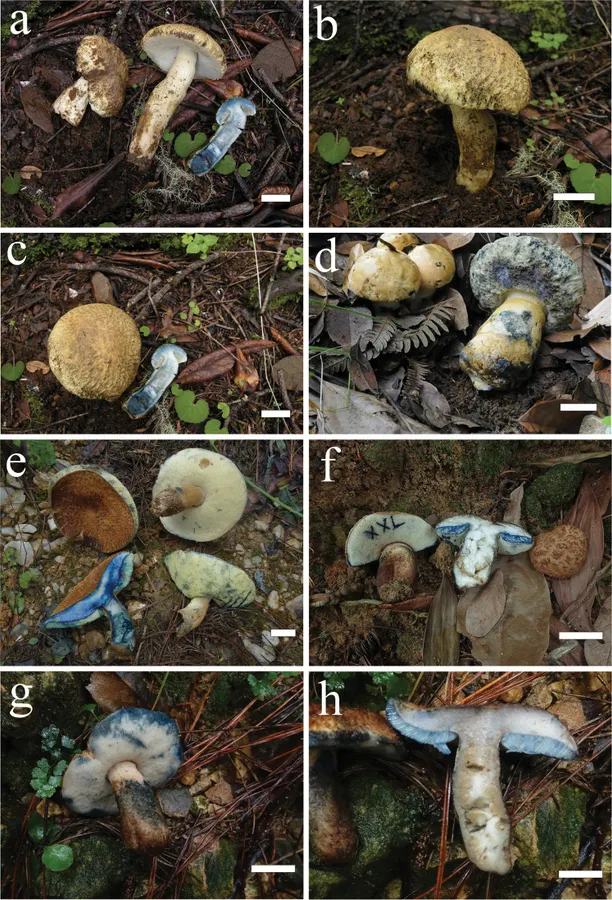
a–c Gyroporus alpinus (KUN -HKAS 56318, type, photos by Y.C. Li) d Gyroporus flavocyanescens (KUN -HKAS 76966, type, photo by X.L. Wu) e–h G. brunneofloccosus (e KUN -HKAS 107735, photo by G. Wu f GDGM 77125, photo by J.Y. Xu g, h GDGM 74638, photos by J.Y. Xu). Scale bars: 2 cm.
- Jenis
- Pelat ilmiah
- Kredit
- Cong Huang, Ming Zhang, Xing-Liang Wu, Gang Wu, Jian-Ping Xu, Zhu L. Yang, Yan-Chun Li
- Lisensi
- CC BY 4.0
- Sumber media
- Buka entri sumber
Dokumentasi tambahan
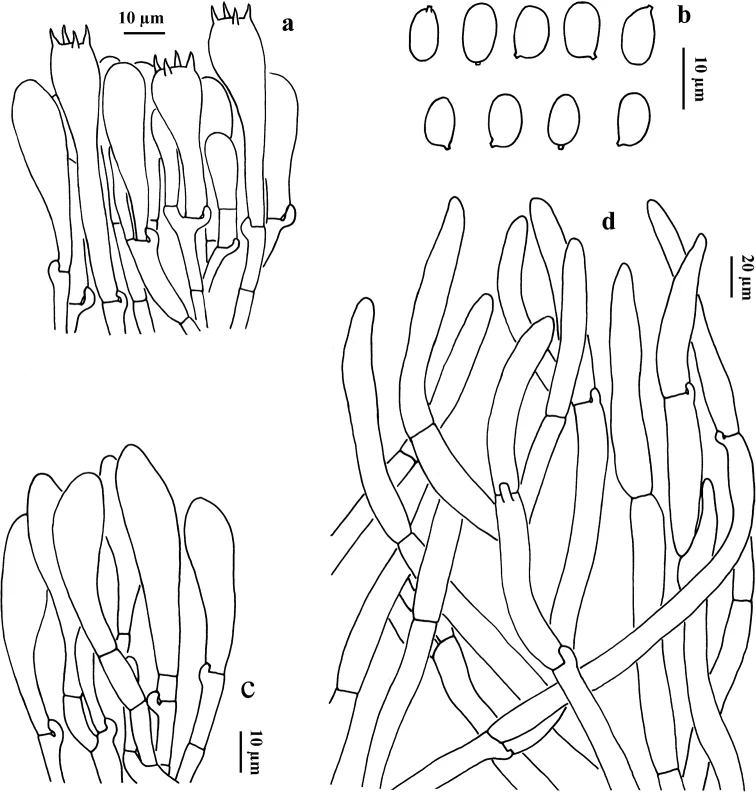
Microscopic features of G. alpinus (HKAS 56318, type) a basidia and cheilocystidium b basidiospores c cheilocystidia d pileipellis (squamules).
Kredit dan penggunaan
Cong Huang, Ming Zhang, Xing-Liang Wu, Gang Wu, Jian-Ping Xu, Zhu L. Yang, Yan-Chun Li
Ukuran dan format gambar disesuaikan tanpa pemotongan, retus, atau penambahan skala. Lisensi sumber dipertahankan.
Sumber profil
- [1] Cyanescent Gyroporus (Gyroporaceae, Boletales) from China — Gyroporus alpinus
- [2] Catalogue of Life Base2026-09-11 — Gyroporus alpinus
- [3] Dokumentasi visual — Gyroporus alpinus
- [4] Dokumentasi visual — Gyroporus alpinus
Rujukan halaman ini
Fungi. Gyroporus alpinus. Rilis data fungi-2026-10-12-expansion-2. https://fungi-atlas.mgadib.chatgpt.site/jamur/gyroporus-alpinus/.
Status: impor sumber; pemeriksaan editorial per profil belum selesai. Untuk klaim biologis, gunakan rujukan pada bagian terkait dan periksa konteks sumber aslinya.