Ciri dan struktur
Cortina present. Pileus robust, fleshy, 20–40 mm in diameter, irregular convex, somewhat domed or not, reddish brown center with grayish tones, outwards ocher and lighter towards margin (buff not white), not particularly two-toned, with hoary canescent coating that dries shiny; margin turned in at first, and then turned down. Lamellae narrowly attached, slight emarginate, or with a tooth, or pulling away, somewhat broad, milk coffee, L = 36–44; edges white floccose. Stipe 30–40 × 5–10 mm, equal, straight or not, whitish and pruinose at apex, dingy ocher and longitudinally fibrillose and striate in lower part, base sometimes encased in sand or earth. Context dingy whitish, darker below, and flesh staining brown; stipe solid or slightly hollow. Odor raphanoid. Exsiccate: pileus and stipe medium ochraceous brown; lamellae dark brown; stipe base encased in soil in the large collection (CLC1577). Basidiospores elliptical, or some slightly amygdaliform or ovoid, with rounded end, smooth to slightly rough (O0, O1), small apiculus, not guttulate, not dextrinoid (D0), perispore not loosening (P0), 8–11 × 5–6, on average 9.1 × 5.6 µm, Q = 1.63 Basidia clavate, four-spored, 30–35 × 7–8 µm. Pleurocystidia usually absent but occasionally present, sometimes rostrate. Cheilocystidia mostly cylindrical for the top two thirds and then swollen near the base (lageniform or ventricose), 30–70 µm long × 3–8 µm at apex, 3–7 µm in middle, and 6–11 µm at base, no yellow contents noted. Epicutis thickness up to 200 µm, with no encrusted hyphae recorded.
Habitat dan peran ekologis
Collected from two different sites, one in Montana, the second in Colorado. The first site is a mixture of Dryas, Salix planifolia and S. reticulata, with some Persicaria present. The second site is a low alpine zone with dwarf willows. In both cases the growth habit was gregarious, sometimes in rings, sometimes cespitose, but not completely joined.
- Habitat atau konteks temuan
- Informasi belum tersedia pada sumber rilis ini.
- Substrat
- Informasi belum tersedia pada sumber rilis ini.
- Peran atau konteks
- Belum dikategorikan pada rilis ini.
Reproduksi
Cortina present. Pileus robust, fleshy, 20–40 mm in diameter, irregular convex, somewhat domed or not, reddish brown center with grayish tones, outwards ocher and lighter towards margin (buff not white), not particularly two-toned, with hoary canescent coating that dries shiny; margin turned in at first, and then turned down. Lamellae narrowly attached, slight emarginate, or with a tooth, or pulling away, somewhat broad, milk coffee, L = 36–44; edges white floccose. Stipe 30–40 × 5–10 mm, equal, straight or not, whitish and pruinose at apex, dingy ocher and longitudinally fibrillose and striate in lower part, base sometimes encased in sand or earth. Context dingy whitish, darker below, and flesh staining brown; stipe solid or slightly hollow.
Catatan identitas dan cakupan
- Nama diterima mengikuti Catalogue of Life Base2026-09-11; uraian mempertahankan konsep dan nama sumber aslinya.
- Preserve original treatment localities, hosts and substrate scope. Materials examined describe documented specimens, not the full global range.
- Impor dan terjemahan otomatis belum diperiksa editorial per profil. Struktur reproduktif yang disebutkan tidak membuktikan seluruh siklus hidup diketahui.
- Pengukuran pada uraian mengikuti spesimen, kultur, dan metode sumber; angka tidak diperluas ke semua populasi.
Catatan distribusi dalam narasi mengikuti sumbernya. Dokumentasi spesimen atau foto mengikuti catatan sumber. Bukti wilayah Indonesia dan penilaian konservasi tidak disimpulkan dari gambar.
Melihat dengan konteks
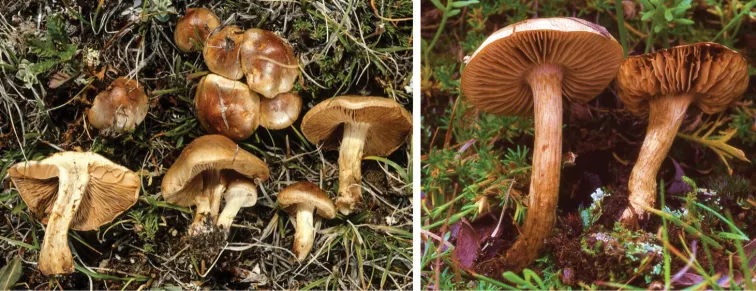
Hebeloma alpinicola, DBG-F-020565 and CLC1577.
- Jenis
- Pelat ilmiah
- Kredit
- Cathy L. Cripps, Ursula Eberhardt, Nicole Schütz, Henry J. Beker, Vera S. Evenson, Egon Horak
- Lisensi
- CC BY 4.0
- Sumber media
- Buka entri sumber
Dokumentasi tambahan
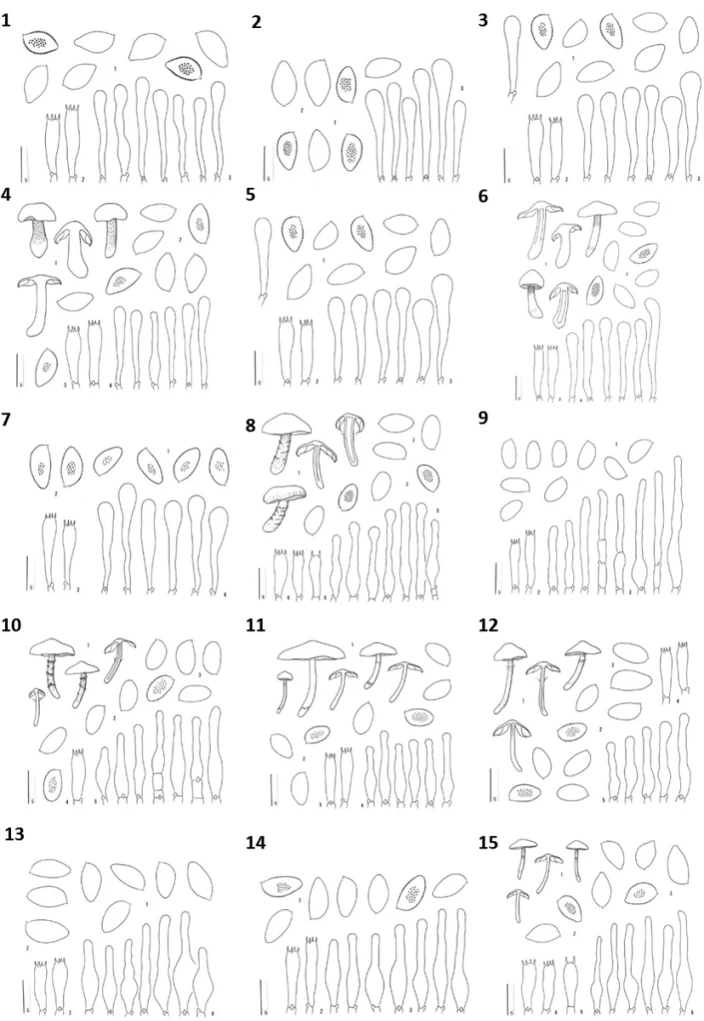
Pelat perbandingan struktur mikroskopis. Hebeloma alpinicola ditampilkan pada panel 9; panel lainnya memuat spesies pembanding. Pembagian panel mengikuti keterangan sumber.
Kredit dan penggunaan
Cathy L. Cripps, Ursula Eberhardt, Nicole Schütz, Henry J. Beker, Vera S. Evenson, Egon Horak
Ukuran dan format gambar disesuaikan tanpa pemotongan, retus, atau penambahan skala. Lisensi sumber dipertahankan.
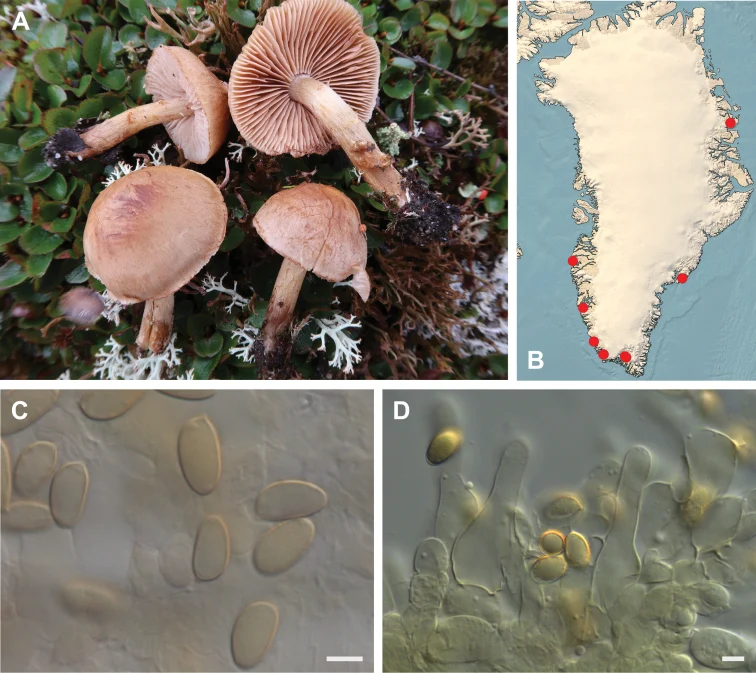
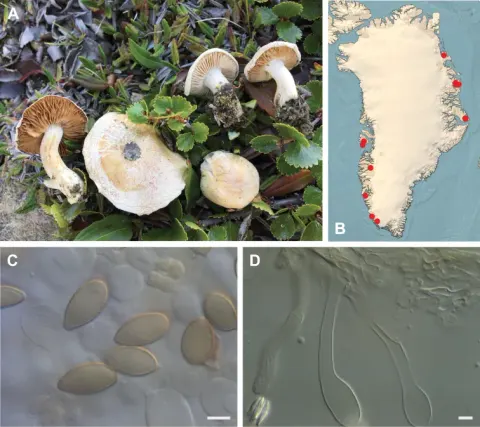
Pelat Hebeloma alpinicola: tubuh buah pada panel A, peta koleksi pada B, serta spora dan keilosistidia pada C–D. Pembagian panel dan identitas mengikuti sumber.
Kredit dan penggunaan
Ursula Eberhardt, Henry J. Beker, Torbjørn Borgen, Henning Knudsen, Nicole Schütz, Steen A. Elborne
Ukuran dan format gambar disesuaikan tanpa pemotongan, retus, atau penambahan skala. Lisensi sumber dipertahankan.
Sumber profil
- [1] The genus Hebeloma in the Rocky Mountain Alpine Zone — Hebeloma alpinicola
- [2] Catalogue of Life Base2026-09-11 — Hebeloma alpinicola
- [3] Dokumentasi visual — Hebeloma alpinicola
- [4] Dokumentasi visual — Hebeloma alpinicola
- [5] Dokumentasi visual — Hebeloma alpinicola
Rujukan halaman ini
Fungi. Hebeloma alpinicola. Rilis data fungi-2026-10-12-expansion-2. https://fungi-atlas.mgadib.chatgpt.site/jamur/hebeloma-alpinicola/.
Status: impor sumber; pemeriksaan editorial per profil belum selesai. Untuk klaim biologis, gunakan rujukan pada bagian terkait dan periksa konteks sumber aslinya.