Ciri dan struktur
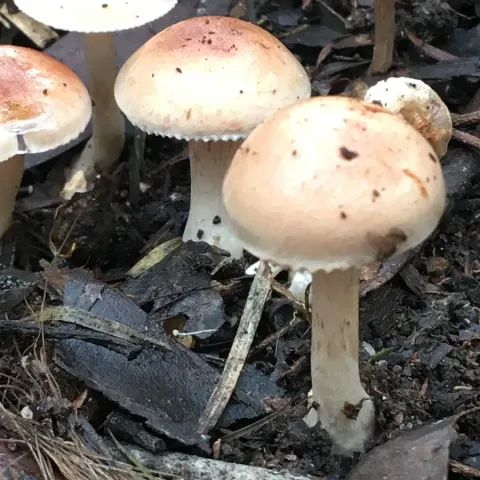
The small ellipsoid, non-dextrinoid, almost smooth basidiospores (on average 8.0–10.2 × 5.6–6.5 µm) and at least 50 full length lamellae distinguish this species from all other known North American Hebeloma species and the ITS sequence differentiates this species from all other known species, worldwide. Pileus (12) 16–45 (52) mm diameter, usually umbonate or subumbonate, rarely convex or applanate; margin usually entire, sometimes involute particularly when young, often with remains of the universal veil, occasionally spotting, not hygrophanous; usually almost unicolored with color at center usually cream to ochraceous or clay-buff but may occasionally be darker, honey to sepia or umber, usually a little paler at the margin. Lamellae emarginate, white, cream to brown, with a weak white fimbriate edge sometimes visible and without droplets, number of full-length lamellae 50–74. Stipe (23) 24–60 (75) mm long, 3–8 (10) mm diameter at median, cylindrical, surface cream, ivory to pale brown but occasionally discoloring from the base upwards, sometimes strongly, fibrillose, at apex pruinose; base with white mycelium. Partial veil present on young specimens, whitish at first, before basidiospores mature, and often clear fibrils remaining on the stipe and pileus. Context in pileus white to cream, firm, in stipe stuffed, becoming hollow with age; taste not recorded, smell occasionally odorless but usually raphanoid, sometimes strongly so or with cacao components. Spore deposit color clay-buff. Basidiospores based on n = 146 spores of the holotype, 5% to 95% percentile range 7.7–9.8 × 5.5–7.0 µm, with median 8.9 × 5.9 µm and av. 8.9 × 6.0 µm with S.D. length 0.68 µm and width 0.44 µm; Q value 5% to 95% percentile range 1.25–1.63, with median 1.48 and av. 1.47 with S.D. 0.11; spore size based on 33 collections medians 7.8–10.3 × 5.5–6.4 µm and av. 8.0–10.2 × 5.6–6.5 µm with av.
Habitat dan peran ekologis
In temperate coniferous woodlands on burnt ground with Pinus and Quercus. Growth habit usually scattered, rarely solitary or caespitose. To date, all collections of Hebeloma ambustiterranum recorded from Mexico at latitudes between 19°N and 20°N and altitudes above 2000 m.
- Habitat atau konteks temuan
- Informasi belum tersedia pada sumber rilis ini.
- Substrat
- Informasi belum tersedia pada sumber rilis ini.
- Peran atau konteks
- Belum dikategorikan pada rilis ini.
Reproduksi
The small ellipsoid, non-dextrinoid, almost smooth basidiospores (on average 8.0–10.2 × 5.6–6.5 µm) and at least 50 full length lamellae distinguish this species from all other known North American Hebeloma species and the ITS sequence differentiates this species from all other known species, worldwide. Pileus (12) 16–45 (52) mm diameter, usually umbonate or subumbonate, rarely convex or applanate; margin usually entire, sometimes involute particularly when young, often with remains of the universal veil, occasionally spotting, not hygrophanous; usually almost unicolored with color at center usually cream to ochraceous or clay-buff but may occasionally be darker, honey to sepia or umber, usually a little paler at the margin.
Catatan identitas dan cakupan
- Nama diterima mengikuti Catalogue of Life Base2026-09-11; uraian mempertahankan konsep dan nama sumber aslinya.
- Preserve original treatment localities, hosts and substrate scope. Materials examined describe documented specimens, not the full global range.
- Impor dan terjemahan otomatis belum diperiksa editorial per profil. Struktur reproduktif yang disebutkan tidak membuktikan seluruh siklus hidup diketahui.
- Pengukuran pada uraian mengikuti spesimen, kultur, dan metode sumber; angka tidak diperluas ke semua populasi.
Catatan distribusi dalam narasi mengikuti sumbernya. Dokumentasi spesimen atau foto mengikuti catatan sumber. Bukti wilayah Indonesia dan penilaian konservasi tidak disimpulkan dari gambar.
Melihat dengan konteks
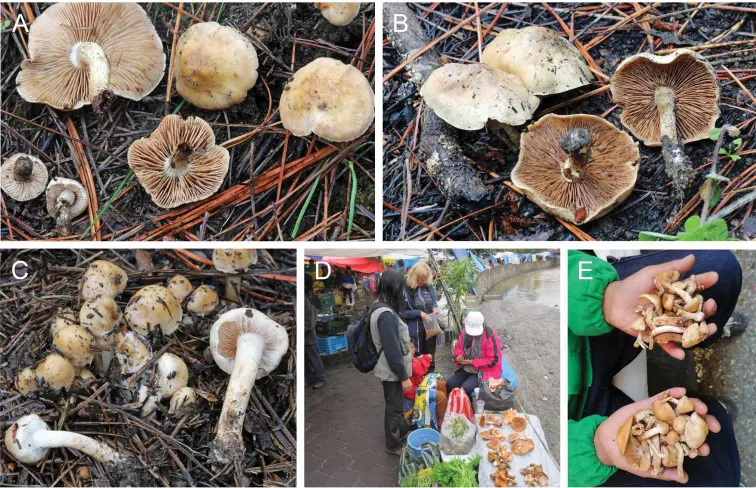
Hebeloma ambustiterranum A–C basidiomata A holotype TLXM 6155 (HJB16802) B TLXM HJB16803. C TLXM HJB16805 D mushroom vendor in the market of Tlaxcala City E H. ambustiterranum sold in the market of Tlaxcala City. Photos A–D H. J. Beker E A. Montoya.
- Jenis
- Pelat ilmiah
- Kredit
- Ursula Eberhardt, Alejandro Kong, Adriana Montoya, Nicole Schütz, Peter Bartlett, Henry J. Beker
- Lisensi
- CC BY 4.0
- Sumber media
- Buka entri sumber
Dokumentasi tambahan
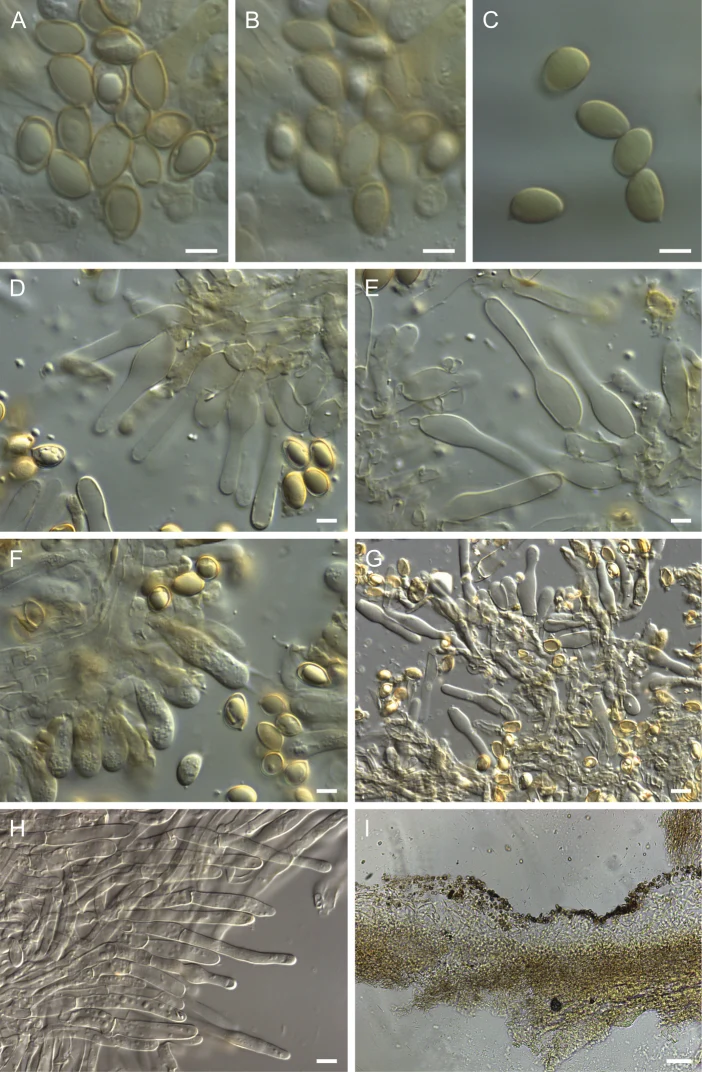
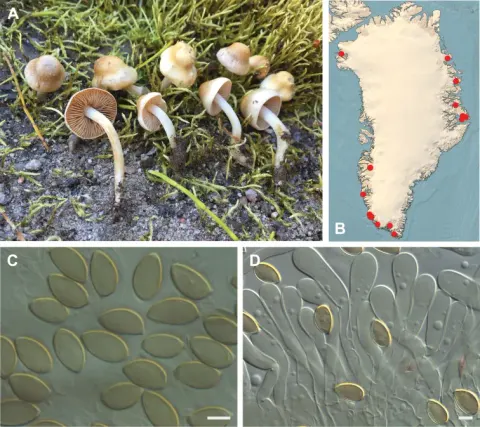
Holotype of Hebeloma ambustiterranum TLXM 6155 (HJB16802) A basidiospores ×1600 B spore ornamentation ×1600 C basidiospores in Melzer’s reagent ×1600 D–E cheilocystidia ×1000 F basidia ×1000 G cheilocystidia on lamella edge ×500 H caulocystidia ×500 I Cutis ×125. All in KOH, except C. Scale bars: 5 µm (A–F); 10 µm (G–J); 50 µm (K). Photos H. J. Beker.
Kredit dan penggunaan
Ursula Eberhardt, Alejandro Kong, Adriana Montoya, Nicole Schütz, Peter Bartlett, Henry J. Beker
Ukuran dan format gambar disesuaikan tanpa pemotongan, retus, atau penambahan skala. Lisensi sumber dipertahankan.
Sumber profil
- [1] Not (only) poison pies – Hebeloma (Agaricales, Hymenogastraceae) in Mexico — Hebeloma ambustiterranum
- [2] Catalogue of Life Base2026-09-11 — Hebeloma ambustiterranum
- [3] Dokumentasi visual — Hebeloma ambustiterranum
- [4] Dokumentasi visual — Hebeloma ambustiterranum
Rujukan halaman ini
Fungi. Hebeloma ambustiterranum. Rilis data fungi-2026-10-12-expansion-2. https://fungi-atlas.mgadib.chatgpt.site/jamur/hebeloma-ambustiterranum/.
Status: impor sumber; pemeriksaan editorial per profil belum selesai. Untuk klaim biologis, gunakan rujukan pada bagian terkait dan periksa konteks sumber aslinya.