Ciri dan struktur
Favoring arctic type habitats with many cheilocystidia clavate-stipitate and rather strongly dextrinoid but indistinctly ornamented spores. Cap (1.7–) 2.4–2.9 (–3.8) cm, plano-convex, with or without suggestion of obtuse umbo, with decurved margin then applanate, only weakly viscid even after heavy rainfall, dull, almost glabrous, marginal zone whitish pale due to a fine adpressed tomentum, often eroded, usually bicolored, center ochre, paler towards the margin becoming very pale brownish, hardly hygrophanous but a few hygrophanous dots. Lamellae emarginate with tooth, ventricose, number of lamellae {L} 36–44, up to 4 mm wide, initially pale, darker (clay buff) at maturity with whitish fimbriate edge and usually some watery droplets or droplets visible with a x10 lens. Stem (2.8–) 4.1–4.4 (–6.0) × 0.5–0.7 (–0.9) cm, to 0.6–0.9 cm at base, whitish fibrillose to pruinose, cylindrical, narrowly fistulose, downwards pale yellowish to pale brownish when rubbed. Context firm, thick particularly in center, whitish pale, watery when moist, in age slightly brownish downwards in stipe. Smell weakly herbaceous-raphanoid. Taste mild. Spore print at most clay buff (Munsell 10YR6/4; in TB 90.071). Spores amygdaloid, ellipsoid or ovoid, on ave. (across eight collections) 10.8–12.0 × 6.4–6.9 µm, ave. Q = 1.65–1.83, (for the holotype, measuring 102 spores, 5% to 95% percentile range 10.4–13.2 × 5.9–7.2 µm with median 11.9 × 6.5 µm and ave. 11.9 × 6.5 µm and S.D. for length 0.84 µm and for width 0.39 µm, and Q value 5% to 95% percentile range 1.57–2.04, with median 1.83 and ave. 1.83 with S.
Habitat dan peran ekologis
This is a new species known from a number of records in the Low Arctic zone in southern and western Greenland. The fact that it was collected several times independently may indicate that it is quite common in these areas. Eight collections, seven with Salix glauca one with S. arctophila. Most collections are from mineral-poor ground.
- Habitat atau konteks temuan
- Informasi belum tersedia pada sumber rilis ini.
- Substrat
- Informasi belum tersedia pada sumber rilis ini.
- Peran atau konteks
- Belum dikategorikan pada rilis ini.
Reproduksi
Favoring arctic type habitats with many cheilocystidia clavate-stipitate and rather strongly dextrinoid but indistinctly ornamented spores. Cap (1.7–) 2.4–2.9 (–3.8) cm, plano-convex, with or without suggestion of obtuse umbo, with decurved margin then applanate, only weakly viscid even after heavy rainfall, dull, almost glabrous, marginal zone whitish pale due to a fine adpressed tomentum, often eroded, usually bicolored, center ochre, paler towards the margin becoming very pale brownish, hardly hygrophanous but a few hygrophanous dots. Lamellae emarginate with tooth, ventricose, number of lamellae {L} 36–44, up to 4 mm wide, initially pale, darker (clay buff) at maturity with whitish fimbriate edge and usually some watery droplets or droplets visible with a x10 lens.
Catatan identitas dan cakupan
- Nama diterima mengikuti Catalogue of Life Base2026-09-11; uraian mempertahankan konsep dan nama sumber aslinya.
- Preserve original treatment localities, hosts and substrate scope. Materials examined describe documented specimens, not the full global range.
- Impor dan terjemahan otomatis belum diperiksa editorial per profil. Struktur reproduktif yang disebutkan tidak membuktikan seluruh siklus hidup diketahui.
- Pengukuran pada uraian mengikuti spesimen, kultur, dan metode sumber; angka tidak diperluas ke semua populasi.
Catatan distribusi dalam narasi mengikuti sumbernya. Dokumentasi spesimen atau foto mengikuti catatan sumber. Bukti wilayah Indonesia dan penilaian konservasi tidak disimpulkan dari gambar.
Melihat dengan konteks
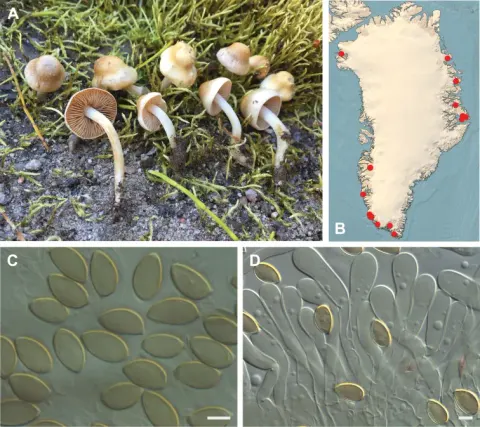
Hebeloma arcticum A HK16.119 (holotype), photograph H. Knudsen B distribution of cited collections.
- Jenis
- Pelat ilmiah
- Kredit
- Ursula Eberhardt, Henry J. Beker, Torbjørn Borgen, Henning Knudsen, Nicole Schütz, Steen A. Elborne
- Lisensi
- CC BY 4.0
- Sumber media
- Buka entri sumber
Dokumentasi tambahan
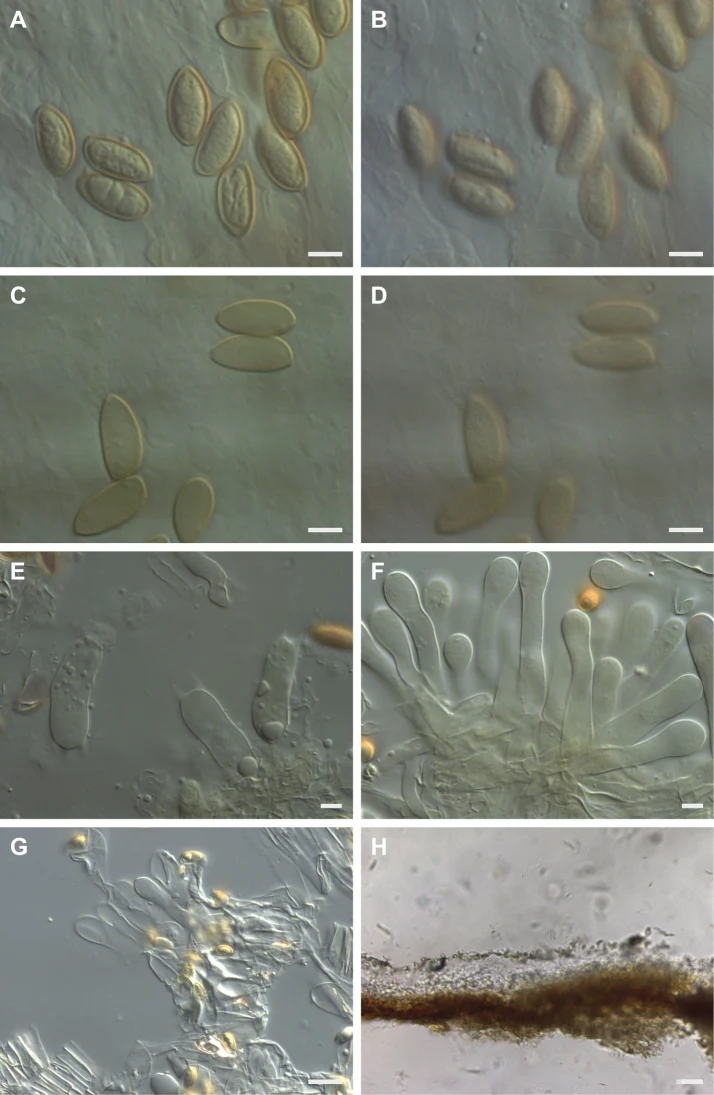
Hebeloma arcticum HK16.119 (holotype) A spores ×1600 and B spore ornamentation ×1600 in Melzer’s reagent C spores and D spore ornamentation ×1600 in KOH E basidia cheilocystidia and F cheilocystidia ×1000 in Melzer’s reagent G caulocystidia ×500 in KOH H cutis ×125 in KOH. Scale bars: 5 µm (A–F); 10 µm (G); 50 µm (H); microphotographs H.K.J. Beker.
Kredit dan penggunaan
Ursula Eberhardt, Henry J. Beker, Torbjørn Borgen, Henning Knudsen, Nicole Schütz, Steen A. Elborne
Ukuran dan format gambar disesuaikan tanpa pemotongan, retus, atau penambahan skala. Lisensi sumber dipertahankan.
Sumber profil
- [1] A survey of Hebeloma (Hymenogastraceae) in Greenland — Hebeloma arcticum
- [2] Catalogue of Life Base2026-09-11 — Hebeloma arcticum
- [3] Dokumentasi visual — Hebeloma arcticum
- [4] Dokumentasi visual — Hebeloma arcticum
Rujukan halaman ini
Fungi. Hebeloma arcticum. Rilis data fungi-2026-10-12-expansion-2. https://fungi-atlas.mgadib.chatgpt.site/jamur/hebeloma-arcticum/.
Status: impor sumber; pemeriksaan editorial per profil belum selesai. Untuk klaim biologis, gunakan rujukan pada bagian terkait dan periksa konteks sumber aslinya.