Ciri dan struktur
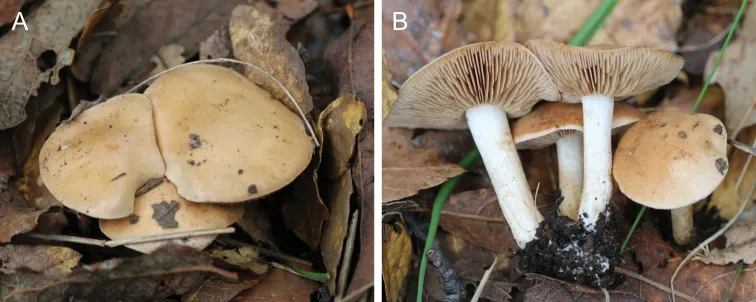
The short clavate-ventricose cheilocystidia, with average apical width less 6.5 µm, the small (on average less than 10 × 5.5 µm), weakly ornamented but rather strongly dextrinoid basidiospores and the whitish to cream or buff color of the pileus, differentiate this species from other Hebeloma species. Pileus (22) 32–38 (47) mm diameter, convex, often applanate, occasionally umbonate; margin smooth, often involute, particularly when young, occasionally eroded, not hygrophanous; usually almost unicolored, usually cream or buff, sometimes slightly paler towards margin. Lamellae often adnate or adnexed, occasionally emarginate, depth up to 4 mm, white, cream to brown, with white fimbriate edge but without droplets on the lamella edge, number of full-length lamellae 70–80. Stipe (31) 37–46 (48) mm long, (5) 7–8 (10) mm diameter at median, usually cylindrical but sometimes with a clavate base, surface cream, ivory, not discoloring, fibrillose, pruinose, particularly towards apex; base with white mycelium. Context in pileus and stipe white to cream, firm, in stipe stuffed; taste not recorded, smell earthy. Spore deposit color not recorded. Basidiospores based on n = 64 spores of the holotype, 5% to 95% percentile range 8.6–10.5 × 4.9–5.7 µm, with median 9.4 × 5.3 µm and av. 9.5 × 5.3 µm with S.D. length 0.57 µm and width 0.26 µm; Q value 5% to 95% percentile range 1.64–1.95, with median 1.79 and av. 1.78 with S.D. 0.10; spore size based on four collections medians 9.1–9.5 × 5.3–5.6 µm and av. 9.1–9.5 × 5.3–5.5 µm with av. S.D. length 0.50 µm and width 0.30 µm, av. Q 1.65–1.78, amygdaloid, occasionally limoniform, with small apiculus and rounded apically, often subacute, with a distinct thinning of the apical wall and sometimes a papilla, usually guttulate with one or sometimes more oily drops, at most weakly ornamented (ornamentation only visible under immersion), with a perispore hardly loosening, rather strongly dextrinoid, becoming medium reddish brown in Melzer’s reagent (O1/2; P0; D3); yellow brown in KOH.
Habitat dan peran ekologis
In deciduous or mixed woodlands apparently associated with Quercus or Pseudotsuga. Growth habit mainly caespitose, sometimes with a few scattered basidiomes. To date, all collections of Hebeloma cohaerens recorded from Tlaxcala at altitudes of 2600 m or more.
- Habitat atau konteks temuan
- Informasi belum tersedia pada sumber rilis ini.
- Substrat
- Informasi belum tersedia pada sumber rilis ini.
- Peran atau konteks
- Belum dikategorikan pada rilis ini.
Reproduksi
The short clavate-ventricose cheilocystidia, with average apical width less 6.5 µm, the small (on average less than 10 × 5.5 µm), weakly ornamented but rather strongly dextrinoid basidiospores and the whitish to cream or buff color of the pileus, differentiate this species from other Hebeloma species. Pileus (22) 32–38 (47) mm diameter, convex, often applanate, occasionally umbonate; margin smooth, often involute, particularly when young, occasionally eroded, not hygrophanous; usually almost unicolored, usually cream or buff, sometimes slightly paler towards margin. Lamellae often adnate or adnexed, occasionally emarginate, depth up to 4 mm, white, cream to brown, with white fimbriate edge but without droplets on the lamella edge, number of full-length lamellae 70–80.
Catatan identitas dan cakupan
- Nama diterima mengikuti Catalogue of Life Base2026-09-11; uraian mempertahankan konsep dan nama sumber aslinya.
- Preserve original treatment localities, hosts and substrate scope. Materials examined describe documented specimens, not the full global range.
- Impor dan terjemahan otomatis belum diperiksa editorial per profil. Struktur reproduktif yang disebutkan tidak membuktikan seluruh siklus hidup diketahui.
- Pengukuran pada uraian mengikuti spesimen, kultur, dan metode sumber; angka tidak diperluas ke semua populasi.
Catatan distribusi dalam narasi mengikuti sumbernya. Dokumentasi spesimen atau foto mengikuti catatan sumber. Bukti wilayah Indonesia dan penilaian konservasi tidak disimpulkan dari gambar.
Melihat dengan konteks
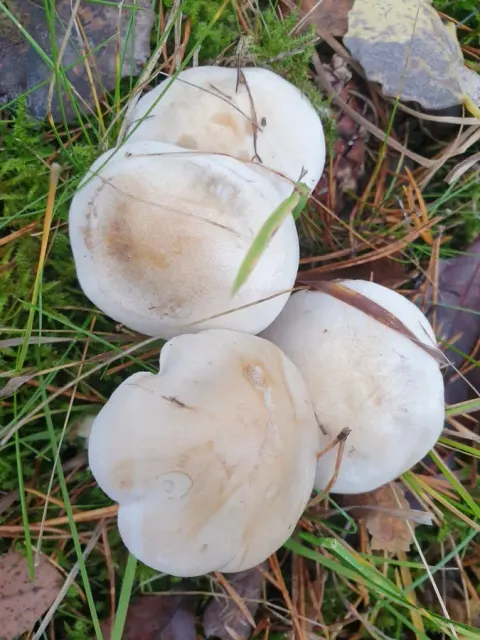
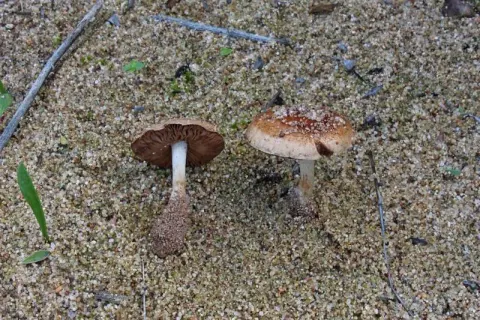
A–B basidiomata, holotype of Hebeloma cohaerens TLXM 6156 (HJB17733). Photos A. Kong.
- Jenis
- Pelat ilmiah
- Kredit
- Ursula Eberhardt, Alejandro Kong, Adriana Montoya, Nicole Schütz, Peter Bartlett, Henry J. Beker
- Lisensi
- CC BY 4.0
- Sumber media
- Buka entri sumber
Dokumentasi tambahan
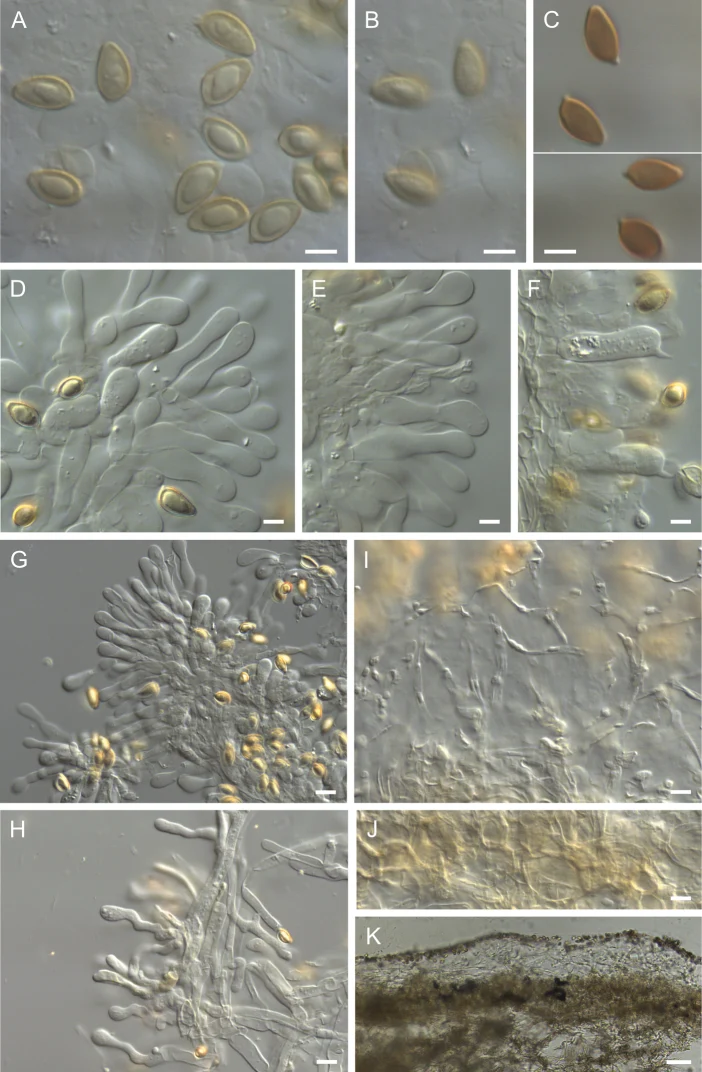
Holotype of Hebeloma cohaerens TLXM 6156 (HJB17733) A basidiospores ×1600− B spore ornamentation ×1600 C basidiospores in Melzer’s reagent ×1600 D–E cheilocystidia ×1000 F basidia ×1000 G cheilocystidia ×500 H caulocystidia ×500 I epicutis hyphae ×1000 J subcutis ×1000 K cutis ×125. All in KOH, except C. Scale bars: 5 µm (A–F); 10 µm (G–J); 50 µm (K). Photos H. J. Beker.
Kredit dan penggunaan
Ursula Eberhardt, Alejandro Kong, Adriana Montoya, Nicole Schütz, Peter Bartlett, Henry J. Beker
Ukuran dan format gambar disesuaikan tanpa pemotongan, retus, atau penambahan skala. Lisensi sumber dipertahankan.
Sumber profil
- [1] Not (only) poison pies – Hebeloma (Agaricales, Hymenogastraceae) in Mexico — Hebeloma cohaerens
- [2] Catalogue of Life Base2026-09-11 — Hebeloma cohaerens
- [3] Dokumentasi visual — Hebeloma cohaerens
- [4] Dokumentasi visual — Hebeloma cohaerens
Rujukan halaman ini
Fungi. Hebeloma cohaerens. Rilis data fungi-2026-10-12-expansion-2. https://fungi-atlas.mgadib.chatgpt.site/jamur/hebeloma-cohaerens/.
Status: impor sumber; pemeriksaan editorial per profil belum selesai. Untuk klaim biologis, gunakan rujukan pada bagian terkait dan periksa konteks sumber aslinya.