Ciri dan struktur
Cap 2.5–7.5 cm, convex to irregularly gibbous, sometimes broadly umbonate, with incurved later straight, opaque margin, occasionally appendiculate, dry and dull, unicolored mainly sepia, sometimes with light grayish adpressed covering. Lamellae almost free to emarginate gray (olive) brown, edge entire, slightly tomentose, number of lamellae {L} 45–58. Stem whitish pale fibrillose, sordid gray-brown, often more or less buried in sand with a sand bulb around the base, cortina pale. Context initially fairly thick, with cavity, firm watery grayish in pileus, pale brownish in stipe to near buff, towards base dark, sordid brown. Smell weakly and indistinctly raphanoid. Taste similar, mild. Spore deposit color not recorded. Spores ellipsoid, often ovoid or amygdaloid on ave. 12.0‒14.5 × 7.5‒8.5 µm, ave. Q 1.5‒1.9, very weakly ornamented (O1 O2), perispore not noticeably loosening (P0), indistinctly dextrinoid (D0 D1), yellow brown, ± guttulate, not papillate. Basidia 26‒42 × 7‒11 µm, ave. Q = 3.0‒4.2, mostly four-spored. Cheilocystidia lageniform to ventricose, occasionally cylindrical or clavate-ventricose, occasionally with a characteristic wall thickening, apically, basically, sometimes septate, on ave. 40‒50 × 5.5‒8 (apex) × 5‒9 (middle) × 10‒13 (base) µm, ratios A/M = 0.90‒1.26, A/B = 0.46‒0.77, B/M = 1.40‒2.45. Epicutis an ixocutis, up to 120 µm thick (measured from exsiccata), maximum hyphae width 10 µm, sometimes encrusted, shape of trama elements beneath subcutis sausage-shaped, cylindrical or ellipsoid. Caulocystidia similar to cheilocystidia, but usually less ventricose, up to 130 µm long.
Habitat dan peran ekologis
Known from a few collections from three localities in southwestern Greenland. H. colvinii was described by Peck (1875; effectively published 1876) from West Albany in North America. He found it in drifting sand in West Albany near Albany, N.Y. State. Later Kauffman (1918) reported this or a very similar species from New Richmond in Michigan, as did Ritchie (1946) from Lewes, Delaware Bay. Neither of these two collections has been examined as part of this study. Five collections, all with Salix glauca in pure sand along a river. In one of the localities, Sandflugtsdalen (“valley of driftsand”) at Kangerlussuaq, it was very common and scattered over a large area. The sand is mineral-rich due to mixing with loess.
- Habitat atau konteks temuan
- Informasi belum tersedia pada sumber rilis ini.
- Substrat
- Informasi belum tersedia pada sumber rilis ini.
- Peran atau konteks
- Belum dikategorikan pada rilis ini.
Reproduksi
Cap 2.5–7.5 cm, convex to irregularly gibbous, sometimes broadly umbonate, with incurved later straight, opaque margin, occasionally appendiculate, dry and dull, unicolored mainly sepia, sometimes with light grayish adpressed covering. Lamellae almost free to emarginate gray (olive) brown, edge entire, slightly tomentose, number of lamellae {L} 45–58. Stem whitish pale fibrillose, sordid gray-brown, often more or less buried in sand with a sand bulb around the base, cortina pale. Context initially fairly thick, with cavity, firm watery grayish in pileus, pale brownish in stipe to near buff, towards base dark, sordid brown. Smell weakly and indistinctly raphanoid. Taste similar, mild. Spore deposit color not recorded.
Catatan identitas dan cakupan
- Nama diterima mengikuti Catalogue of Life Base2026-09-11; uraian mempertahankan konsep dan nama sumber aslinya.
- Preserve original treatment localities, hosts and substrate scope. Materials examined describe documented specimens, not the full global range.
- Impor dan terjemahan otomatis belum diperiksa editorial per profil. Struktur reproduktif yang disebutkan tidak membuktikan seluruh siklus hidup diketahui.
- Pengukuran pada uraian mengikuti spesimen, kultur, dan metode sumber; angka tidak diperluas ke semua populasi.
Catatan distribusi dalam narasi mengikuti sumbernya. Dokumentasi spesimen atau foto mengikuti catatan sumber. Bukti wilayah Indonesia dan penilaian konservasi tidak disimpulkan dari gambar.
Melihat dengan konteks
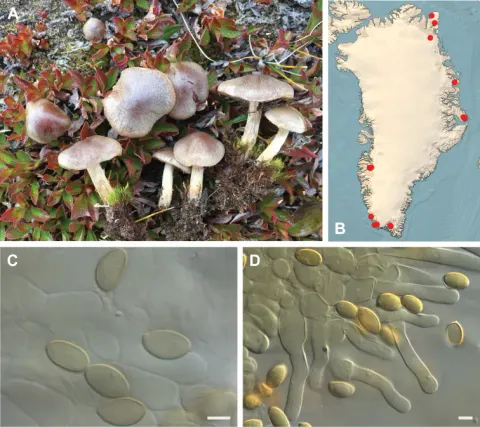
Hebeloma colvinii A HK16.005, photograph H. Knudsen B distribution of cited collections; C spores ×1600 and D cheilocystidia ×1000 of HK16.005 in Melzer’s reagent. Scale bars: 5 µm; microphotographs H.K.J. Beker.
- Jenis
- Pelat ilmiah
- Kredit
- Ursula Eberhardt, Henry J. Beker, Torbjørn Borgen, Henning Knudsen, Nicole Schütz, Steen A. Elborne
- Lisensi
- CC BY 4.0
- Sumber media
- Buka entri sumber
Sumber profil
- [1] A survey of Hebeloma (Hymenogastraceae) in Greenland — Hebeloma colvinii
- [2] Catalogue of Life Base2026-09-11 — Hebeloma colvinii
- [3] Dokumentasi visual — Hebeloma colvinii
Rujukan halaman ini
Fungi. Hebeloma colvinii. Rilis data fungi-2026-10-12-expansion-2. https://fungi-atlas.mgadib.chatgpt.site/jamur/hebeloma-colvinii/.
Status: impor sumber; pemeriksaan editorial per profil belum selesai. Untuk klaim biologis, gunakan rujukan pada bagian terkait dan periksa konteks sumber aslinya.