Ciri dan struktur
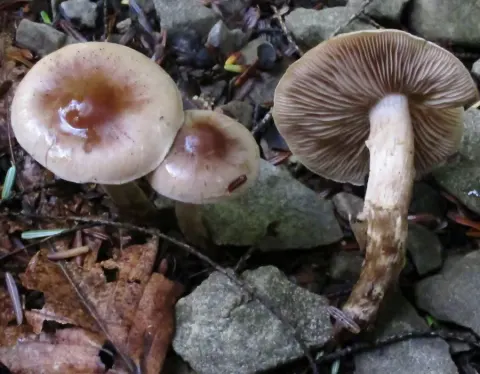
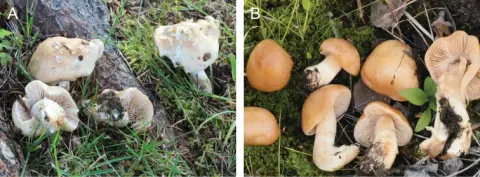
Cap 1.1–4.7 cm in diameter, convex to umbonate, occasionally papillate, margin smooth, tacky when moist, sometimes hygrophanous, uniformly colored or variably bicolored, at center ochraceous or dark olive buff to brownish olive or umber to sepia to fuscous or dark brick, at margin cream to grayish or pinkish buff to ochraceous or dark olive buff to umber, sometimes very thin; with remains of universal veil, partial veil present. Lamellae initially very pale clay, later clay, emarginate, maximum depth 3–8 mm, number of lamellae {L} 32–45, droplets absent, white fimbriate edge usually weakly present. Stem 1.4–4.5(–6.5) × 0.3–0.7(–0.8) cm, pale sordid ochraceous downwards, cylindrical to slightly clavate, fibrillose, whitish pruinose to floccose at apex. Context watery gray brown in cap, in stem lighter, firm, stem interior stuffed, later hollow, occasionally with superior wick, stem flesh usually discoloring from base. Smell usually raphanoid, but sometimes no smell detected. Taste bitter. Spore deposit clay buff to dark olive buff to grayish brown to brownish olive or umber. Spores shape ellipsoid, occasionally amygdaloid or ovoid, on ave. 10.0–13.0 × 5.5–7.5 µm, ave. Q = 1.6–1.9, grayish yellow, rarely guttulate, almost smooth (O1 (O2)), perispore not loosening (P0), not or indistinctly dextrinoid (D0 D1). Basidia (28–)30–34(–37) × 7–9 µm, ave. Q = 4–4.5, mostly four-spored. Cheilocystidia lageniform, ventricose or occasionally cylindrical or clavate, occasionally with characteristic apical thickening, bifurcate, geniculate and septate (sometimes clamped), on ave. 44–69 × 5–7 (apex) × 4.5–5 (middle) × 7.5–10.5 (base) µm, ratios A/M = 1.1–1.4, A/B = 0.53–0.81, B/M = 1.55–2.33.
Habitat dan peran ekologis
Hebeloma marginatulum is widespread and, apparently, one of the most common Hebeloma species in Greenland (11.1% of the collections, see Table 3), also common in other parts of North America and present in parts of Europe (Beker et al. 2016; Cripps et al. 2019). It is a truly arctic-alpine species hardly found outside these areas. Arctic-alpine. Forty-five collections with many hosts. Twenty collections with Salix (S. herbacea 9, S. glauca 6, S. arctophila 3 and S. arctica 2), two with Betula pubescens var. pumila, two with Betula sp. and three with Dryas octopetala and D. integrifolia (as always, other potential hosts may have been nearby). In the Rocky Mountains, it is also common, found with Salix arctica, S. reticulata and S. planifolia (Cripps et al. 2019). Beker et al. (2016) have S. herbacea and S. polaris as the main hosts. Hebeloma marginatulum occurs on a variety of soil types seemingly without specific preferences.
- Habitat atau konteks temuan
- Informasi belum tersedia pada sumber rilis ini.
- Substrat
- Informasi belum tersedia pada sumber rilis ini.
- Peran atau konteks
- Belum dikategorikan pada rilis ini.
Reproduksi
Cap 1.1–4.7 cm in diameter, convex to umbonate, occasionally papillate, margin smooth, tacky when moist, sometimes hygrophanous, uniformly colored or variably bicolored, at center ochraceous or dark olive buff to brownish olive or umber to sepia to fuscous or dark brick, at margin cream to grayish or pinkish buff to ochraceous or dark olive buff to umber, sometimes very thin; with remains of universal veil, partial veil present. Lamellae initially very pale clay, later clay, emarginate, maximum depth 3–8 mm, number of lamellae {L} 32–45, droplets absent, white fimbriate edge usually weakly present. Stem 1.4–4.5(–6.5) × 0.3–0.7(–0.8) cm, pale sordid ochraceous downwards, cylindrical to slightly clavate, fibrillose, whitish pruinose to floccose at apex.
Catatan identitas dan cakupan
- Nama diterima mengikuti Catalogue of Life Base2026-09-11; uraian mempertahankan konsep dan nama sumber aslinya.
- Preserve original treatment localities, hosts and substrate scope. Materials examined describe documented specimens, not the full global range.
- Impor dan terjemahan otomatis belum diperiksa editorial per profil. Struktur reproduktif yang disebutkan tidak membuktikan seluruh siklus hidup diketahui.
- Pengukuran pada uraian mengikuti spesimen, kultur, dan metode sumber; angka tidak diperluas ke semua populasi.
Catatan distribusi dalam narasi mengikuti sumbernya. Dokumentasi spesimen atau foto mengikuti catatan sumber. Bukti wilayah Indonesia dan penilaian konservasi tidak disimpulkan dari gambar.
Melihat dengan konteks
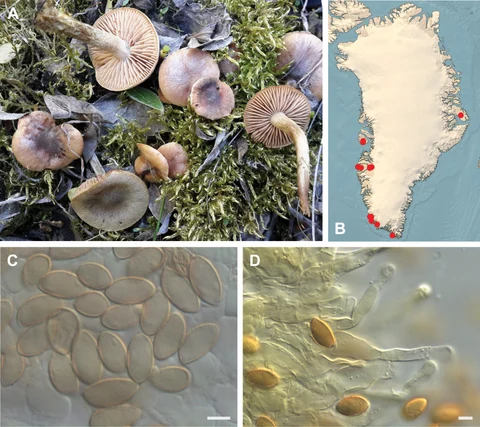
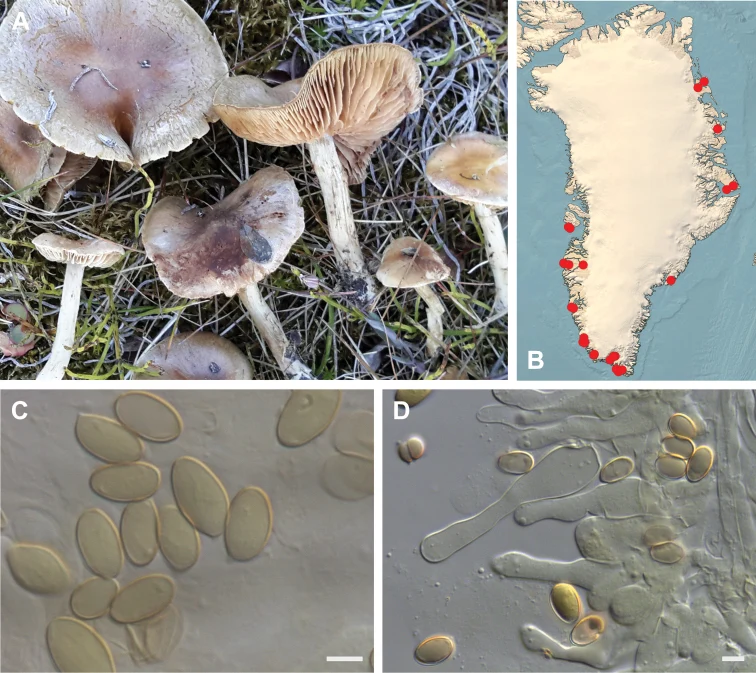
Pelat Hebeloma marginatulum: tubuh buah pada panel A, peta koleksi pada B, serta spora dan keilosistidia pada C–D. Pembagian panel dan identitas mengikuti sumber.
- Jenis
- Pelat ilmiah
- Kredit
- Ursula Eberhardt, Henry J. Beker, Torbjørn Borgen, Henning Knudsen, Nicole Schütz, Steen A. Elborne
- Lisensi
- CC BY 4.0
- Sumber media
- Buka entri sumber
Dokumentasi tambahan
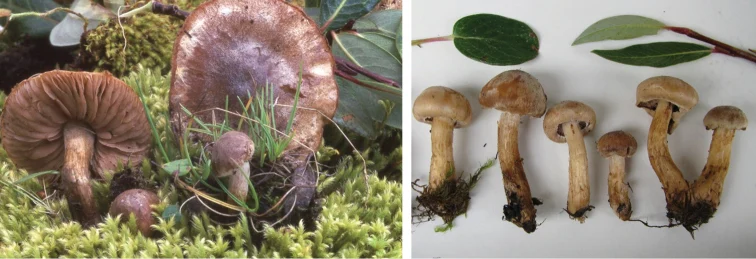
Hebeloma marginatulum DBG-F-020841 and CLC3545.
Kredit dan penggunaan
Cathy L. Cripps, Ursula Eberhardt, Nicole Schütz, Henry J. Beker, Vera S. Evenson, Egon Horak
Ukuran dan format gambar disesuaikan tanpa pemotongan, retus, atau penambahan skala. Lisensi sumber dipertahankan.
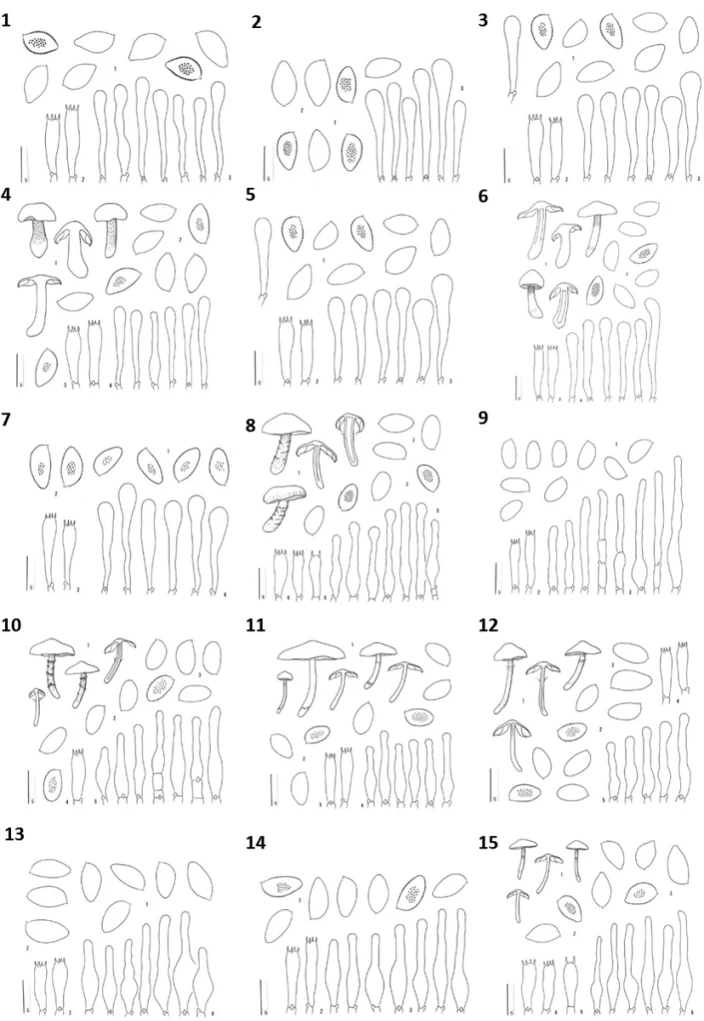
Pelat perbandingan struktur mikroskopis. Hebeloma marginatulum ditampilkan pada panel 8; panel lainnya memuat spesies pembanding. Pembagian panel mengikuti keterangan sumber.
Kredit dan penggunaan
Cathy L. Cripps, Ursula Eberhardt, Nicole Schütz, Henry J. Beker, Vera S. Evenson, Egon Horak
Ukuran dan format gambar disesuaikan tanpa pemotongan, retus, atau penambahan skala. Lisensi sumber dipertahankan.
Sumber profil
- [1] A survey of Hebeloma (Hymenogastraceae) in Greenland — Hebeloma marginatulum
- [2] Catalogue of Life Base2026-09-11 — Hebeloma marginatulum
- [3] Dokumentasi visual — Hebeloma marginatulum
- [4] Dokumentasi visual — Hebeloma marginatulum
- [5] Dokumentasi visual — Hebeloma marginatulum
Rujukan halaman ini
Fungi. Hebeloma marginatulum. Rilis data fungi-2026-10-12-expansion-2. https://fungi-atlas.mgadib.chatgpt.site/jamur/hebeloma-marginatulum/.
Status: impor sumber; pemeriksaan editorial per profil belum selesai. Untuk klaim biologis, gunakan rujukan pada bagian terkait dan periksa konteks sumber aslinya.