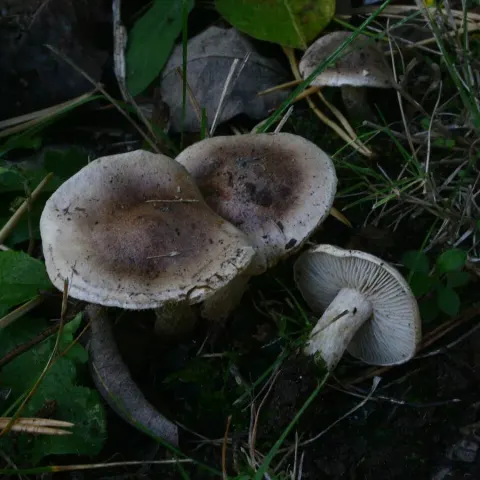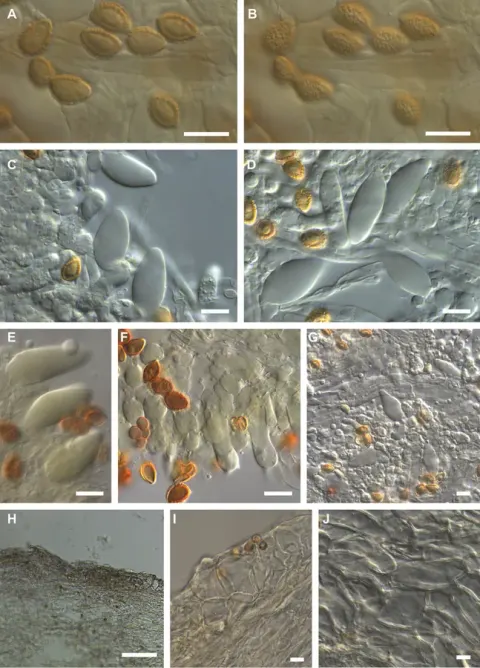
01 / Morfologi

Ciri dan struktur

Cap 1.2–2.4 cm in diameter, convex to umbonate, sometimes papillate, margin smooth, tacky when moist, not hygrophanous, unicolored or variably bicolored, at center grayish brown to yellowish brown or umber, tomentose, usually covered, particularly at the margin, with soft hairs, at margin dark grayish buff, sometimes with remains of universal veil, partial veil present. Lamellae light brown, later slightly darker, emarginate, maximum depth 2.5–5 mm, number of lamellae {L} 25–32, droplets absent, white fimbriate edge weakly present. Stem 1.1–4.6 × 0.2–0.4 cm, whitish pale floccose in apex, downwards lengthily fibrillose, sordid brown or very pale ochraceous, cylindrical, stem Q (3.7–)4.8–8.3(–9.7), fibrillose. Context firm, stem interior stuffed, later hollow, flesh usually discoloring from base. Smell raphanoid, sometimes strongly. Taste mild. Spore deposit brownish olive. Spores ellipsoid, sometimes ovoid, pale yellow to yellow brown, guttulate, sometimes weakly, on ave. 10.0–12.0 × 6.0–6.5 µm, ave. Q = 1.5–1.8, almost smooth or weakly ornamented (O1 O2), perispore not loosening (P0), indextrinoid (D0). Basidia 28–33(-37) × 8–9 µm, ave. Q = 3.1–4.4, mostly four-spored. Cheilocystidia lageniform or ventricose, occasionally with characteristic basal or median wall thickening, septate, on ave. 38–45 × 4.5–6 (apex) × 4.5–6 (middle) × 8–10.5 (base) µm, ratios A/M = 1.02–1.10, A/B = 0.51–0.73, B/M = 1.52–2.10. Epicutis an ixocutis, 90–100 µm thick (measured from exsiccata), maximum hyphae width 6 µm, sometimes encrusted, trama elements beneath subcutis isodiametric up to 15 µm wide.

Sebagian uraian ditampilkan dalam bahasa sumber; terjemahannya belum tersedia atau belum lolos pemeriksaan.

Rujukan: [1]

Pengukuran mengikuti objek, spesimen atau kultur, dan metode yang disebutkan sumber. Baca uraian asli untuk konteks lengkap.

02 / Kehidupan

Habitat dan peran ekologis

Recently described from three records on Svalbard (Beker et al. 2016). The Greenland records are all north of 69° and, together with the type from 78°N, establish this as one of the few agarics, which appear only to occur in the High Arctic zone. The Greenland records are new to North America and the first outside Europe. High Arctic. Three collections, two with Dryas and one with Salix sp. The collections from Zackenberg were on rich soil. Beker et al. (2016) described it from Svalbard, where the host was Salix polaris.

Sebagian uraian ditampilkan dalam bahasa sumber; terjemahannya belum tersedia atau belum lolos pemeriksaan.

Rujukan: [1]

Habitat atau konteks temuan
Informasi belum tersedia pada sumber rilis ini.
Substrat
Informasi belum tersedia pada sumber rilis ini.
Peran atau konteks
Belum dikategorikan pada rilis ini.
Temukan hubungan serupa
03 / Siklus hidup

Reproduksi

Cap 1.2–2.4 cm in diameter, convex to umbonate, sometimes papillate, margin smooth, tacky when moist, not hygrophanous, unicolored or variably bicolored, at center grayish brown to yellowish brown or umber, tomentose, usually covered, particularly at the margin, with soft hairs, at margin dark grayish buff, sometimes with remains of universal veil, partial veil present. Lamellae light brown, later slightly darker, emarginate, maximum depth 2.5–5 mm, number of lamellae {L} 25–32, droplets absent, white fimbriate edge weakly present. Stem 1.1–4.6 × 0.2–0.4 cm, whitish pale floccose in apex, downwards lengthily fibrillose, sordid brown or very pale ochraceous, cylindrical, stem Q (3.7–)4.8–8.3(–9.7), fibrillose.

Sebagian uraian ditampilkan dalam bahasa sumber; terjemahannya belum tersedia atau belum lolos pemeriksaan.

Rujukan: [1]

04 / Batas informasi

Catatan identitas dan cakupan

  • Nama diterima mengikuti Catalogue of Life Base2026-09-11; uraian mempertahankan konsep dan nama sumber aslinya.
  • Preserve original treatment localities, hosts and substrate scope. Materials examined describe documented specimens, not the full global range.
  • Impor dan terjemahan otomatis belum diperiksa editorial per profil. Struktur reproduktif yang disebutkan tidak membuktikan seluruh siklus hidup diketahui.
  • Pengukuran pada uraian mengikuti spesimen, kultur, dan metode sumber; angka tidak diperluas ke semua populasi.

Catatan distribusi dalam narasi mengikuti sumbernya. Dokumentasi spesimen atau foto mengikuti catatan sumber. Bukti wilayah Indonesia dan penilaian konservasi tidak disimpulkan dari gambar.

05 / Dokumentasi

Melihat dengan konteks

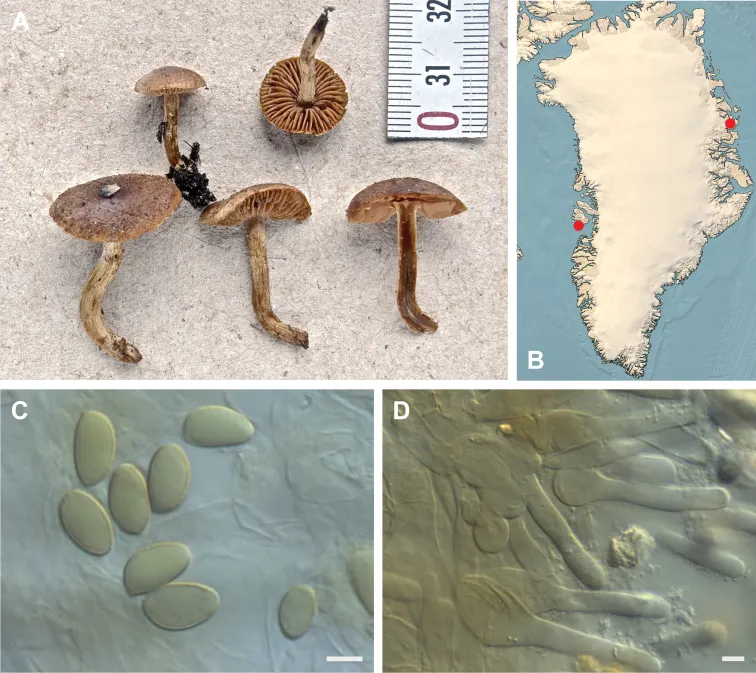
Hebeloma pubescens A TB99.194, photograph T. Borgen B distribution of cited collections; C spores ×1600 and D cheilocystidia ×1000 of TB99.194 in Melzer’s reagent. Scale bars: 5 µm; microphotographs H.K.J. Beker.

Jenis
Pelat ilmiah
Kredit
Ursula Eberhardt, Henry J. Beker, Torbjørn Borgen, Henning Knudsen, Nicole Schütz, Steen A. Elborne
Lisensi
CC BY 4.0
Sumber media
Buka entri sumber

Gambar menunjukkan objek menurut identifikasi sumber, bukan verifikasi independen spesimen oleh Fungi. Tidak ada skala baru yang ditambahkan.

06 / Rujukan

Sumber profil

  1. [1] A survey of Hebeloma (Hymenogastraceae) in Greenland — Hebeloma pubescensBagian sumber: PMC8076164_section_99
    Tanggal penghimpunan sumber: 2026-10-12
    Teks sumber: CC BY 4.0 · Eberhardt U, Beker HJ, Borgen T, Knudsen H, Schütz N, Elborne SA.
  2. [2] Catalogue of Life Base2026-09-11 — Hebeloma pubescensBagian sumber: ColDP NameUsage.tsv ID 6LH35; accepted species; source 2073
    Tanggal penghimpunan sumber: 2026-10-12
  3. [3] Dokumentasi visual — Hebeloma pubescensBagian sumber: Individual media record; identification follows the source, not independent determination
    Tanggal penghimpunan sumber: 2026-10-12
    Media sumber: CC BY 4.0 · Ursula Eberhardt, Henry J. Beker, Torbjørn Borgen, Henning Knudsen, Nicole Schütz, Steen A. Elborne

Adaptasi teks: CC BY 4.0. Eberhardt U, Beker HJ, Borgen T, Knudsen H, Schütz N, Elborne SA. — A survey of Hebeloma (Hymenogastraceae) in Greenland — Hebeloma pubescens

Uraian asli dan riwayat sumber

Riwayat atau halaman sumber

Ringkasan sumber

Cap 1.2–2.4 cm in diameter, convex to umbonate, sometimes papillate, margin smooth, tacky when moist, not hygrophanous, unicolored or variably bicolored, at center grayish brown to yellowish brown or umber, tomentose, usually covered, particularly at the margin, with soft hairs, at margin dark grayish buff, sometimes with remains of universal veil, partial veil present. Lamellae light brown, later slightly darker, emarginate, maximum depth 2.5–5 mm, number of lamellae {L} 25–32, droplets absent, white fimbriate edge weakly present.

Revisi sumber

Morfologi sumber

Cap 1.2–2.4 cm in diameter, convex to umbonate, sometimes papillate, margin smooth, tacky when moist, not hygrophanous, unicolored or variably bicolored, at center grayish brown to yellowish brown or umber, tomentose, usually covered, particularly at the margin, with soft hairs, at margin dark grayish buff, sometimes with remains of universal veil, partial veil present. Lamellae light brown, later slightly darker, emarginate, maximum depth 2.5–5 mm, number of lamellae {L} 25–32, droplets absent, white fimbriate edge weakly present. Stem 1.1–4.6 × 0.2–0.4 cm, whitish pale floccose in apex, downwards lengthily fibrillose, sordid brown or very pale ochraceous, cylindrical, stem Q (3.7–)4.8–8.3(–9.7), fibrillose. Context firm, stem interior stuffed, later hollow, flesh usually discoloring from base. Smell raphanoid, sometimes strongly. Taste mild. Spore deposit brownish olive. Spores ellipsoid, sometimes ovoid, pale yellow to yellow brown, guttulate, sometimes weakly, on ave. 10.0–12.0 × 6.0–6.5 µm, ave. Q = 1.5–1.8, almost smooth or weakly ornamented (O1 O2), perispore not loosening (P0), indextrinoid (D0). Basidia 28–33(-37) × 8–9 µm, ave. Q = 3.1–4.4, mostly four-spored. Cheilocystidia lageniform or ventricose, occasionally with characteristic basal or median wall thickening, septate, on ave. 38–45 × 4.5–6 (apex) × 4.5–6 (middle) × 8–10.5 (base) µm, ratios A/M = 1.02–1.10, A/B = 0.51–0.73, B/M = 1.52–2.10. Epicutis an ixocutis, 90–100 µm thick (measured from exsiccata), maximum hyphae width 6 µm, sometimes encrusted, trama elements beneath subcutis isodiametric up to 15 µm wide.

Revisi sumber

Ekologi sumber

Recently described from three records on Svalbard (Beker et al. 2016). The Greenland records are all north of 69° and, together with the type from 78°N, establish this as one of the few agarics, which appear only to occur in the High Arctic zone. The Greenland records are new to North America and the first outside Europe. High Arctic. Three collections, two with Dryas and one with Salix sp. The collections from Zackenberg were on rich soil. Beker et al. (2016) described it from Svalbard, where the host was Salix polaris.

Revisi sumber

Struktur reproduksi sumber

Cap 1.2–2.4 cm in diameter, convex to umbonate, sometimes papillate, margin smooth, tacky when moist, not hygrophanous, unicolored or variably bicolored, at center grayish brown to yellowish brown or umber, tomentose, usually covered, particularly at the margin, with soft hairs, at margin dark grayish buff, sometimes with remains of universal veil, partial veil present. Lamellae light brown, later slightly darker, emarginate, maximum depth 2.5–5 mm, number of lamellae {L} 25–32, droplets absent, white fimbriate edge weakly present. Stem 1.1–4.6 × 0.2–0.4 cm, whitish pale floccose in apex, downwards lengthily fibrillose, sordid brown or very pale ochraceous, cylindrical, stem Q (3.7–)4.8–8.3(–9.7), fibrillose.

Revisi sumber

Rujukan halaman ini

Fungi. Hebeloma pubescens. Rilis data fungi-2026-10-12-expansion-2. https://fungi-atlas.mgadib.chatgpt.site/jamur/hebeloma-pubescens/.

Status: impor sumber; pemeriksaan editorial per profil belum selesai. Untuk klaim biologis, gunakan rujukan pada bagian terkait dan periksa konteks sumber aslinya.