Ciri dan struktur
Cap 1.0–2.2 cm in diameter, convex to umbonate, sometimes umbilicate, margin smooth, tacky when moist, occasionally hygrophanous, unicolored, sometimes bicolored, at center sepia to fuscous or dark brick, at margin pinkish buff to clay pink to cinnamon, sometimes quite thin margin, without remains of universal veil, partial veil present. Lamellae initially light clay, at maturity slightly more brownish, attachment emarginate, maximum depth 3–5 mm, number of lamellae {L} 18–35, droplets absent, white fimbriate edge sometimes present but weak. Stem (1.5–)1.9–3.1(–3.7) × 0.2–0.3(–0.5) cm, light watery brownish, darker towards base, cylindrical, stem Q (5–)8–12.7(–16.5), fibrillose, usually pruinose at apex. Context firm, stem interior stuffed, later hollow, stem flesh variably discoloring from base. Smell raphanoid sometimes strongly. Taste weakly raphanoid. Spore deposit sepia. Spores amygdaloid, occasionally limoniform, guttulation variable, on ave. 12.0–14.5 × 7.5–8.5 µm, ave. Q = 1.5–1.7, yellow brown to brown, almost smooth to weakly ornamented (O1 O2), perispore not loosening (P0), rather strongly dextrinoid (D2 D3). Basidia 27–37(-40) × 9–12 µm, ave. Q = 3.3–3.9, mostly four-spored. Cheilocystidia lageniform, ventricose, occasionally with characteristically median wall thickening, some septate, on ave. 45–60 × 4.5–6 (apex) × 4.5–5 (middle) × 8.5–12 (base) µm, occasionally cystidia with yellow contents, ratios A/M = 0.92–1.25, A/B = 0.43–0.61, B/M = 1.87–2.61. Epicutis an ixocutis, 30–35 µm thick (measured from exsiccata), maximum hyphae width 5 µm, without encrustations, shape of trama elements beneath subcutis sausage-shaped, up to 18 µm wide.
Habitat dan peran ekologis
Recently described from high arctic Svalbard (Beker et al. 2016). The eleven Greenland records indicate that it is quite common in the High Arctic zone in Greenland north of 67°N. Circumpolar, High Arctic. Twelve collections, four recorded with Salix arctica, four with S. glauca, two with Salix spp., one with Betula nana and one with Bistorta vivipara. Bistorta is often present near collections of mycorrhizal fungi, but only when it was the only possibility was this host recorded. In the Rocky Mountains, Cripps et al. (2019) reported two collections growing with S. glauca and S. arctica. In Greenland, H. spetsbergense is growing both in acid and calcareous habitats, most often in humid localities like bogs, riversides and ditches. The five collections from Svalbard, including the type, are from localities on base-poor ground with S. polaris (Beker et al. 2016).
- Habitat atau konteks temuan
- Informasi belum tersedia pada sumber rilis ini.
- Substrat
- Informasi belum tersedia pada sumber rilis ini.
- Peran atau konteks
- Mitra tumbuhan
Reproduksi
Cap 1.0–2.2 cm in diameter, convex to umbonate, sometimes umbilicate, margin smooth, tacky when moist, occasionally hygrophanous, unicolored, sometimes bicolored, at center sepia to fuscous or dark brick, at margin pinkish buff to clay pink to cinnamon, sometimes quite thin margin, without remains of universal veil, partial veil present. Lamellae initially light clay, at maturity slightly more brownish, attachment emarginate, maximum depth 3–5 mm, number of lamellae {L} 18–35, droplets absent, white fimbriate edge sometimes present but weak. Stem (1.5–)1.9–3.1(–3.7) × 0.2–0.3(–0.5) cm, light watery brownish, darker towards base, cylindrical, stem Q (5–)8–12.7(–16.5), fibrillose, usually pruinose at apex.
Catatan identitas dan cakupan
- Nama diterima mengikuti Catalogue of Life Base2026-09-11; uraian mempertahankan konsep dan nama sumber aslinya.
- Preserve original treatment localities, hosts and substrate scope. Materials examined describe documented specimens, not the full global range.
- Impor dan terjemahan otomatis belum diperiksa editorial per profil. Struktur reproduktif yang disebutkan tidak membuktikan seluruh siklus hidup diketahui.
- Pengukuran pada uraian mengikuti spesimen, kultur, dan metode sumber; angka tidak diperluas ke semua populasi.
Catatan distribusi dalam narasi mengikuti sumbernya. Dokumentasi spesimen atau foto mengikuti catatan sumber. Bukti wilayah Indonesia dan penilaian konservasi tidak disimpulkan dari gambar.
Melihat dengan konteks
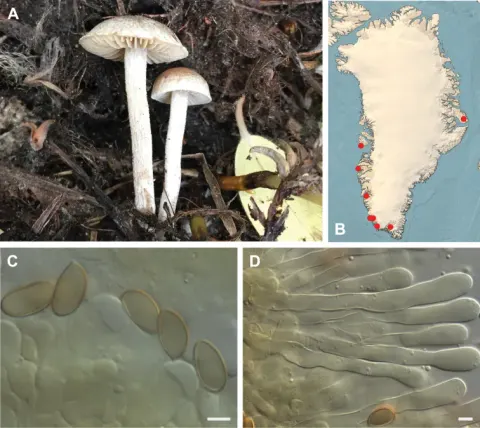
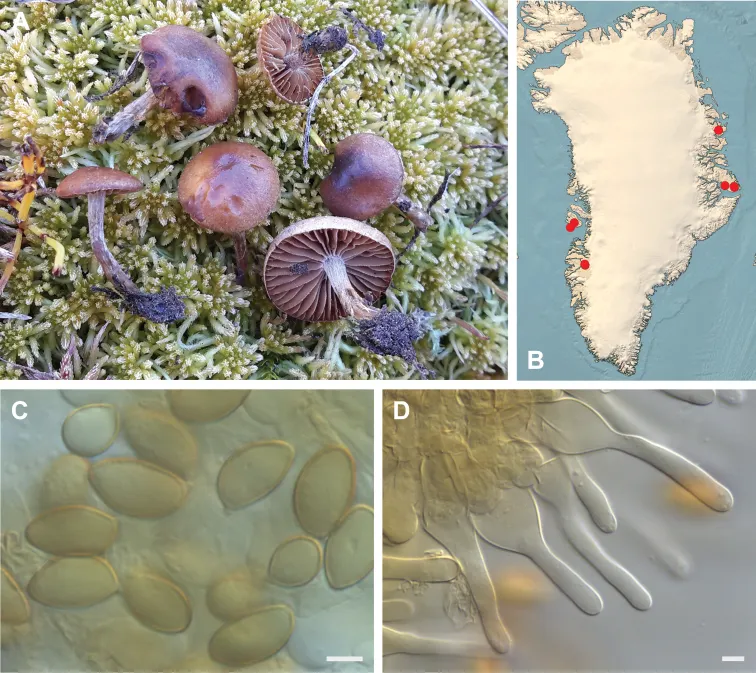
Hebeloma spetsbergense A HK16.071, photograph H. Knudsen B distribution of cited collections C spores ×1600 and D cheilocystidia ×1000 of HK16.071 in Melzer’s reagent. Scale bars: 5 µm; microphotographs H.K.J. Beker.
- Jenis
- Pelat ilmiah
- Kredit
- Ursula Eberhardt, Henry J. Beker, Torbjørn Borgen, Henning Knudsen, Nicole Schütz, Steen A. Elborne
- Lisensi
- CC BY 4.0
- Sumber media
- Buka entri sumber
Sumber profil
- [1] A survey of Hebeloma (Hymenogastraceae) in Greenland — Hebeloma spetsbergense
- [2] Catalogue of Life Base2026-09-11 — Hebeloma spetsbergense
- [3] Dokumentasi visual — Hebeloma spetsbergense
Rujukan halaman ini
Fungi. Hebeloma spetsbergense. Rilis data fungi-2026-10-12-expansion-2. https://fungi-atlas.mgadib.chatgpt.site/jamur/hebeloma-spetsbergense/.
Status: impor sumber; pemeriksaan editorial per profil belum selesai. Untuk klaim biologis, gunakan rujukan pada bagian terkait dan periksa konteks sumber aslinya.