Ciri dan struktur
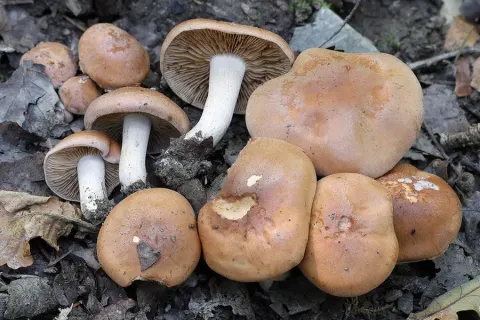
Pileo convexo-expanso, 3–4 cm. lato, subviscido, glabro, pallido-roseo, raphanico; lamellis sinuatis, latis, confertis; sporis subovoidcis, pallidis, levibus, 8–10 × 4–4.5 μ[m]; stipite acquali, pallido, 3 × 0.5 cm. Pileus convex to applanate, 3–4 cm broad, slightly viscid, glabrous, pale pink, with raphanoid smell; lamellae sinuate, broad, crowded; spores subovoid, pale, smooth, 8–10 × 4–4.5 μ[m]; stipe equal, pale, 3 × 0.5 cm. Pileus (20) 32–45 (46) mm diameter, usually convex, occasionally umbonate; occasionally with remains of universal veil; margin often smooth, occasionally scalloped, not hygrophanous; usually unicolor, occasionally two colors, at center cream to buff to ochraceous, often becoming paler towards the margin. Lamellae usually emarginate, occasionally adnate or adnexed; white, cream to brown, usually with white fimbriate edge, without droplets on the lamella edge, number of full-length lamellae 80–92. Stipe 30–56 (70) mm long, 5–10 (11) mm diameter at median, often clavate or cylindrical, 5–13 (14) mm wide at base, surface cream, ivory to white rarely discoloring, pruinose, particularly towards apex. Context in pileus white to cream, firm, similar color in stipe, becoming hollow with age; taste raphanoid, smell raphanoid, occasionally earthy. Spore deposit cinnamon color. Basidiospores based on n = 63 spores of the holotype, 5% to 95% percentile range 8.4–9.8 × 4.6–5.2 µm, with median 9.0 × 4.8 µm and av. 9.0 × 4.9 µm with S.D. length 0.51 µm and width 0.18 µm; Q value 5% to 95% percentile range 1.65–2.03, with median 1.88 and av. 1.85 with S.D. 0.12; spore size based on seven collections medians 8.5–10.2 × 4.6–5.3 µm and av. 8.6–9.9 × 4.6–5.3 µm with av.
Habitat dan peran ekologis
Where only one possible associate was recorded, that associate has always been Quercus (Fagaceae). We have additional records where Pinus, Abies and Fagus were recorded as possible associates, but in each of these cases a number of possible associates were mentioned by the collector. We are only aware of five collections other than that from Mexico. These are all from the eastern half of the United States: Ohio, Pennsylvania and Tennessee.
- Habitat atau konteks temuan
- Informasi belum tersedia pada sumber rilis ini.
- Substrat
- Informasi belum tersedia pada sumber rilis ini.
- Peran atau konteks
- Belum dikategorikan pada rilis ini.
Reproduksi
Pileo convexo-expanso, 3–4 cm. lato, subviscido, glabro, pallido-roseo, raphanico; lamellis sinuatis, latis, confertis; sporis subovoidcis, pallidis, levibus, 8–10 × 4–4.5 μ[m]; stipite acquali, pallido, 3 × 0.5 cm. Pileus convex to applanate, 3–4 cm broad, slightly viscid, glabrous, pale pink, with raphanoid smell; lamellae sinuate, broad, crowded; spores subovoid, pale, smooth, 8–10 × 4–4.5 μ[m]; stipe equal, pale, 3 × 0.5 cm. Pileus (20) 32–45 (46) mm diameter, usually convex, occasionally umbonate; occasionally with remains of universal veil; margin often smooth, occasionally scalloped, not hygrophanous; usually unicolor, occasionally two colors, at center cream to buff to ochraceous, often becoming paler towards the margin.
Catatan identitas dan cakupan
- Nama diterima mengikuti Catalogue of Life Base2026-09-11; uraian mempertahankan konsep dan nama sumber aslinya.
- Preserve original treatment localities, hosts and substrate scope. Materials examined describe documented specimens, not the full global range.
- Impor dan terjemahan otomatis belum diperiksa editorial per profil. Struktur reproduktif yang disebutkan tidak membuktikan seluruh siklus hidup diketahui.
- Pengukuran pada uraian mengikuti spesimen, kultur, dan metode sumber; angka tidak diperluas ke semua populasi.
Catatan distribusi dalam narasi mengikuti sumbernya. Dokumentasi spesimen atau foto mengikuti catatan sumber. Bukti wilayah Indonesia dan penilaian konservasi tidak disimpulkan dari gambar.
Melihat dengan konteks
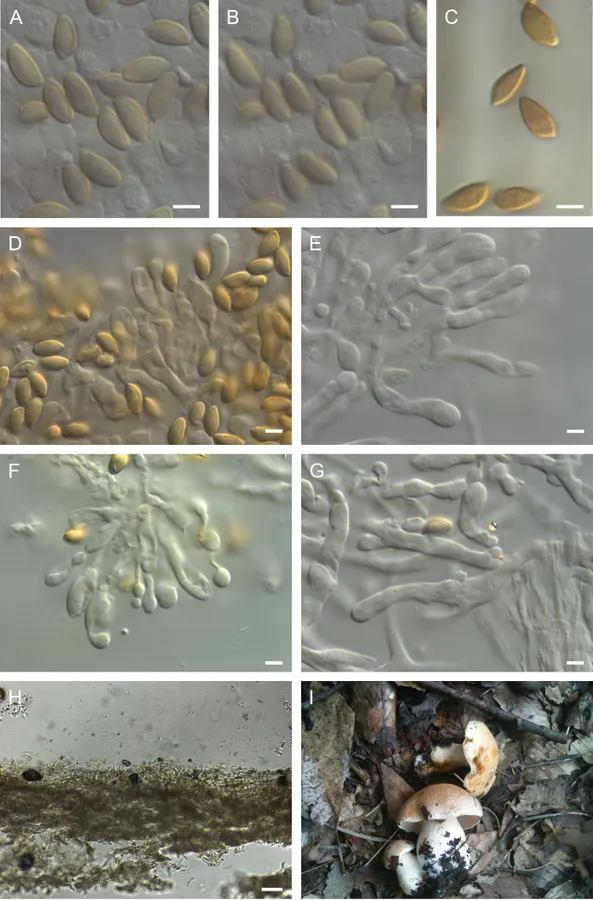
Hebeloma subaustrale A basidiospores and B spore ornamentation of holotype FLAS-F-19345 ×1600 C spores of SPFS-2011-63 (HJB17796) in Melzer’s reagent ×1600 D spores and cheilocystidia of holotype ×1000 E cheilocystidia of isotype TENN-F-021177 ×1000 F cheilocystidia of holotype ×1000 G caulocystidia of isotype ×1000 H cutis of SPFS-2011-63 ×125. All in KOH, except C. I basidiomata of collection SPFS-2011-63. Scale bars: 5 µm (A–G); 50 µm (H). Photos A–G H. J. Beker H D. Bartholow.
- Jenis
- Pelat ilmiah
- Kredit
- Ursula Eberhardt, Alejandro Kong, Adriana Montoya, Nicole Schütz, Peter Bartlett, Henry J. Beker
- Lisensi
- CC BY 4.0
- Sumber media
- Buka entri sumber
Sumber profil
- [1] Not (only) poison pies – Hebeloma (Agaricales, Hymenogastraceae) in Mexico — Hebeloma subaustrale
- [2] Catalogue of Life Base2026-09-11 — Hebeloma subaustrale
- [3] Dokumentasi visual — Hebeloma subaustrale
Rujukan halaman ini
Fungi. Hebeloma subaustrale. Rilis data fungi-2026-10-12-expansion-2. https://fungi-atlas.mgadib.chatgpt.site/jamur/hebeloma-subaustrale/.
Status: impor sumber; pemeriksaan editorial per profil belum selesai. Untuk klaim biologis, gunakan rujukan pada bagian terkait dan periksa konteks sumber aslinya.