Ciri dan struktur
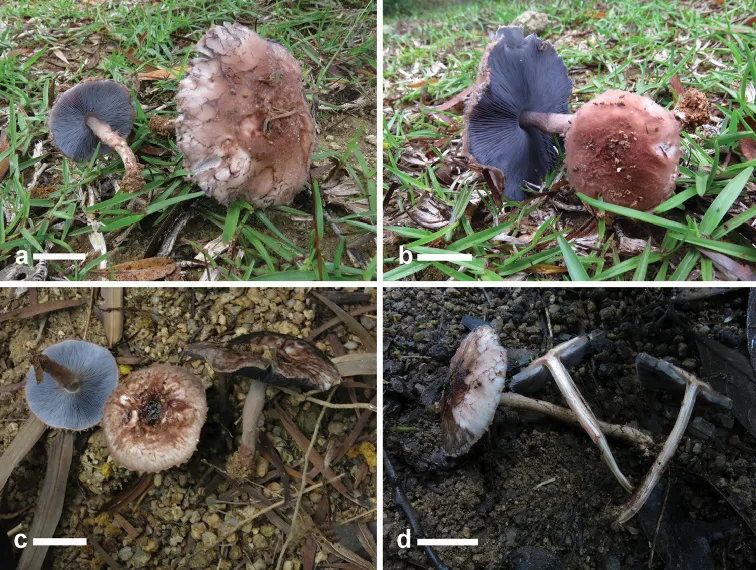
Basidiomata medium-sized to large. Pileus 35–65 mm broad, at first hemispherical, then convex to applanate with age, sometimes depressed at disc, pileus surface covered by snuff brown, chestnut brown, purple-brown or grayish red (9B4, 9C4, 10CD4), woolly-floccose or woolly arachnoid velar remnants, usually darker at center, outer zone showing dull white to whitish background when the velar remnants vanish; margin incurved with slightly appendiculate velar remnants, often slightly lacerated; context 3–4 mm thick at pileus centre, elsewhere thin, changes from white to slightly reddening when cut or injured. Lamellae free, depressed around the stipe, broadly ventricose, bluish gray to leaden gray (19B3, 18C3) when young, becoming dark blue (19E4–7) to bluish gray (19D3–5) when mature; 3–4 tiers of lamellulae. Stipe 50–60 × 5–6 mm, central, cylindrical, slightly tapering towards the base, floccose-squamulose all over the stipe, often vanish from handling or rain, with lighter shade of the pileus color, fistulose; stipe context slightly reddening when cut or injured. Annulus delicate, fugacious. Odor and taste unknown. Basidiospores [60/3/3] (5.5–)6–6.5(–7) × 3.5–4.5(–5) µm, [mean length = 6.25 µm, mean width = 4.15 µm, Q = 1.42–1.55(–1.63), Q m = 1.50 ± 0.043], ellipsoid to ovoid-ellipsoid, inamyloid, slightly thick-walled (0.5 µm), smooth, dark brown, grayish brown to slightly leaden gray in H 2 O and 5% KOH. Basidia 13–19 × 7–9 µm, clavate to broadly clavate, colorless or pale yellow in H 2 O and KOH, 4-spored, rarely 2-spored, with sterigmata up to 2 µm long. Lamellar trama regular to subregular, composed of thin-walled cylindrical hyphae 4–8 µm wide.
Habitat dan peran ekologis
Solitary, scattered on the ground; known from Malaysia, Thailand, and now China.
- Habitat atau konteks temuan
- Informasi belum tersedia pada sumber rilis ini.
- Substrat
- tanah
- Peran atau konteks
- Belum dikategorikan pada rilis ini.
Reproduksi
Basidiomata medium-sized to large. Pileus 35–65 mm broad, at first hemispherical, then convex to applanate with age, sometimes depressed at disc, pileus surface covered by snuff brown, chestnut brown, purple-brown or grayish red (9B4, 9C4, 10CD4), woolly-floccose or woolly arachnoid velar remnants, usually darker at center, outer zone showing dull white to whitish background when the velar remnants vanish; margin incurved with slightly appendiculate velar remnants, often slightly lacerated; context 3–4 mm thick at pileus centre, elsewhere thin, changes from white to slightly reddening when cut or injured. Lamellae free, depressed around the stipe, broadly ventricose, bluish gray to leaden gray (19B3, 18C3) when young, becoming dark blue (19E4–7) to bluish gray (19D3–5) when mature; 3–4 tiers of lamellulae.
Catatan identitas dan cakupan
- Nama diterima mengikuti Catalogue of Life Base2026-09-11; uraian mempertahankan konsep dan nama sumber aslinya.
- Preserve original treatment localities, hosts and substrate scope. Materials examined describe documented specimens, not the full global range.
- Impor dan terjemahan otomatis belum diperiksa editorial per profil. Struktur reproduktif yang disebutkan tidak membuktikan seluruh siklus hidup diketahui.
- Pengukuran pada uraian mengikuti spesimen, kultur, dan metode sumber; angka tidak diperluas ke semua populasi.
Catatan distribusi dalam narasi mengikuti sumbernya. Dokumentasi spesimen atau foto mengikuti catatan sumber. Bukti wilayah Indonesia dan penilaian konservasi tidak disimpulkan dari gambar.
Melihat dengan konteks
Basidiomata of Heinemannomyces splendidissimus. a Basidiomata showing leaden-blue lamellae and floccose pileus surface (GDGM 46633) b Basidiomata showing dark blue lamellae and floccose pileus surface (GDGM 46633) c Basidiomata showing blue lamellae and slightly depressed pileus disc (GDGM 46634) d Basidiomata showing pileus surface and a reddening context when cut (GDGM 46635). Scale bars: 20 mm.
- Jenis
- Pelat ilmiah
- Kredit
- Md. Iqbal Hosen, Zong-ping Song, Genevieve Gates, Samantha C. Karunarathna, M. Salahuddin M. Chowdhury, Tai-Hui Li
- Lisensi
- CC BY 4.0
- Sumber media
- Buka entri sumber
Dokumentasi tambahan
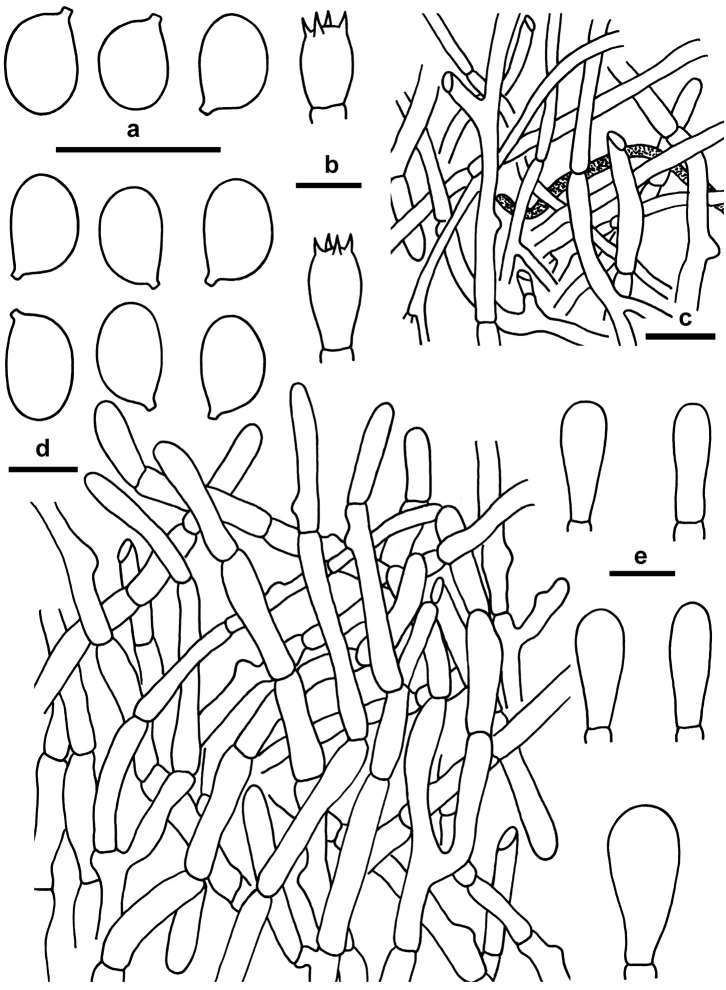
Microscopic features of Heinemannomyces splendidissimus (GDGM 46633). a Basidiospores b Basidia c Elements from stipe surface d Pileipellis e Cheilocystidia. Scale bars: 10 µm.
Kredit dan penggunaan
Md. Iqbal Hosen, Zong-ping Song, Genevieve Gates, Samantha C. Karunarathna, M. Salahuddin M. Chowdhury, Tai-Hui Li
Ukuran dan format gambar disesuaikan tanpa pemotongan, retus, atau penambahan skala. Lisensi sumber dipertahankan.
Sumber profil
- [1] Two new species of Xanthagaricus and some notes on Heinemannomyces from Asia — Heinemannomyces splendidissimus
- [2] Catalogue of Life Base2026-09-11 — Heinemannomyces splendidissimus
- [3] Dokumentasi visual — Heinemannomyces splendidissimus
- [4] Dokumentasi visual — Heinemannomyces splendidissimus
Rujukan halaman ini
Fungi. Heinemannomyces splendidissimus. Rilis data fungi-2026-10-12-expansion-2. https://fungi-atlas.mgadib.chatgpt.site/jamur/heinemannomyces-splendidissimus/.
Status: impor sumber; pemeriksaan editorial per profil belum selesai. Untuk klaim biologis, gunakan rujukan pada bagian terkait dan periksa konteks sumber aslinya.