01 / Morfologi

Ciri dan struktur

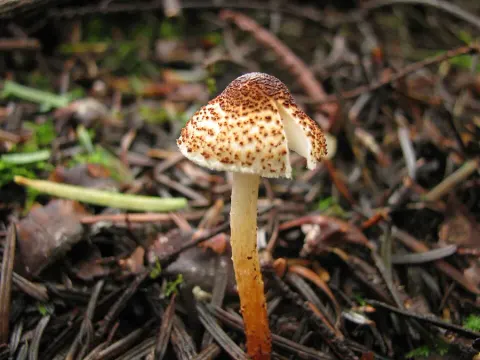
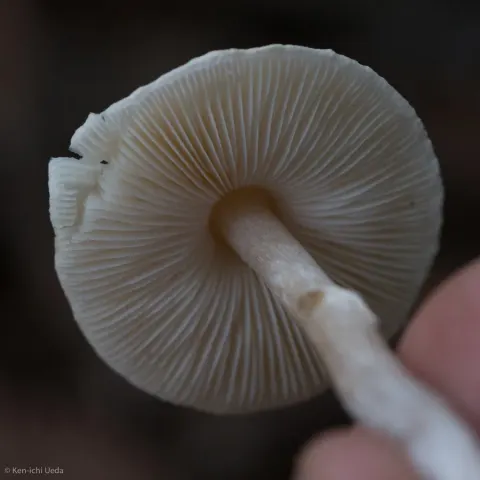
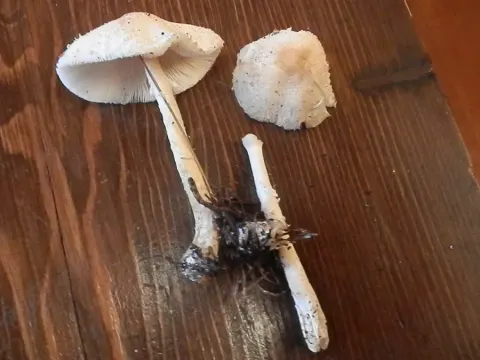
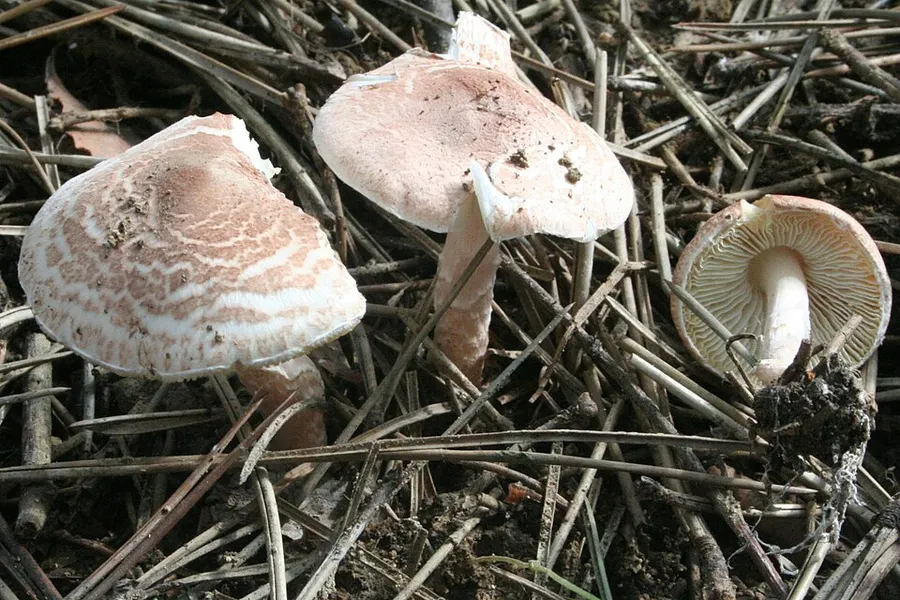
The cap is 2.7 – 4 cm across, hemispherical at first before becoming more convex without an obvious boss. It is red-brown when young, before fading to a pale pinkish brown with darker brown scales. There is generally a large unbroken scale in the centre of the cap. The cap margin is inrolled and the cap is fleshy. The thick uncrowded gills are white, with occasional forks and smaller gills (lamellulae) in between. They are free (unattached to the stem). The spore print is white. The cylindrical stem is 2 – 3.5 cm tall by 0.6 – 0.9 cm wide. The upper part of the stem is pinkish tan while the lower part is covered in dark brown scales. They are separated by a dark brown ring-like zone. The thick flesh reddens on bruising or cutting, and smells somewhat like unripe fruit. The taste is mild. The oval spores are 6–7.5 μm long by 3.5–5 μm wide, and are dextrinoid – they turn red-brown in Melzer's reagent.

Sebagian uraian ditampilkan dalam bahasa sumber; terjemahannya belum tersedia atau belum lolos pemeriksaan.

Rujukan: [1]

Pengukuran mengikuti objek, spesimen atau kultur, dan metode yang disebutkan sumber. Baca uraian asli untuk konteks lengkap.

02 / Kehidupan

Habitat dan peran ekologis

The deadly dapperling is found in warmer parts of Europe, generally the south, but has also been recorded from Britain and Germany. Di Asia, telah tercatat dari Turki, Israel, Pakistan, Iran and China timur.

Sebagian uraian ditampilkan dalam bahasa sumber; terjemahannya belum tersedia atau belum lolos pemeriksaan.

Rujukan: [1]

Habitat atau konteks temuan
Informasi belum tersedia pada sumber rilis ini.
Substrat
Informasi belum tersedia pada sumber rilis ini.
Peran atau konteks
Belum dikategorikan pada rilis ini.
Temukan hubungan serupa
03 / Siklus hidup

Reproduksi

The cap is 2.7 – 4 cm across, hemispherical at first before becoming more convex without an obvious boss. It is red-brown when young, before fading to a pale pinkish brown with darker brown scales. There is generally a large unbroken scale in the centre of the cap. The cap margin is inrolled and the cap is fleshy. The thick uncrowded gills are white, with occasional forks and smaller gills (lamellulae) in between. They are free (unattached to the stem). The spore print is white. The cylindrical stem is 2 – 3.5 cm tall by 0.6 – 0.9 cm wide. The upper part of the stem is pinkish tan while the lower part is covered in dark brown scales. They are separated by a dark brown ring-like zone. The thick flesh reddens on bruising or cutting, and smells somewhat like unripe fruit.

Sebagian uraian ditampilkan dalam bahasa sumber; terjemahannya belum tersedia atau belum lolos pemeriksaan.

Rujukan: [1]

Sinonim menurut acuan taksonomi rilis: Lepiota barlae; Lepiota barlaeana; Lepiota brunneoincarnata f. pallida; Lepiota patouillardii
04 / Batas informasi

Catatan identitas dan cakupan

  • Nama diterima mengikuti Catalogue of Life Base2026-09-11; uraian mempertahankan konsep dan nama sumber aslinya.
  • Original geographic, specimen and life-cycle scope retained; source import awaits individual editorial review.
  • Impor dan terjemahan otomatis belum diperiksa editorial per profil. Struktur reproduktif yang disebutkan tidak membuktikan seluruh siklus hidup diketahui.
  • Pengukuran pada uraian mengikuti spesimen, kultur, dan metode sumber; angka tidak diperluas ke semua populasi.

Catatan distribusi dalam narasi mengikuti sumbernya. Dokumentasi spesimen atau foto mengikuti catatan sumber. Bukti wilayah Indonesia dan penilaian konservasi tidak disimpulkan dari gambar.

05 / Dokumentasi

Melihat dengan konteks

Dokumentasi Lepiota brunneoincarnata dari Wikimedia Commons. Lepiota brunneoincarnata in a park in Massy, France. Identifikasi mengikuti record berkas sumber.

Jenis
Fotografi
Kredit
User:Strobilomyces
Sumber media
Buka entri sumber

Gambar menunjukkan objek menurut identifikasi sumber, bukan verifikasi independen spesimen oleh Fungi. Tidak ada skala baru yang ditambahkan.

06 / Rujukan

Sumber profil

  1. [1] Lepiota brunneoincarnata — Wikipedia (en)Bagian sumber: Frozen revision 1253882899
    Tanggal penghimpunan sumber: 2026-10-12
    Teks sumber: CC BY-SA4.0 · Wikipedia contributors
  2. [2] Catalogue of Life Base2026-09-11 — Lepiota brunneoincarnataBagian sumber: ColDP NameUsage.tsv ID 6PDM4; accepted species; source 2073
    Tanggal penghimpunan sumber: 2026-10-12
  3. [3] Dokumentasi visual — Lepiota brunneoincarnataBagian sumber: Individual media record; identification follows the source, not independent determination
    Tanggal penghimpunan sumber: 2026-10-12
    Media sumber: CC BY-SA 3.0 · User:Strobilomyces

Adaptasi teks: CC BY-SA 4.0. Wikipedia contributors — Lepiota brunneoincarnata — Wikipedia (en)

Uraian asli dan riwayat sumber

Riwayat atau halaman sumber

Ringkasan sumber

Lepiota brunneoincarnata, the deadly dapperling, is a gilled mushroom of the genus Lepiota in the order Agaricales. Widely distributed in Europe and temperate regions of Asia as far east as China, it grows in grassy areas such as fields, parks and gardens, and is often mistaken for edible mushrooms. The mushroom has a brown scaled cap up to 4 cm wide with a pinkish brown stem and white gills. It is highly toxic, with several deaths having been recorded as it resembles the edible grey knight (Tricholoma terreum) and fairy ring champignon (Marasmius oreades).

Revisi sumber

Morfologi sumber

The cap is 2.7 – 4 cm across, hemispherical at first before becoming more convex without an obvious boss. It is red-brown when young, before fading to a pale pinkish brown with darker brown scales. There is generally a large unbroken scale in the centre of the cap. The cap margin is inrolled and the cap is fleshy. The thick uncrowded gills are white, with occasional forks and smaller gills (lamellulae) in between. They are free (unattached to the stem). The spore print is white. The cylindrical stem is 2 – 3.5 cm tall by 0.6 – 0.9 cm wide. The upper part of the stem is pinkish tan while the lower part is covered in dark brown scales. They are separated by a dark brown ring-like zone. The thick flesh reddens on bruising or cutting, and smells somewhat like unripe fruit. The taste is mild. The oval spores are 6–7.5 μm long by 3.5–5 μm wide, and are dextrinoid – they turn red-brown in Melzer's reagent.

Revisi sumber

Ekologi sumber

The deadly dapperling is found in warmer parts of Europe, generally the south, but has also been recorded from Britain and Germany. In Asia, it has been recorded from Turkey, Israel, Pakistan, Iran and eastern China.

Revisi sumber

Struktur reproduksi sumber

The cap is 2.7 – 4 cm across, hemispherical at first before becoming more convex without an obvious boss. It is red-brown when young, before fading to a pale pinkish brown with darker brown scales. There is generally a large unbroken scale in the centre of the cap. The cap margin is inrolled and the cap is fleshy. The thick uncrowded gills are white, with occasional forks and smaller gills (lamellulae) in between. They are free (unattached to the stem). The spore print is white. The cylindrical stem is 2 – 3.5 cm tall by 0.6 – 0.9 cm wide. The upper part of the stem is pinkish tan while the lower part is covered in dark brown scales. They are separated by a dark brown ring-like zone. The thick flesh reddens on bruising or cutting, and smells somewhat like unripe fruit.

Revisi sumber

Rujukan halaman ini

Fungi. Lepiota brunneoincarnata. Rilis data fungi-2026-10-12-expansion-2. https://fungi-atlas.mgadib.chatgpt.site/jamur/lepiota-brunneoincarnata/.

Status: impor sumber; pemeriksaan editorial per profil belum selesai. Untuk klaim biologis, gunakan rujukan pada bagian terkait dan periksa konteks sumber aslinya.