Ciri dan struktur
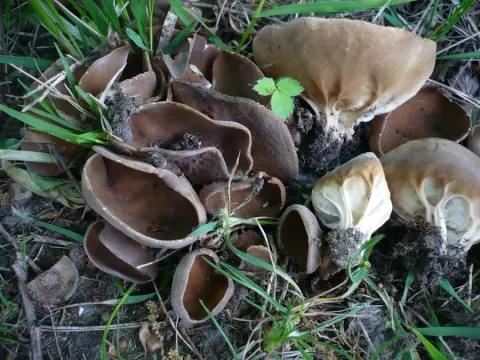
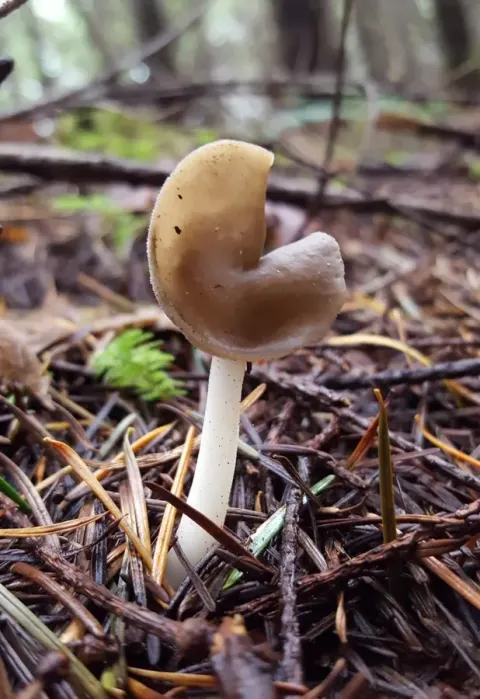
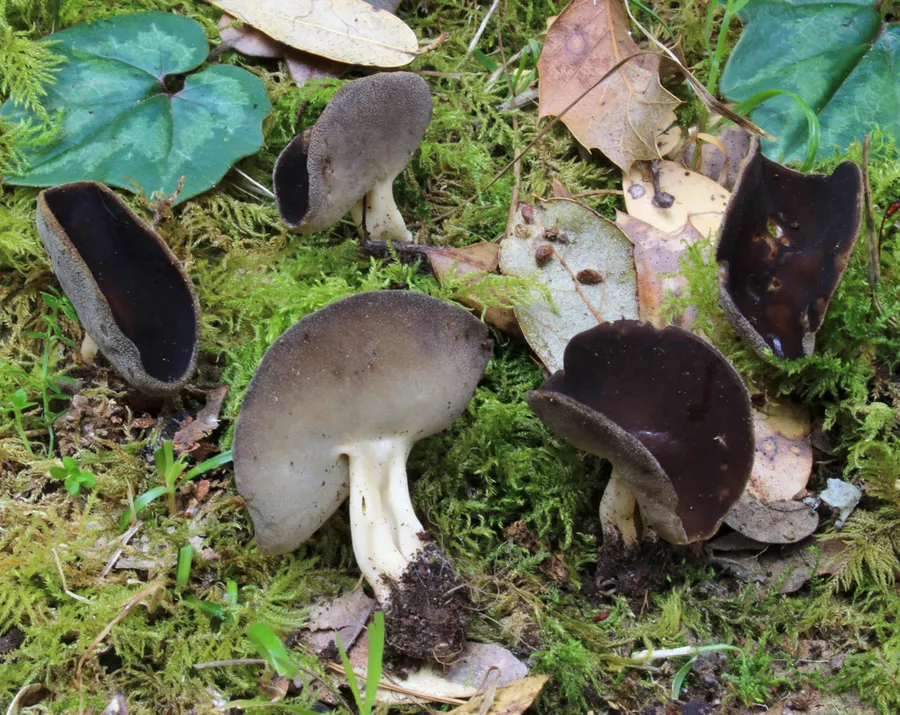
The fruiting bodies consist of a stalked, cup- to saucer-shaped apothecium that often becomes laterally compressed with age, measuring 2.5–5 cm across. The spore-bearing surface, or hymenium, is smooth and dark greyish-brown to brownish-black, contrasting subtly with the outer receptacle, which is the same colour or slightly paler and is finely downy (pubescent). Supporting the cup is a distinct, hollow stipe 1.5–6 cm tall and 0.8–2 cm thick, coloured whitish to pale grey. The stipe bears three to six blunt ribs separated by grooves that continue seamlessly onto the base of the cup, giving the entire structure a subtly ribbed appearance. Beneath the hymenium lies the medullary excipulum, a layer of densely interwoven hyphae (textura intricata) 3–7 micrometres (μm) wide, forming a firm but flexible tissue. Overlying this is the ectal excipulum, composed of angular (textura angularis) cells 25–50 × 20–40 μm in size; some of these outer cells produce fascicled tufts of three to six hyphal cells that are cylindrical to club-shaped, 10–26 × 8–14 μm. The spore-bearing asci are pleurorhynchous—arising from a hooked basal cell—and measure 270–330 × 13–15 μm, each enclosing eight spores. The ascospores are ellipsoid, contain a single oil droplet (uniguttulate), and range from 18.2–21.8 μm long by 11.4–13.2 μm wide. Interspersed among the asci are paraphyses, sterile filaments 3–4 μm wide at the base with brown-walled, granular contents, which swell to 5–8 μm at their club-shaped tips.
Habitat dan peran ekologis
Helvella solitaria has a boreal and temperate distribution. It is most often encountered in both coniferous and mixed forests, ranging from lowland woodlands to alpine zones. It typically fruits on the ground, favouring mineral-rich soils beneath shrubs such as willows and in dryas‐dominated fellfield associations, but it has also been recorded on grassy verges and even roadside substrates under trembling aspen. Fruiting bodies appear from early summer into autumn, with collections documented at elevations from near sea level up to around 2400 m. This species is widespread across Europe, with confirmed records from Iceland, Norway, Sweden, Switzerland and France, extending eastwards into the Caucasus region of Georgia and northern Russia. Beyond Europe, it has been sequenced from North America, notably in Alberta, Canada, indicating a broader Holarctic distribution.
- Habitat atau konteks temuan
- hutan
- Substrat
- tanah
- Peran atau konteks
- Belum dikategorikan pada rilis ini.
Reproduksi
The fruiting bodies consist of a stalked, cup- to saucer-shaped apothecium that often becomes laterally compressed with age, measuring 2.5–5 cm across. The spore-bearing surface, or hymenium, is smooth and dark greyish-brown to brownish-black, contrasting subtly with the outer receptacle, which is the same colour or slightly paler and is finely downy (pubescent). Supporting the cup is a distinct, hollow stipe 1.5–6 cm tall and 0.8–2 cm thick, coloured whitish to pale grey. The stipe bears three to six blunt ribs separated by grooves that continue seamlessly onto the base of the cup, giving the entire structure a subtly ribbed appearance. Beneath the hymenium lies the medullary excipulum, a layer of densely interwoven hyphae (textura intricata) 3–7 micrometres (μm) wide, forming a firm but flexible tissue.
Catatan identitas dan cakupan
- Nama diterima mengikuti Catalogue of Life Base2026-09-11; uraian mempertahankan konsep dan nama sumber aslinya.
- Original geographic, specimen and life-cycle scope retained; source import awaits individual editorial review.
- Impor dan terjemahan otomatis belum diperiksa editorial per profil. Struktur reproduktif yang disebutkan tidak membuktikan seluruh siklus hidup diketahui.
- Pengukuran pada uraian mengikuti spesimen, kultur, dan metode sumber; angka tidak diperluas ke semua populasi.
Catatan distribusi dalam narasi mengikuti sumbernya. Dokumentasi spesimen atau foto mengikuti catatan sumber. Bukti wilayah Indonesia dan penilaian konservasi tidak disimpulkan dari gambar.
Melihat dengan konteks
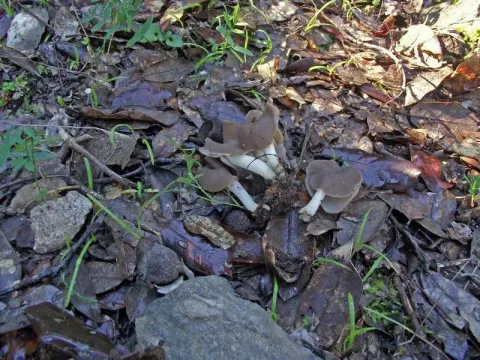
Dokumentasi Helvella solitaria menurut asosiasi foto pada record takson iNaturalist. Kredit: Davide Puddu. Identitas mengikuti sumber; bukan penentuan spesimen independen.
- Jenis
- Fotografi
- Kredit
- (c) Davide Puddu, some rights reserved (CC BY), uploaded by Davide Puddu
- Lisensi
- CC BY 4.0
- Sumber media
- Buka entri sumber
Sumber profil
- [1] Helvella solitaria — Wikipedia (en)
- [2] Catalogue of Life Base2026-09-11 — Helvella solitaria
- [3] Dokumentasi visual — Helvella solitaria
Rujukan halaman ini
Fungi. Helvella solitaria. Rilis data fungi-2026-10-12-expansion-2. https://fungi-atlas.mgadib.chatgpt.site/jamur/helvella-solitaria/.
Status: impor sumber; pemeriksaan editorial per profil belum selesai. Untuk klaim biologis, gunakan rujukan pada bagian terkait dan periksa konteks sumber aslinya.