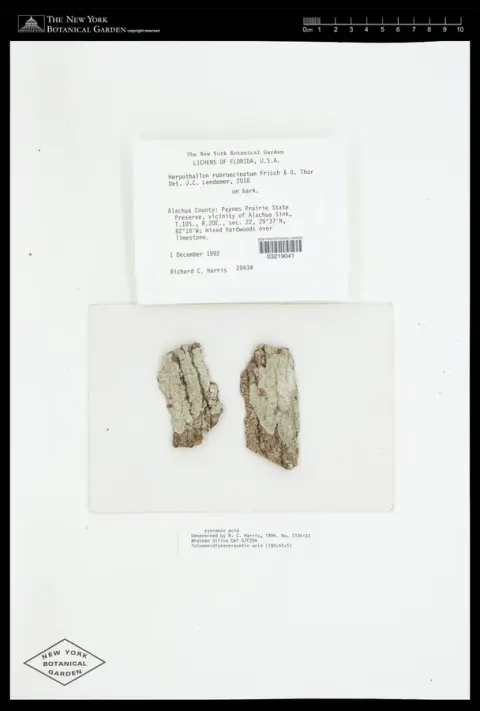
Ciri dan struktur
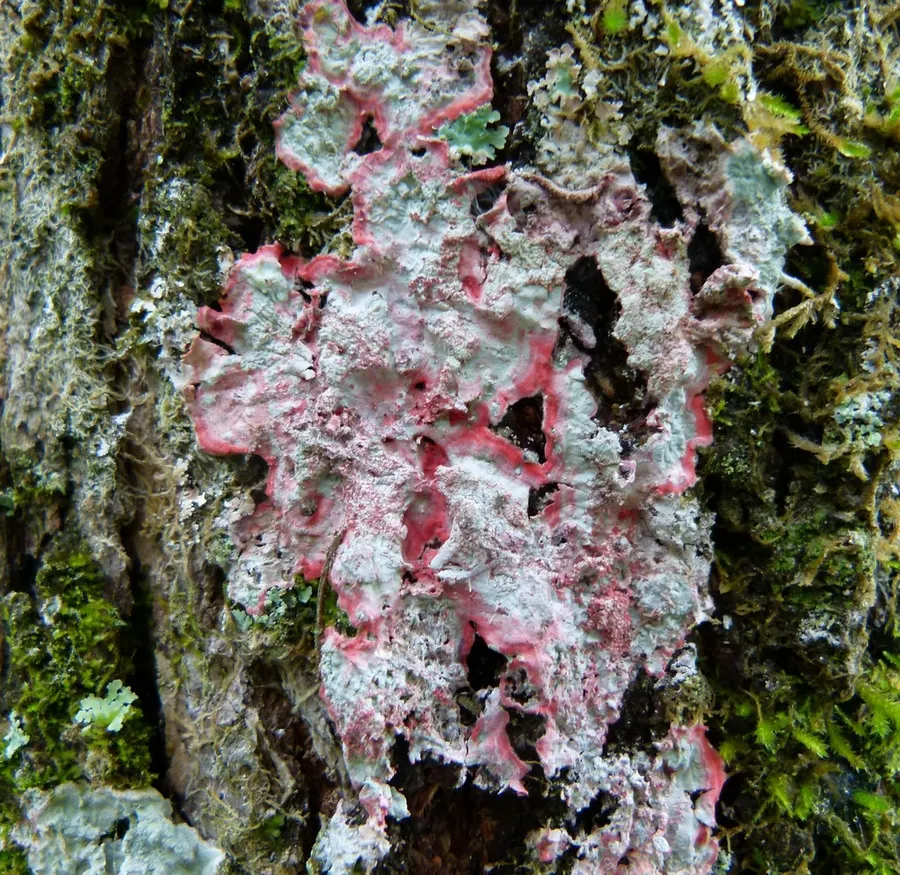
Cryptothecia rubrocincta is a crustose lichen, because it grows in the form of a surface crust. The thallus, or body of the lichen is spread out flat and can be either tightly to loosely attached to the growing surface. It is 0.15–0.30 mm thick, and can be smooth, or have low radiating ridges. The older, central region of the lichen surface has many reproductive structures called isidia; they resemble granules that are 0.1–0.4 by 0.1 mm. The species relies entirely on vegetative means to reproduce, and is not known to have any sexual structures. From the center outwards, three color zones can be differentiated in mature specimens; the first grayish-green, the second white, and finally a bright red cottony rim. The lichen has a distinct prothallus—fibers of whitish fungal hyphae at the edge that lack photobiont, and which project beyond the thallus onto the growing surface. The prothallus is red to whitish in the inner part, red the in outer part. The surface of the thallus does not have a well-defined cortex, an outer layer of well-packed hyphae. The medulla (a loosely arranged layer of hyphae below the cortex and photobiont zone) is whitish but the lower part is red. It has few to many calcium oxalate crystals that are 3–8 μm diameter. The hyphae of the medulla have many such crystals on the walls, that are 1–2 μm in diameter. The algal photobiont (technically a phycobiont, as it is a green algal photosynthetic partner) is from the genus Trentepohlia. Normally, the algae is long and filamentous; when in the lichen state, it is divided into shorter filaments. The alga has a large chloroplast that contains droplets of beta-carotene.
Habitat dan peran ekologis
Lichen ini tersebar luas di Amerika Serikat tenggara; di 1954 batas utara distribusi diberikan sebagai garis melewati Louisiana selatan, Mississippi, Alabama and Georgia. Although the batas utara diperpanjang ke selatan Delaware, penulis kemudian merevisi pendapatnya, dan batas utara dianggap sebagai North Carolina. Di Carolina Utara, ditemukan di Pulau Smith, lokasi yang menonjol karena mewakili batas utara distribusi kelapa palmetto (Sabal palmetto). Kehadiran pohon 6 meter (20 kaki ini yang berjarak antara spesies pohon dominan Quercus virginiana memberikan pulau ini penampilan subtropis ⁇ bersesuaian dengan iklim yang disukai lichen. Cryptothecia rubrocincta juga tersebar luas di daerah tropis dan subtropis di Amerika Selatan Barat Indies and Central and. Di Selatan America it ditemukan di utara Chile and Argentina. Hal ini lebih jarang terjadi di Afrika, karena hanya dikumpulkan dari tiga wilayah pegunungan yang secara geografis terpisah secara luas: São Tomé dan Príncipe, Tanzania, dan DR Kongo. Lilin dapat ditemukan di ketinggian mulai dari permukaan laut sampai 2600 m (di Kolombia). Lilin biasanya tumbuh di kulit kasar di habitat yang terlindung dan berbayar di hutan subtropis yang lembab dan padat.
- Habitat atau konteks temuan
- hutan
- Substrat
- Informasi belum tersedia pada sumber rilis ini.
- Peran atau konteks
- Pembentuk liken
Reproduksi
Cryptothecia rubrocincta is a crustose lichen, because it grows in the form of a surface crust. The thallus, or body of the lichen is spread out flat and can be either tightly to loosely attached to the growing surface. It is 0.15–0.30 mm thick, and can be smooth, or have low radiating ridges. The older, central region of the lichen surface has many reproductive structures called isidia; they resemble granules that are 0.1–0.4 by 0.1 mm. The species relies entirely on vegetative means to reproduce, and is not known to have any sexual structures. From the center outwards, three color zones can be differentiated in mature specimens; the first grayish-green, the second white, and finally a bright red cottony rim.
Catatan identitas dan cakupan
- Nama diterima mengikuti Catalogue of Life Base2026-09-11; uraian mempertahankan konsep dan nama sumber aslinya.
- Original geographic, specimen and life-cycle scope retained; source import awaits individual editorial review.
- Impor dan terjemahan otomatis belum diperiksa editorial per profil. Struktur reproduktif yang disebutkan tidak membuktikan seluruh siklus hidup diketahui.
- Pengukuran pada uraian mengikuti spesimen, kultur, dan metode sumber; angka tidak diperluas ke semua populasi.
Catatan distribusi dalam narasi mengikuti sumbernya. Dokumentasi spesimen atau foto mengikuti catatan sumber. Bukti wilayah Indonesia dan penilaian konservasi tidak disimpulkan dari gambar.
Melihat dengan konteks
Dokumentasi Herpothallon rubrocinctum menurut asosiasi foto pada record takson iNaturalist. Kredit: botanygirl. Identitas mengikuti sumber; bukan penentuan spesimen independen.
- Jenis
- Fotografi
- Kredit
- (c) botanygirl, some rights reserved (CC BY), uploaded by botanygirl
- Lisensi
- CC BY 4.0
- Sumber media
- Buka entri sumber
Dokumentasi tambahan
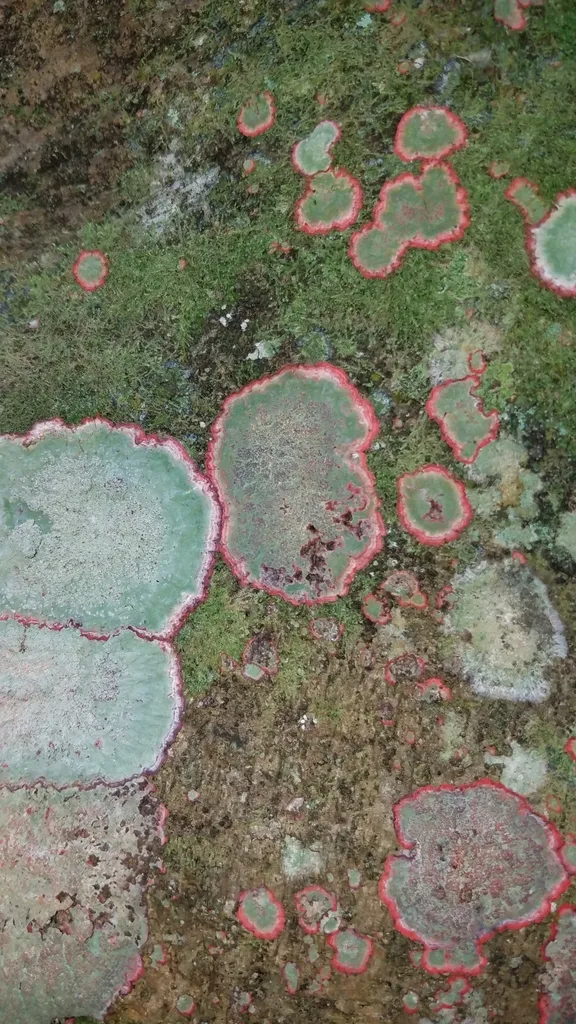
Foto yang diasosiasikan dengan Herpothallon rubrocinctum pada iNaturalist. Identifikasi mengikuti sumber; bukan penentuan spesimen independen.
Kredit dan penggunaan
(c) Alan Rockefeller, some rights reserved (CC BY), uploaded by Alan Rockefeller
Ukuran dan format gambar disesuaikan tanpa pemotongan, retus, atau penambahan skala. Lisensi sumber dipertahankan.
Sumber profil
- [1] Cryptothecia rubrocincta — Wikipedia (en)
- [2] Catalogue of Life Base2026-09-11 — Herpothallon rubrocinctum
- [3] Dokumentasi visual — Herpothallon rubrocinctum
- [4] Dokumentasi visual — Herpothallon rubrocinctum
Rujukan halaman ini
Fungi. Herpothallon rubrocinctum. Rilis data fungi-2026-10-12-expansion-2. https://fungi-atlas.mgadib.chatgpt.site/jamur/herpothallon-rubrocinctum/.
Status: impor sumber; pemeriksaan editorial per profil belum selesai. Untuk klaim biologis, gunakan rujukan pada bagian terkait dan periksa konteks sumber aslinya.