Ciri dan struktur
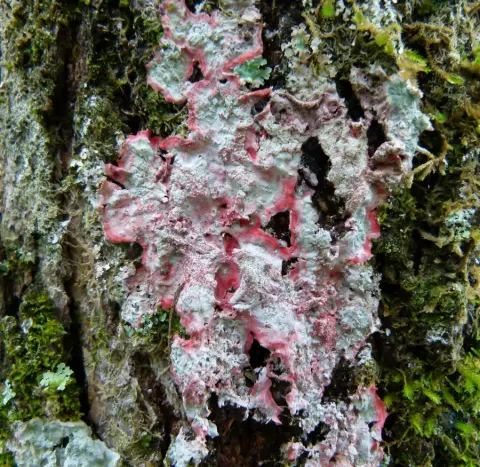
Herpothallon rubroechinatum forms a crust-like growth on tree bark (corticolous). The thallus (lichen body) is clearly defined by a distinct border of white, radiating fungal filaments (hyphae) that typically contain at least some rust-red pigmentation. The main surface of the thallus appears greyish white, becoming beige with age, and lacks a protective outer layer (). The thallus texture is cottony, in some areas appearing almost . The central part of the thallus is densely covered with slightly darker, compact reproductive structures called pseudisidia. These pseudisidia appear as if they were sprinkled with rust-red, needle-shaped pigment crystals, which is a distinctive characteristic of this species. The pseudisidia come in two forms (dimorphic): some are swollen and globular, containing a central pycnidium (structure producing asexual spores), while others develop into elongated, worm-like forms. The internal tissue (medulla) is white, containing brownish granules and sparse calcium oxalate crystals. When tested with chemical spot tests, the green-white parts of the thallus are K−, but the rust-red portions are (K+) purple. The thallus is P+ (bright yellow), C−, and KC−. It does not fluoresce under ultraviolet light (UV−), and shows no staining reaction with iodine (I−). Chemical analysis reveals the presence of psoromic acid, which gives the species its P+ (yellow) reaction.
Habitat dan peran ekologis
Herpothallon rubroechinatum has a neotropical distribution, occurring in tropical regions of the Americas. It was documented in the Galápagos Islands in 2013, representing a new record for both the archipelago and Ecuador. In the Galápagos, the few known specimens were collected in the humid zone of Santa Cruz Island, growing on both native endemic trees such as Scalesia pedunculata and introduced trees including Cinchona pubescens and Cedrela odorata. It prefers semi-shaded to shaded and sheltered habitats. The lichen is also found in Costa Rica and Peru.
- Habitat atau konteks temuan
- Informasi belum tersedia pada sumber rilis ini.
- Substrat
- Informasi belum tersedia pada sumber rilis ini.
- Peran atau konteks
- Pembentuk liken
Reproduksi
The thallus texture is cottony, in some areas appearing almost . The central part of the thallus is densely covered with slightly darker, compact reproductive structures called pseudisidia. These pseudisidia appear as if they were sprinkled with rust-red, needle-shaped pigment crystals, which is a distinctive characteristic of this species. The pseudisidia come in two forms (dimorphic): some are swollen and globular, containing a central pycnidium (structure producing asexual spores), while others develop into elongated, worm-like forms. The internal tissue (medulla) is white, containing brownish granules and sparse calcium oxalate crystals.
Catatan identitas dan cakupan
- Nama diterima mengikuti Catalogue of Life Base2026-09-11; uraian mempertahankan konsep dan nama sumber aslinya.
- Original geographic, specimen and life-cycle scope retained; source import awaits individual editorial review.
- Impor dan terjemahan otomatis belum diperiksa editorial per profil. Struktur reproduktif yang disebutkan tidak membuktikan seluruh siklus hidup diketahui.
- Pengukuran pada uraian mengikuti spesimen, kultur, dan metode sumber; angka tidak diperluas ke semua populasi.
Catatan distribusi dalam narasi mengikuti sumbernya. Dokumentasi spesimen atau foto mengikuti catatan sumber. Bukti wilayah Indonesia dan penilaian konservasi tidak disimpulkan dari gambar.
Melihat dengan konteks
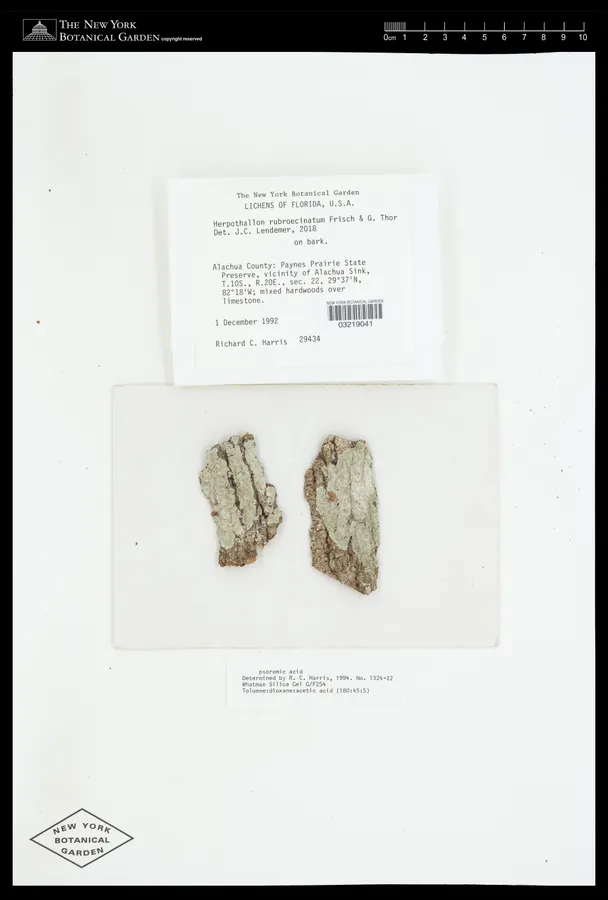
Voucher herbarium Herpothallon rubroechinatum (03219041), The New York Botanical Garden. Identifikasi mengikuti record spesimen sumber. Foto bahan, kemasan, atau label herbarium sebagaimana tersedia pada record institusi; bukan foto lapangan atau penentuan spesimen independen.
- Jenis
- Voucher herbarium
- Kredit
- The New York Botanical Garden
- Lisensi
- CC BY 4.0
- Sumber media
- Buka entri sumber
Sumber profil
- [1] Herpothallon rubroechinatum — Wikipedia (en)
- [2] Catalogue of Life Base2026-09-11 — Herpothallon rubroechinatum
- [3] Dokumentasi visual — Herpothallon rubroechinatum
Rujukan halaman ini
Fungi. Herpothallon rubroechinatum. Rilis data fungi-2026-10-12-expansion-2. https://fungi-atlas.mgadib.chatgpt.site/jamur/herpothallon-rubroechinatum/.
Status: impor sumber; pemeriksaan editorial per profil belum selesai. Untuk klaim biologis, gunakan rujukan pada bagian terkait dan periksa konteks sumber aslinya.