01 / Morfologi

Ciri dan struktur

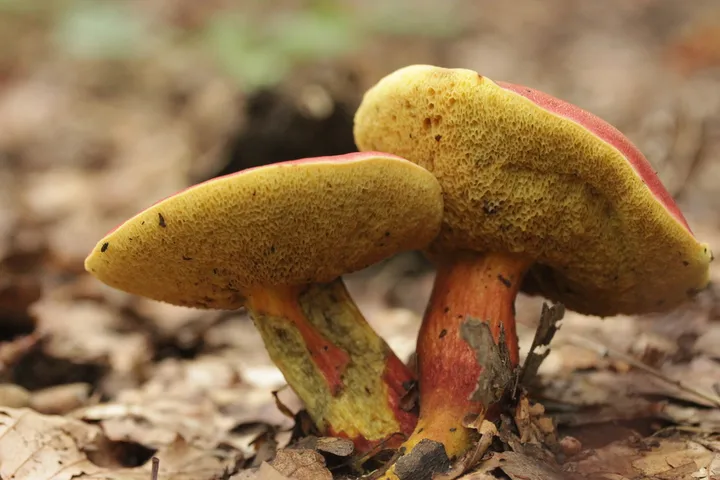
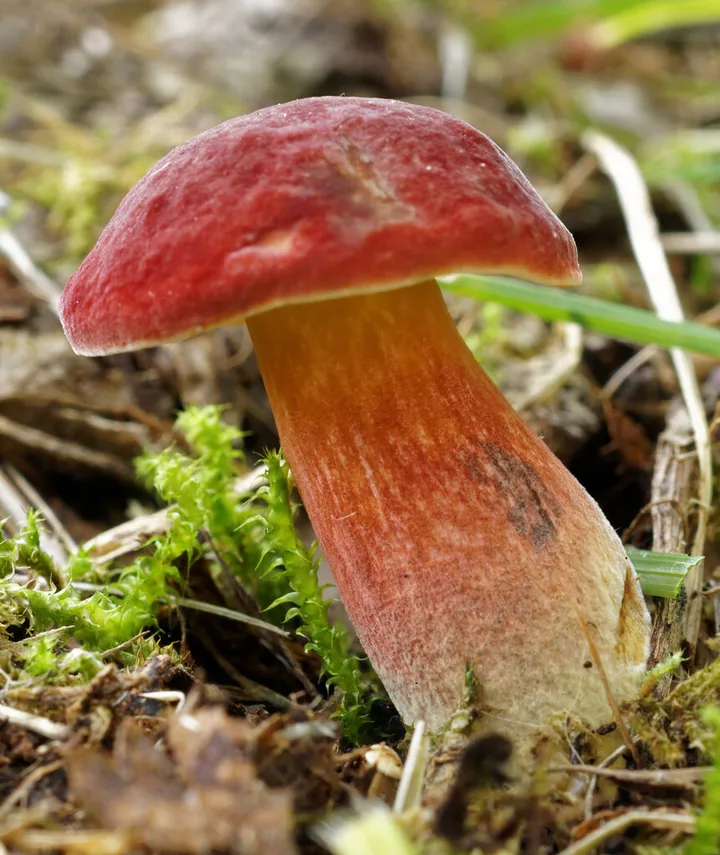
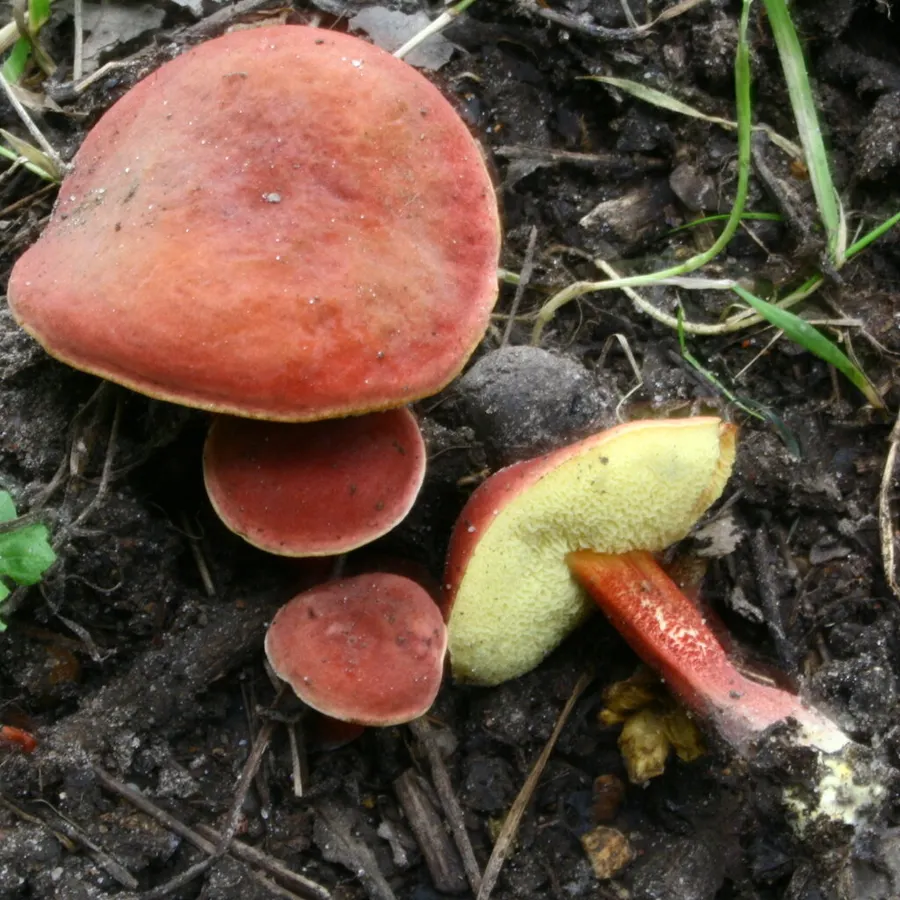
Basidiomes pileate-stipitate, xerocomoid, epigeal, small to medium-small sized. Ontogenetic development gymnocarpic. Pileus (2–)3.5–10(–15) cm broad, nearly hemispherical at first, then convex, pulvinate to applanate, also slightly depressed at centre, sometimes irregularly shaped; surface matt, dry, ± finely tomentose to sometimes rugulose, but later smooth, sometimes areolate towards the peripheral zone or with minute to coarse cracks especially in dry weather and showing a yellowish or somewhat pinkish subcuticular layer resembling some areolate Xerocomellus species; margin initially involute then extended, regular to wavy-lobed, acute and slightly exceeding the pileal context; rather variable in colours, but generally with bright red tints, initially blood red, wine red, cherry red, rose red, orange-red, pink, fading in mature basidiomes from ochraceous red, ochraceous pink to reddish-brown, with a margin at the very beginning whitish (due to a narrow band 1–2 mm broad), then gradually concolourous with age, unchanging or becoming slightly darker on handling or when injured. Tubes up to 12 mm long, at first adnate, later emarginate or slightly decurrent with a tooth, initially lemon or chrome yellow, later greenish-yellow to olive brown, slightly bluing when injured. Pores large, wider than 1 mm (up to 1.5–2 mm) in old basidiomes, roundish to angular, concolourous with the tubes, in mature basidiomes with orange-rusty tinges, weakly bluing when bruised and later becoming dirty brownish. Stipe (2–)2.5–7(–12) × 0.4–2.5(–3.5) cm, usually as long as or slightly longer than pileus diameter, central or slightly off-centre, solid, firstly versiform, clavate or somewhat bulbous, later more cylindrical or sometime inflated in the lower part, always tapering at the very base and slightly rooting; surface with fine reddish punctuations or fibrils on an ochraceous yellow background, later often with rather coarse longitudinal striations; surface usually concolourous with the pileus or paler, but yellow or pale yellow at apex; sometimes the stipe can be entirely yellow or entirely red, or a mix of both colours; basal mycelium whitish-yellow.

Sebagian uraian ditampilkan dalam bahasa sumber; terjemahannya belum tersedia atau belum lolos pemeriksaan.

Rujukan: [1]

Pengukuran mengikuti objek, spesimen atau kultur, dan metode yang disebutkan sumber. Baca uraian asli untuk konteks lengkap.

02 / Kehidupan

Habitat dan peran ekologis

Solitary, gregarious in small groups (2–3 basidiomes) or even subcaespitose, growing on bare soil, on litter or in the grass, often in anthropogenic environments, such as gardens, urban parks, lawns, meadows, disturbed roadsides, light grassy forest and planting edges, shrublands, sometimes in undisturbed forests, mostly under broadleaved trees including preferably Quercus spp. (Q. cerris, Q. coccifera, Q. faginea, Q. frainetto, Q. petraea, Q. pubescens, Q. pyrenaica, Q. robur), Castanea sativa, Fagus spp. (F. sylvatica, F. orientalis), and Tilia spp. (T. cordata, T. × europaea). Hal ini juga dikumpulkan di hutan campuran dengan kehadiran Carpinus betulus, Corylus avellana, Betula pendula, dan kadang-kadang Pinus sylvestris dan Salix spp, tetapi tidak ada laporan di hutan monodominant yang terdiri dari spesies ini. There are some molecularly unconfirmed data (Engel et al. 1996; Ladurner and Simonini 2003; Assyov in litt.; Klofac in litt.; pers. obs.) about a possible ectomycorrhizal association of H. rubellus with Abies, Alnus, Cedrus, Picea, Populus; however, they are not confirmed in the present study. Periode berbuah utama adalah musim semi (akhir April) hingga musim gugur (November to awal Desember).

Sebagian uraian ditampilkan dalam bahasa sumber; terjemahannya belum tersedia atau belum lolos pemeriksaan.

Rujukan: [1]

Habitat atau konteks temuan
hutan
Substrat
Informasi belum tersedia pada sumber rilis ini.
Peran atau konteks
Mitra tumbuhan
Temukan hubungan serupa
03 / Siklus hidup

Reproduksi

Basidiomes pileate-stipitate, xerocomoid, epigeal, small to medium-small sized. Ontogenetic development gymnocarpic. Pileus (2–)3.5–10(–15) cm broad, nearly hemispherical at first, then convex, pulvinate to applanate, also slightly depressed at centre, sometimes irregularly shaped; surface matt, dry, ± finely tomentose to sometimes rugulose, but later smooth, sometimes areolate towards the peripheral zone or with minute to coarse cracks especially in dry weather and showing a yellowish or somewhat pinkish subcuticular layer resembling some areolate Xerocomellus species; margin initially involute then extended, regular to wavy-lobed, acute and slightly exceeding the pileal context; rather variable in colours, but generally with bright red tints, initially blood red, wine red, cherry red, rose red, orange-red, pink, fading in mature basidiomes from ochraceous red, ochraceous pink to reddish-brown, with a margin at the very beginning whitish (due to a narrow band 1–2 mm broad), then gradually concolourous with age, unchanging or becoming slightly darker on handling or when injured.

Sebagian uraian ditampilkan dalam bahasa sumber; terjemahannya belum tersedia atau belum lolos pemeriksaan.

Rujukan: [1]

Sinonim menurut acuan taksonomi rilis: Boletus caribaeus; Boletus caribaeus var. crassotunicatus; Boletus chrysenteron var. versicolor; Boletus fraternus; Boletus rubellus; Boletus rubellus f. crassotunicatus; Boletus rubellus f. serotinus; Boletus rubellus f. subdumetorum; Boletus rubellus subsp. bicoloroides; Boletus rubellus subsp. borneensis; Boletus rubellus subsp. caribaeus; Boletus rubellus subsp. consobrinus; Boletus rubellus subsp. dumetorum; Boletus rubellus subsp. fraternus; Boletus rubellus subsp. purpureus; Boletus rubellus var. flammeus; Boletus rubeus; Boletus subtomentosus var. rubellus; Leucobolites rubellus; Suillus rubellus; Suillus rubeus; Suillus sanguineus; Suillus versicolor; Tubiporus rubellus; Versipellis pruinata var. versicolor; Viscipellis sanguinea; Xerocomellus rubellus; Xerocomus versicolor
04 / Batas informasi

Catatan identitas dan cakupan

  • Nama diterima mengikuti Catalogue of Life Base2026-09-11; uraian mempertahankan konsep dan nama sumber aslinya.
  • Preserve original treatment localities, hosts and substrate scope. Materials examined describe documented specimens, not the full global range.
  • Impor dan terjemahan otomatis belum diperiksa editorial per profil. Struktur reproduktif yang disebutkan tidak membuktikan seluruh siklus hidup diketahui.
  • Pengukuran pada uraian mengikuti spesimen, kultur, dan metode sumber; angka tidak diperluas ke semua populasi.

Catatan distribusi dalam narasi mengikuti sumbernya. Dokumentasi spesimen atau foto mengikuti catatan sumber. Bukti wilayah Indonesia dan penilaian konservasi tidak disimpulkan dari gambar.

05 / Dokumentasi

Melihat dengan konteks

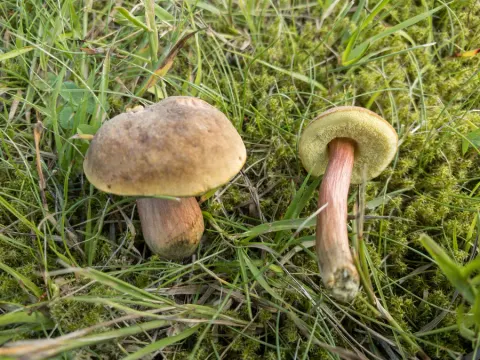
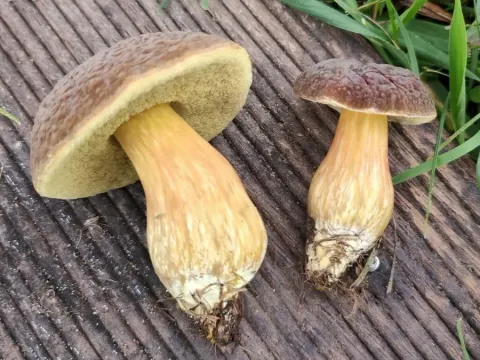
Dokumentasi Hortiboletus rubellus menurut asosiasi foto pada record takson iNaturalist. Kredit: Strobilomyces. Identitas mengikuti sumber; bukan penentuan spesimen independen.

Jenis
Fotografi
Kredit
(c) Strobilomyces, some rights reserved (CC BY-SA)
Sumber media
Buka entri sumber

Gambar menunjukkan objek menurut identifikasi sumber, bukan verifikasi independen spesimen oleh Fungi. Tidak ada skala baru yang ditambahkan.

Dokumentasi tambahan

06 / Rujukan

Sumber profil

  1. [1] Morphological and molecular re-assessment of European and Levantine species of the genus Hortiboletus (Boletaceae) — Hortiboletus rubellusBagian sumber: PMC12179652_section_16
    Tanggal penghimpunan sumber: 2026-10-12
    Teks sumber: CC BY 4.0 · Biketova, Alona Yu. & Svetasheva, Tatyana Yu.
  2. [2] Catalogue of Life Base2026-09-11 — Hortiboletus rubellusBagian sumber: ColDP NameUsage.tsv ID 3MQH3; accepted species; source 2073
    Tanggal penghimpunan sumber: 2026-10-12
  3. [3] Dokumentasi visual — Hortiboletus rubellusBagian sumber: Identitas mengikuti sumber dokumentasi; bukan penentuan spesimen independen.
    Tanggal penghimpunan sumber: 2026-10-17
    Media sumber: CC BY-SA 4.0 · (c) Strobilomyces, some rights reserved (CC BY-SA)
  4. [4] Dokumentasi visual — Hortiboletus rubellusBagian sumber: Identitas mengikuti sumber dokumentasi; bukan penentuan spesimen independen.
    Tanggal penghimpunan sumber: 2026-10-17
    Teks sumber: CC BY-SA 4.0 · (c) Björn S., some rights reserved (CC BY-SA)
  5. [5] Dokumentasi visual — Hortiboletus rubellusBagian sumber: Identitas mengikuti sumber dokumentasi; bukan penentuan spesimen independen.
    Tanggal penghimpunan sumber: 2026-10-17
    Teks sumber: CC BY-SA 4.0 · (c) Lukas, some rights reserved (CC BY-SA)

Adaptasi teks: CC BY 4.0. Biketova, Alona Yu. & Svetasheva, Tatyana Yu. — Morphological and molecular re-assessment of European and Levantine species of the genus Hortiboletus (Boletaceae) — Hortiboletus rubellus

Uraian asli dan riwayat sumber

Riwayat atau halaman sumber

Ringkasan sumber

Basidiomes pileate-stipitate, xerocomoid, epigeal, small to medium-small sized. Ontogenetic development gymnocarpic. Pileus (2–)3.5–10(–15) cm broad, nearly hemispherical at first, then convex, pulvinate to applanate, also slightly depressed at centre, sometimes irregularly shaped; surface matt, dry, ± finely tomentose to sometimes rugulose, but later smooth, sometimes areolate towards the peripheral zone or with minute to coarse cracks especially in dry weather and showing a yellowish or somewhat pinkish subcuticular layer resembling some areolate Xerocomellus species; margin initially involute then extended, regular to wavy-lobed, acute and slightly exceeding the pileal context; rather variable in colours, but generally with bright red tints, initially blood red, wine red, cherry red, rose red, orange-red, pink, fading in mature basidiomes from ochraceous red, ochraceous pink to reddish-brown, with a margin at the very beginning whitish (due to a narrow band 1–2 mm broad), then gradually concolourous with age, unchanging or becoming slightly darker on handling or when injured.

Revisi sumber

Morfologi sumber

Basidiomes pileate-stipitate, xerocomoid, epigeal, small to medium-small sized. Ontogenetic development gymnocarpic. Pileus (2–)3.5–10(–15) cm broad, nearly hemispherical at first, then convex, pulvinate to applanate, also slightly depressed at centre, sometimes irregularly shaped; surface matt, dry, ± finely tomentose to sometimes rugulose, but later smooth, sometimes areolate towards the peripheral zone or with minute to coarse cracks especially in dry weather and showing a yellowish or somewhat pinkish subcuticular layer resembling some areolate Xerocomellus species; margin initially involute then extended, regular to wavy-lobed, acute and slightly exceeding the pileal context; rather variable in colours, but generally with bright red tints, initially blood red, wine red, cherry red, rose red, orange-red, pink, fading in mature basidiomes from ochraceous red, ochraceous pink to reddish-brown, with a margin at the very beginning whitish (due to a narrow band 1–2 mm broad), then gradually concolourous with age, unchanging or becoming slightly darker on handling or when injured. Tubes up to 12 mm long, at first adnate, later emarginate or slightly decurrent with a tooth, initially lemon or chrome yellow, later greenish-yellow to olive brown, slightly bluing when injured. Pores large, wider than 1 mm (up to 1.5–2 mm) in old basidiomes, roundish to angular, concolourous with the tubes, in mature basidiomes with orange-rusty tinges, weakly bluing when bruised and later becoming dirty brownish. Stipe (2–)2.5–7(–12) × 0.4–2.5(–3.5) cm, usually as long as or slightly longer than pileus diameter, central or slightly off-centre, solid, firstly versiform, clavate or somewhat bulbous, later more cylindrical or sometime inflated in the lower part, always tapering at the very base and slightly rooting; surface with fine reddish punctuations or fibrils on an ochraceous yellow background, later often with rather coarse longitudinal striations; surface usually concolourous with the pileus or paler, but yellow or pale yellow at apex; sometimes the stipe can be entirely yellow or entirely red, or a mix of both colours; basal mycelium whitish-yellow.

Revisi sumber

Ekologi sumber

Solitary, gregarious in small groups (2–3 basidiomes) or even subcaespitose, growing on bare soil, on litter or in the grass, often in anthropogenic environments, such as gardens, urban parks, lawns, meadows, disturbed roadsides, light grassy forest and planting edges, shrublands, sometimes in undisturbed forests, mostly under broadleaved trees including preferably Quercus spp. (Q. cerris, Q. coccifera, Q. faginea, Q. frainetto, Q. petraea, Q. pubescens, Q. pyrenaica, Q. robur), Castanea sativa, Fagus spp. (F. sylvatica, F. orientalis), and Tilia spp. (T. cordata, T. × europaea). It was also collected in mixed forest with the presence of Carpinus betulus, Corylus avellana, Betula pendula, and sometimes Pinus sylvestris and Salix spp., but there are no reports in monodominant forests consisting of these species. There are some molecularly unconfirmed data (Engel et al. 1996; Ladurner and Simonini 2003; Assyov in litt.; Klofac in litt.; pers. obs.) about a possible ectomycorrhizal association of H. rubellus with Abies, Alnus, Cedrus, Picea, Populus; however, they are not confirmed in the present study. The main fruiting period is spring (late April) to autumn (November to early December).

Revisi sumber

Struktur reproduksi sumber

Basidiomes pileate-stipitate, xerocomoid, epigeal, small to medium-small sized. Ontogenetic development gymnocarpic. Pileus (2–)3.5–10(–15) cm broad, nearly hemispherical at first, then convex, pulvinate to applanate, also slightly depressed at centre, sometimes irregularly shaped; surface matt, dry, ± finely tomentose to sometimes rugulose, but later smooth, sometimes areolate towards the peripheral zone or with minute to coarse cracks especially in dry weather and showing a yellowish or somewhat pinkish subcuticular layer resembling some areolate Xerocomellus species; margin initially involute then extended, regular to wavy-lobed, acute and slightly exceeding the pileal context; rather variable in colours, but generally with bright red tints, initially blood red, wine red, cherry red, rose red, orange-red, pink, fading in mature basidiomes from ochraceous red, ochraceous pink to reddish-brown, with a margin at the very beginning whitish (due to a narrow band 1–2 mm broad), then gradually concolourous with age, unchanging or becoming slightly darker on handling or when injured.

Revisi sumber

Rujukan halaman ini

Fungi. Hortiboletus rubellus. Rilis data fungi-2026-10-12-expansion-2. https://fungi-atlas.mgadib.chatgpt.site/jamur/hortiboletus-rubellus/.

Status: impor sumber; pemeriksaan editorial per profil belum selesai. Untuk klaim biologis, gunakan rujukan pada bagian terkait dan periksa konteks sumber aslinya.