01 / Morfologi

Ciri dan struktur

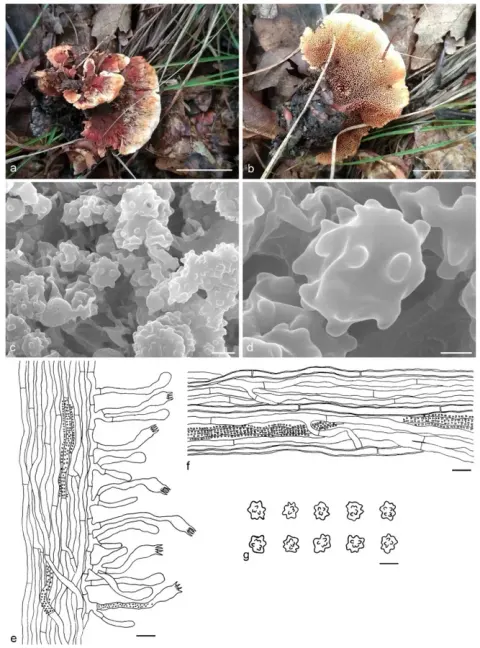
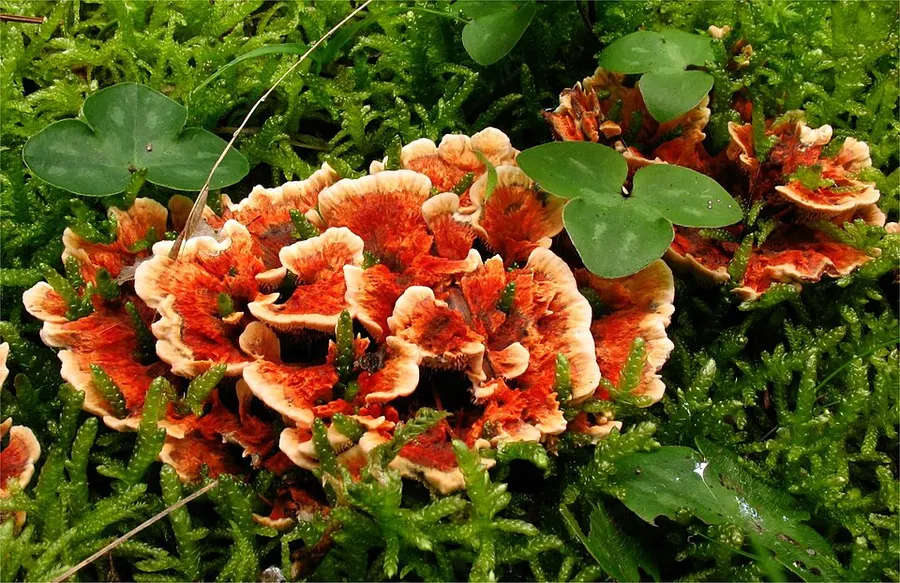
The fruit bodies of Hydnellum auratile arise on a distinct stipe and bear a cap up to 5 cm wide, occurring either singly or in crowded groups. Young caps are vivid orange to orange-brown, with a smooth to slightly scaly surface that feels velvety to the touch. As they mature, fine radial hairs develop and the centre often sinks slightly, creating a shallow, funnel-shaped profile. Concentric wrinkles may appear toward the margin, and the cap colour fades to a muted brownish tone. The flesh (context) is thin—usually no more than 2 mm thick—and mirrors the cap's colour transition from bright orange to pale brown. The stipe reaches about 4 cm in height and 1 cm in width, matching the cap in colour and covered in a similar velvety, felt-like layer of hairs. Under the microscope, the fungus is built of hyphae 2.5–7 μm wide, each separated by simple cross-walls (septa). Its spores are roughly spherical (subglobose), measuring 5–6 × 3.5–4.5 μm, and are ornamented with tiny wart-like projections (tuberculate). In mass, the spores are brown. The widespread Hydnellum aurantiacum is a close lookalike, but can be distinguished by having a white to buff cap, dull orange to brown flesh, and white spines.

Sebagian uraian ditampilkan dalam bahasa sumber; terjemahannya belum tersedia atau belum lolos pemeriksaan.

Rujukan: [1]

Pengukuran mengikuti objek, spesimen atau kultur, dan metode yang disebutkan sumber. Baca uraian asli untuk konteks lengkap.

02 / Kehidupan

Habitat dan peran ekologis

The fungus is widely spread in Europe, and has also been reported from the Pacific Northwest region of North America. It is considered endangered in Switzerland. It forms associations with both coniferous and deciduous trees. It predominantly occurs in calcareous forests, often under Scots pine (Pinus sylvestris) and Norway spruce (Picea abies) on soils derived from limestone, chalk or shell-rich substrates, forming ectomycorrhizal associations with these trees. The species has a broad—but patchy—distribution across the temperate zone of Europe, with confirmed records from France, Italy, Germany, Austria, Switzerland, the Czech Republic, Slovakia, Denmark, Sweden and Finland. Other regions outside Europe where it is known to occur include India, Japan, Australia.

Sebagian uraian ditampilkan dalam bahasa sumber; terjemahannya belum tersedia atau belum lolos pemeriksaan.

Rujukan: [1]

Habitat atau konteks temuan
hutan
Substrat
Informasi belum tersedia pada sumber rilis ini.
Peran atau konteks
Mitra tumbuhan
Temukan hubungan serupa
03 / Siklus hidup

Reproduksi

The stipe reaches about 4 cm in height and 1 cm in width, matching the cap in colour and covered in a similar velvety, felt-like layer of hairs. Under the microscope, the fungus is built of hyphae 2.5–7 μm wide, each separated by simple cross-walls (septa). Its spores are roughly spherical (subglobose), measuring 5–6 × 3.5–4.5 μm, and are ornamented with tiny wart-like projections (tuberculate). In mass, the spores are brown.

Sebagian uraian ditampilkan dalam bahasa sumber; terjemahannya belum tersedia atau belum lolos pemeriksaan.

Rujukan: [1]

Sinonim menurut acuan taksonomi rilis: Hydnum auratile
04 / Batas informasi

Catatan identitas dan cakupan

  • Nama diterima mengikuti Catalogue of Life Base2026-09-11; uraian mempertahankan konsep dan nama sumber aslinya.
  • Original geographic, specimen and life-cycle scope retained; source import awaits individual editorial review.
  • Impor dan terjemahan otomatis belum diperiksa editorial per profil. Struktur reproduktif yang disebutkan tidak membuktikan seluruh siklus hidup diketahui.
  • Pengukuran pada uraian mengikuti spesimen, kultur, dan metode sumber; angka tidak diperluas ke semua populasi.

Catatan distribusi dalam narasi mengikuti sumbernya. Dokumentasi spesimen atau foto mengikuti catatan sumber. Bukti wilayah Indonesia dan penilaian konservasi tidak disimpulkan dari gambar.

05 / Dokumentasi

Melihat dengan konteks

Dokumentasi Hydnellum auratile dari Wikimedia Commons. Fruit bodies of the tooth fungus Hydnellum auratile . Photographed in Gotland, Sweden. Identifikasi mengikuti record berkas sumber.

Jenis
Fotografi
Kredit
Irene Andersson (irenea)
Sumber media
Buka entri sumber

Gambar menunjukkan objek menurut identifikasi sumber, bukan verifikasi independen spesimen oleh Fungi. Tidak ada skala baru yang ditambahkan.

06 / Rujukan

Sumber profil

  1. [1] Hydnellum auratile — Wikipedia (en)Bagian sumber: Frozen revision 1287051738
    Tanggal penghimpunan sumber: 2026-10-12
    Teks sumber: CC BY-SA4.0 · Wikipedia contributors
  2. [2] Catalogue of Life Base2026-09-11 — Hydnellum auratileBagian sumber: ColDP NameUsage.tsv ID 3MZDK; accepted species; source 2073
    Tanggal penghimpunan sumber: 2026-10-12
  3. [3] Dokumentasi visual — Hydnellum auratileBagian sumber: Individual media record; identification follows the source, not independent determination
    Tanggal penghimpunan sumber: 2026-10-12
    Media sumber: CC BY-SA 3.0 · Irene Andersson (irenea)

Adaptasi teks: CC BY-SA 4.0. Wikipedia contributors — Hydnellum auratile — Wikipedia (en)

Uraian asli dan riwayat sumber

Riwayat atau halaman sumber

Ringkasan sumber

Hydnellum auratile is a tooth fungus in the family Bankeraceae, first described by the German mycologist Max Britzelmayr in 1891. The fungus produces distinctive orange to orange-brown fruit bodies with caps up to 5 cm wide that fade to brown with age. It forms ectomycorrhizal associations with both coniferous and deciduous trees, particularly Scots pine and Norway spruce on calcareous soils. Though widely distributed across Europe, parts of Asia, Australia, and North America's Pacific Northwest, H. auratile is considered endangered in Switzerland.

Revisi sumber

Morfologi sumber

The fruit bodies of Hydnellum auratile arise on a distinct stipe and bear a cap up to 5 cm wide, occurring either singly or in crowded groups. Young caps are vivid orange to orange-brown, with a smooth to slightly scaly surface that feels velvety to the touch. As they mature, fine radial hairs develop and the centre often sinks slightly, creating a shallow, funnel-shaped profile. Concentric wrinkles may appear toward the margin, and the cap colour fades to a muted brownish tone. The flesh (context) is thin—usually no more than 2 mm thick—and mirrors the cap's colour transition from bright orange to pale brown. The stipe reaches about 4 cm in height and 1 cm in width, matching the cap in colour and covered in a similar velvety, felt-like layer of hairs. Under the microscope, the fungus is built of hyphae 2.5–7 μm wide, each separated by simple cross-walls (septa). Its spores are roughly spherical (subglobose), measuring 5–6 × 3.5–4.5 μm, and are ornamented with tiny wart-like projections (tuberculate). In mass, the spores are brown. The widespread Hydnellum aurantiacum is a close lookalike, but can be distinguished by having a white to buff cap, dull orange to brown flesh, and white spines.

Revisi sumber

Ekologi sumber

The fungus is widely spread in Europe, and has also been reported from the Pacific Northwest region of North America. It is considered endangered in Switzerland. It forms associations with both coniferous and deciduous trees. It predominantly occurs in calcareous forests, often under Scots pine (Pinus sylvestris) and Norway spruce (Picea abies) on soils derived from limestone, chalk or shell-rich substrates, forming ectomycorrhizal associations with these trees. The species has a broad—but patchy—distribution across the temperate zone of Europe, with confirmed records from France, Italy, Germany, Austria, Switzerland, the Czech Republic, Slovakia, Denmark, Sweden and Finland. Other regions outside Europe where it is known to occur include India, Japan, Australia.

Revisi sumber

Struktur reproduksi sumber

The stipe reaches about 4 cm in height and 1 cm in width, matching the cap in colour and covered in a similar velvety, felt-like layer of hairs. Under the microscope, the fungus is built of hyphae 2.5–7 μm wide, each separated by simple cross-walls (septa). Its spores are roughly spherical (subglobose), measuring 5–6 × 3.5–4.5 μm, and are ornamented with tiny wart-like projections (tuberculate). In mass, the spores are brown.

Revisi sumber

Rujukan halaman ini

Fungi. Hydnellum auratile. Rilis data fungi-2026-10-12-expansion-2. https://fungi-atlas.mgadib.chatgpt.site/jamur/hydnellum-auratile/.

Status: impor sumber; pemeriksaan editorial per profil belum selesai. Untuk klaim biologis, gunakan rujukan pada bagian terkait dan periksa konteks sumber aslinya.