01 / Morfologi

Ciri dan struktur

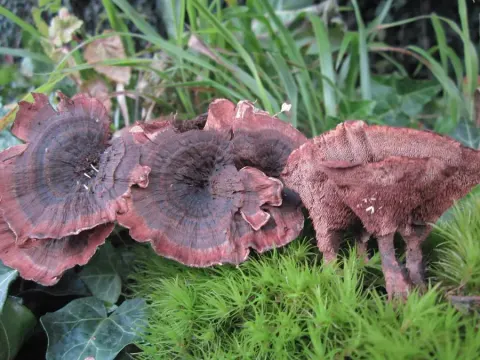
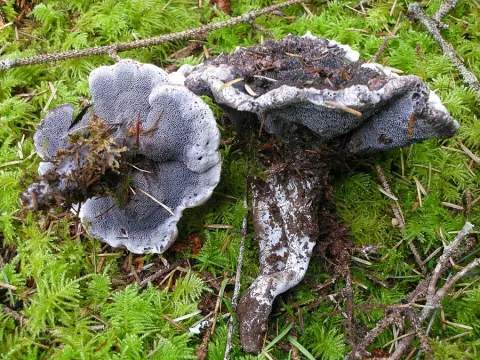
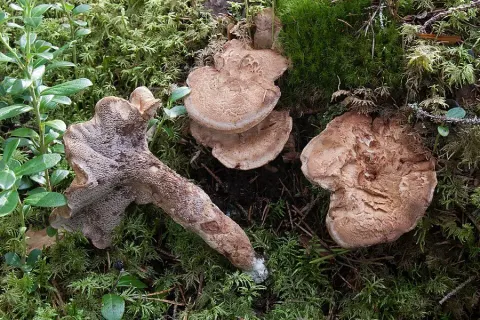
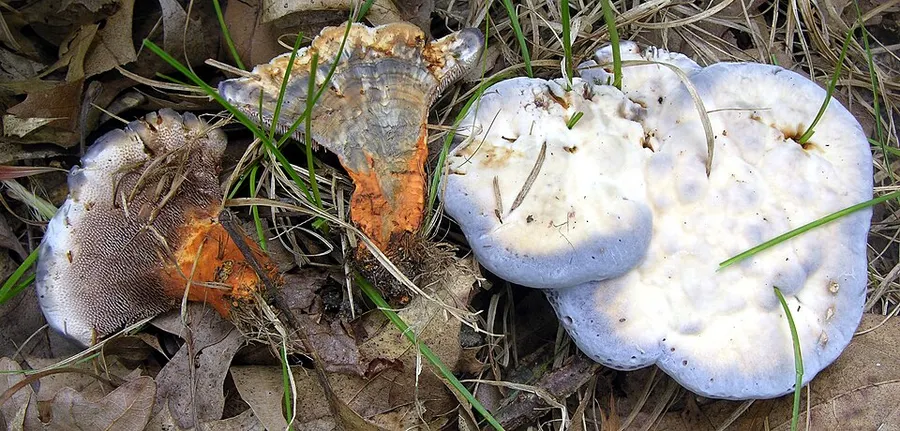
H. caeruleum belongs to a historic group of stipitate hydnoid fungi or 'stalked-tooth fungi' due to its morphological appearance with a cap, woody stipe, and distinct toothed hymenium. The fruiting body can be single or fuse with other bodies (called “confluence”) into gregarious or concrescent sporocarps. Due to this growth pattern, twigs and leaves can sometimes become engulfed into the flesh. Stipe is central and terete in shape, meaning that it is cylindrical and tapers in width. The base of the stipe is more bulbous and sometimes has an orange coloration. H. caeruleum produces brownish basidiospores which are subglobose, or not quite spherical. The basidiospores are 5–6.2 x 4.5–5.5 μm in size with tuberculate ornamentation. had a high tendency of dichotomously branched tubercles, or two tubercles that arose from the same area. The species has a monomitic hyphal system. Simple-septa generative hyphae makes up the tissues and is rarely found with clamp connections. Basidia are clavate with four sterigmata.

Sebagian uraian ditampilkan dalam bahasa sumber; terjemahannya belum tersedia atau belum lolos pemeriksaan.

Rujukan: [1]

Pengukuran mengikuti objek, spesimen atau kultur, dan metode yang disebutkan sumber. Baca uraian asli untuk konteks lengkap.

02 / Kehidupan

Habitat dan peran ekologis

Hydnellum caeruleum adalah mikoriza dan sering ditemukan di humus di bawah pohon konifer. H. caeruleum adalah jamur ektomikoriza yang berasal dari daerah temperat Asia, Eropa, dan Amerika Utara. The species is commonly found in pine and spruce ecosystems due to its mycorrhizal relationships with coniferous trees. Sebuah studi tentang jamur-jamur hidnoid stipitat di hutan Scottish coniferous, yang berfokus pada status konservasi dan distribusi jamur di habitat ini, menemukan H. caeruleum membuat hubungan yang menarik ektomikoriza. H. caeruleum membuat hubungan dengan semak heather (Arctostaphylos uva-ursi) di situs tanpa pohon, menunjukkan bahwa jamur mungkin dapat beralih inang dari pohon konifer ke spesies semak. Penelitian menunjukkan bahwa temuan ini penting untuk bidang perlindungan jamur dan pohon, karena H. caeruleum bisa bertahan hidup bahkan setelah peristiwa penggugurannya hutan dan membantu dalam akhirnya pemanenan kembali habitatnya.

Sebagian uraian ditampilkan dalam bahasa sumber; terjemahannya belum tersedia atau belum lolos pemeriksaan.

Rujukan: [1]

Habitat atau konteks temuan
hutan
Substrat
Informasi belum tersedia pada sumber rilis ini.
Peran atau konteks
Mitra tumbuhan
Temukan hubungan serupa
03 / Siklus hidup

Reproduksi

H. caeruleum belongs to a historic group of stipitate hydnoid fungi or 'stalked-tooth fungi' due to its morphological appearance with a cap, woody stipe, and distinct toothed hymenium. The fruiting body can be single or fuse with other bodies (called “confluence”) into gregarious or concrescent sporocarps. Due to this growth pattern, twigs and leaves can sometimes become engulfed into the flesh. Stipe is central and terete in shape, meaning that it is cylindrical and tapers in width. The base of the stipe is more bulbous and sometimes has an orange coloration. H. caeruleum produces brownish basidiospores which are subglobose, or not quite spherical. The basidiospores are 5–6.2 x 4.5–5.5 μm in size with tuberculate ornamentation. had a high tendency of dichotomously branched tubercles, or two tubercles that arose from the same area.

Sebagian uraian ditampilkan dalam bahasa sumber; terjemahannya belum tersedia atau belum lolos pemeriksaan.

Rujukan: [1]

Sinonim menurut acuan taksonomi rilis: Calodon caeruleus; Calodon cyaneotinctus; Hydnellum alachuanum; Hydnellum cyaneotinctum; Hydnellum inquinatum; Hydnum alachuanum; Hydnum caeruleum; Hydnum cyaneotinctum; Hydnum inquinatum; Hydnum suaveolens subsp. caeruleum; Hydnum suaveolens var. caeruleum; Phellodon caeruleus; Sarcodon alachuanus
04 / Batas informasi

Catatan identitas dan cakupan

  • Nama diterima mengikuti Catalogue of Life Base2026-09-11; uraian mempertahankan konsep dan nama sumber aslinya.
  • Original geographic, specimen and life-cycle scope retained; source import awaits individual editorial review.
  • Impor dan terjemahan otomatis belum diperiksa editorial per profil. Struktur reproduktif yang disebutkan tidak membuktikan seluruh siklus hidup diketahui.
  • Pengukuran pada uraian mengikuti spesimen, kultur, dan metode sumber; angka tidak diperluas ke semua populasi.

Catatan distribusi dalam narasi mengikuti sumbernya. Dokumentasi spesimen atau foto mengikuti catatan sumber. Bukti wilayah Indonesia dan penilaian konservasi tidak disimpulkan dari gambar.

05 / Dokumentasi

Melihat dengan konteks

Dokumentasi Hydnellum caeruleum dari Wikimedia Commons. Fruit bodies of the fungus Hydnellum caeruleum Karsten. Specimen photographed in Walking Iron Park, Dane Co. WI, USA. Identifikasi mengikuti record berkas sumber.

Jenis
Fotografi
Kredit
This image was created by user Steve Nelsen (sfnelsen) at Mushroom Observer , a source for mycological images. You can contact this user here .
Sumber media
Buka entri sumber

Gambar menunjukkan objek menurut identifikasi sumber, bukan verifikasi independen spesimen oleh Fungi. Tidak ada skala baru yang ditambahkan.

06 / Rujukan

Sumber profil

  1. [1] Hydnellum caeruleum — Wikipedia (en)Bagian sumber: Frozen revision 1372265290
    Tanggal penghimpunan sumber: 2026-10-12
    Teks sumber: CC BY-SA4.0 · Wikipedia contributors
  2. [2] Catalogue of Life Base2026-09-11 — Hydnellum caeruleumBagian sumber: ColDP NameUsage.tsv ID 3MZDL; accepted species; source 2073
    Tanggal penghimpunan sumber: 2026-10-12
  3. [3] Dokumentasi visual — Hydnellum caeruleumBagian sumber: Individual media record; identification follows the source, not independent determination
    Tanggal penghimpunan sumber: 2026-10-12
    Media sumber: CC BY-SA 3.0 · This image was created by user Steve Nelsen (sfnelsen) at Mushroom Observer , a source for mycological images. You can contact this user here .

Adaptasi teks: CC BY-SA 4.0. Wikipedia contributors — Hydnellum caeruleum — Wikipedia (en)

Uraian asli dan riwayat sumber

Riwayat atau halaman sumber

Ringkasan sumber

Hydnellum caeruleum, commonly known as the blue-gray hydnellum, blue-green hydnellum, blue spine, blue tooth, or bluish tooth, is an inedible fungus found in North America, Europe, and temperate areas of Asia. The young caps have shades of blue, gray and brown, with light blue near the margin. The stem is orange to brown. The flesh is blue to black in the cap, and red to brownish in the stem. The blue hues tend to fade with age. Hydnellum aurantiacum is very similar to mature specimens but differs in color.

Revisi sumber

Morfologi sumber

H. caeruleum belongs to a historic group of stipitate hydnoid fungi or 'stalked-tooth fungi' due to its morphological appearance with a cap, woody stipe, and distinct toothed hymenium. The fruiting body can be single or fuse with other bodies (called “confluence”) into gregarious or concrescent sporocarps. Due to this growth pattern, twigs and leaves can sometimes become engulfed into the flesh. Stipe is central and terete in shape, meaning that it is cylindrical and tapers in width. The base of the stipe is more bulbous and sometimes has an orange coloration. H. caeruleum produces brownish basidiospores which are subglobose, or not quite spherical. The basidiospores are 5–6.2 x 4.5–5.5 μm in size with tuberculate ornamentation. had a high tendency of dichotomously branched tubercles, or two tubercles that arose from the same area. The species has a monomitic hyphal system. Simple-septa generative hyphae makes up the tissues and is rarely found with clamp connections. Basidia are clavate with four sterigmata.

Revisi sumber

Ekologi sumber

Hydnellum caeruleum is mycorrhizal and often found in the humus beneath conifer trees. H. caeruleum is an ectomycorrhizal fungus native to temperate regions of Asia, Europe, and North America. The species is commonly found in pine and spruce ecosystems due to its mycorrhizal relationships with coniferous trees. A study on stipitate hydnoid fungi in Scottish coniferous forests, which focused on the conservation status and distribution of fungi in these habitats, discovered H. caeruleum making an interesting ectomycorrhizal association. H. caeruleum made an association with an heather shrub (Arctostaphylos uva-ursi) in a treeless site, indicating that the fungus may be able to switch hosts from coniferous trees to shrub species. The study suggested that this finding is important for the field of fungi and tree conservation, as H. caeruleum could survive even after a deforestation event and assist in the eventual reforestation of its habitat.

Revisi sumber

Struktur reproduksi sumber

H. caeruleum belongs to a historic group of stipitate hydnoid fungi or 'stalked-tooth fungi' due to its morphological appearance with a cap, woody stipe, and distinct toothed hymenium. The fruiting body can be single or fuse with other bodies (called “confluence”) into gregarious or concrescent sporocarps. Due to this growth pattern, twigs and leaves can sometimes become engulfed into the flesh. Stipe is central and terete in shape, meaning that it is cylindrical and tapers in width. The base of the stipe is more bulbous and sometimes has an orange coloration. H. caeruleum produces brownish basidiospores which are subglobose, or not quite spherical. The basidiospores are 5–6.2 x 4.5–5.5 μm in size with tuberculate ornamentation. had a high tendency of dichotomously branched tubercles, or two tubercles that arose from the same area.

Revisi sumber

Rujukan halaman ini

Fungi. Hydnellum caeruleum. Rilis data fungi-2026-10-12-expansion-2. https://fungi-atlas.mgadib.chatgpt.site/jamur/hydnellum-caeruleum/.

Status: impor sumber; pemeriksaan editorial per profil belum selesai. Untuk klaim biologis, gunakan rujukan pada bagian terkait dan periksa konteks sumber aslinya.