Ciri dan struktur
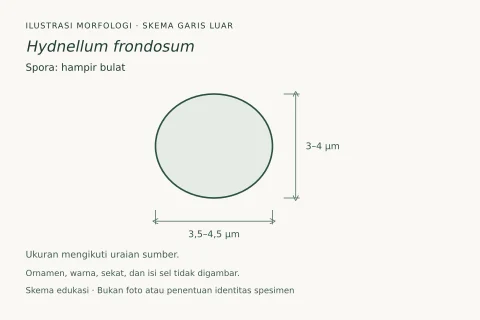
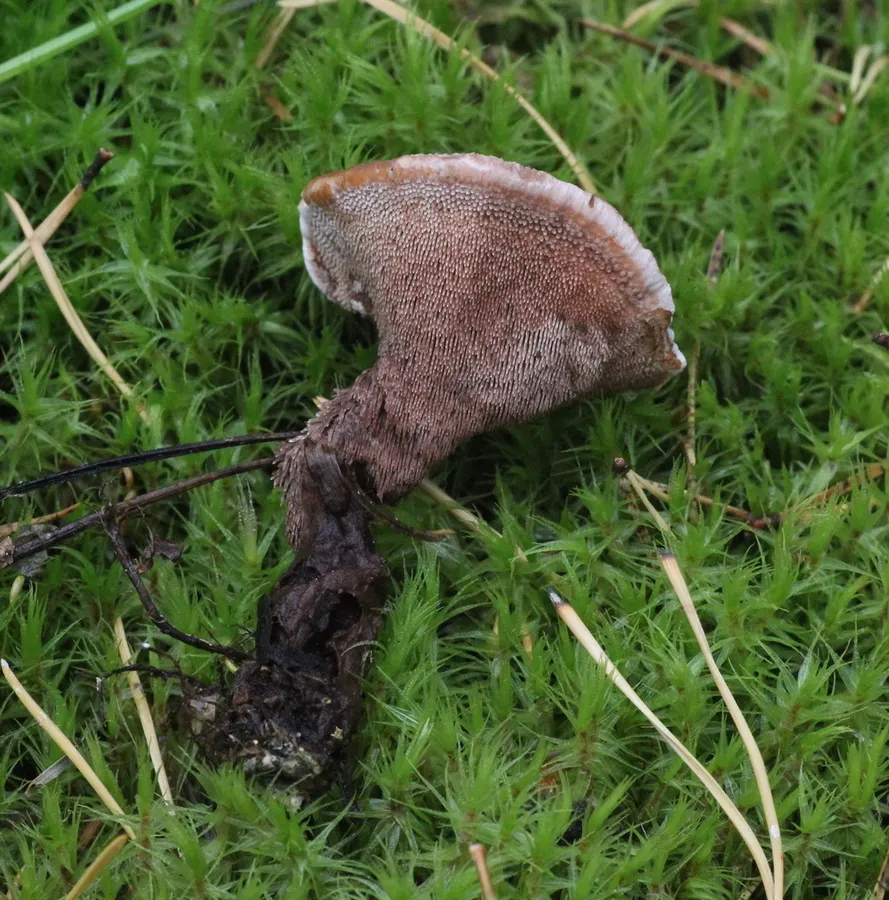
The fruit bodies of Hydnellum ferrugineum are more or less top-shaped with caps that are 3 – 10 cm in diameter. They are at first convex, then pulvinate (cushion-shaped), later flattening or becoming slightly depressed in the center. The cap surface of young fruit bodies is uneven, with a velvety to felted texture, and a whitish to pink color. It sometimes exudes blood-red drops of fluid in the depressions. The surface later becomes flesh-colored to dark reddish brown, but with wavy margin remaining whitish. The lower surface of the fruit body bears the hymenium, the fertile spore-bearing tissue. It comprises a dense arrangement of white to reddish brown spines up to 6 mm long, hanging vertically downwards. The stout stipe measures 1 – 6 cm long by 1 – 3 cm thick, and is the same color as the cap. The fungus employs an indeterminate growth pattern, in which the fruit body formation begins from a vertical column of hyphae that eventually expand at the top to form the cap. Any solid objects encountered during growth, such as grass or twigs, can be enveloped by the expanding fruit body. Similarly, closely neighboring caps can fuse together during growth. The broadly ellipsoid to roughly spherical spores are 5.5–7.5 by 4.5–5.5 μm. Their surfaces are covered with small rounded bumps. The basidia (spore-bearing cells) are narrowly club-shaped, four-spored, and measure 25–30 by 6–7.5 μm. The hyphae of the flesh are brownish with thin walls, and measure 4–6 μm; hyphae in the spines are thin-walled, septate, and sometimes branched, measuring 3.5–4.5 μm. The hyphae do not have clamp connections.
Habitat dan peran ekologis
Hydnellum ferrugineum terutama ditemukan di hutan konifer, sering di dekat pohon pinus, tetapi terkadang dengan pohon sawit. Fruit bodies memiliki preferensi untuk tanah berpasir dengan tingkat rendah bahan organik dan nutrisi, dan tumbuh secara terpisah atau dalam kelompok. They are lebih mungkin ditemukan di hutan yang tumbuh lebih tua. Jamur ini ditemukan di Amerika Utara, termasuk Meksiko. Ini tersebar luas tetapi umumnya tidak umum di seluruh Eropa, meskipun mungkin ada daerah lokal di mana ini umum. Di Inggris, H. ferrugineum sementara diklasifikasikan sebagai terancam punah, dan dilindungi di bawah Act Wildlife and Countryryide Act 1981; itu dimasukkan sebagai salah satu spesies 14 yang dianggap dalam Aksi Keanekaragaman Hayati Inggris Plan for jamur hidroid stipitat (yaitu jamur hidroid dengan topi dan stipe) di 2004. Jamur ini dilindungi di Montenegro. It has been collected in India and North Africa. Jamur membentuk karpet keras dari mycelia di humus dan tanah atas hutan pinus. Mat mycelial ini tumbuh lebih besar dengan pohon tua, dan dapat mencakup area beberapa meter persegi. Wilayah ini umumnya tidak memiliki semak kerdil dan mempromosikan pertumbuhan mus yang kuat; liken rusa sering terjadi di tengah-tengah mat besar. Kehadiran jamur mengubah sifat tanah, menghasilkan lapisan humus yang lebih tipis, penetrasi air bawah tanah yang berkurang, pH tanah yang berkurang, dan peningkatan tingkat pernapasan akar serta jumlah akar.
- Habitat atau konteks temuan
- hutan
- Substrat
- Informasi belum tersedia pada sumber rilis ini.
- Peran atau konteks
- Belum dikategorikan pada rilis ini.
Reproduksi
The fruit bodies of Hydnellum ferrugineum are more or less top-shaped with caps that are 3 – 10 cm in diameter. They are at first convex, then pulvinate (cushion-shaped), later flattening or becoming slightly depressed in the center. The cap surface of young fruit bodies is uneven, with a velvety to felted texture, and a whitish to pink color. It sometimes exudes blood-red drops of fluid in the depressions. The surface later becomes flesh-colored to dark reddish brown, but with wavy margin remaining whitish. The lower surface of the fruit body bears the hymenium, the fertile spore-bearing tissue. It comprises a dense arrangement of white to reddish brown spines up to 6 mm long, hanging vertically downwards.
Catatan identitas dan cakupan
- Nama diterima mengikuti Catalogue of Life Base2026-09-11; uraian mempertahankan konsep dan nama sumber aslinya.
- Original geographic, specimen and life-cycle scope retained; source import awaits individual editorial review.
- Impor dan terjemahan otomatis belum diperiksa editorial per profil. Struktur reproduktif yang disebutkan tidak membuktikan seluruh siklus hidup diketahui.
- Pengukuran pada uraian mengikuti spesimen, kultur, dan metode sumber; angka tidak diperluas ke semua populasi.
Catatan distribusi dalam narasi mengikuti sumbernya. Dokumentasi spesimen atau foto mengikuti catatan sumber. Bukti wilayah Indonesia dan penilaian konservasi tidak disimpulkan dari gambar.
Melihat dengan konteks
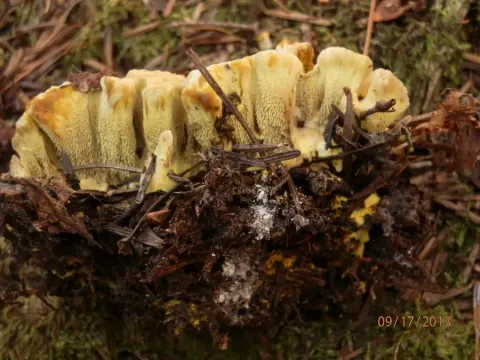
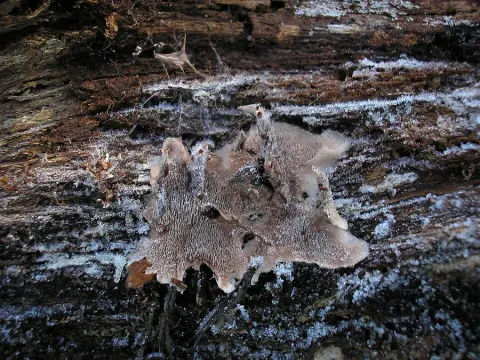
Dokumentasi Hydnellum ferrugineum menurut asosiasi foto pada record takson iNaturalist. Kredit: Nina Filippova. Identitas mengikuti sumber; bukan penentuan spesimen independen.
- Jenis
- Fotografi
- Kredit
- (c) Nina Filippova, some rights reserved (CC BY), uploaded by Nina Filippova
- Lisensi
- CC BY 4.0
- Sumber media
- Buka entri sumber
Sumber profil
- [1] Hydnellum ferrugineum — Wikipedia (en)
- [2] Catalogue of Life Base2026-09-11 — Hydnellum ferrugineum
- [3] Dokumentasi visual — Hydnellum ferrugineum
Rujukan halaman ini
Fungi. Hydnellum ferrugineum. Rilis data fungi-2026-10-12-expansion-2. https://fungi-atlas.mgadib.chatgpt.site/jamur/hydnellum-ferrugineum/.
Status: impor sumber; pemeriksaan editorial per profil belum selesai. Untuk klaim biologis, gunakan rujukan pada bagian terkait dan periksa konteks sumber aslinya.