Ciri dan struktur
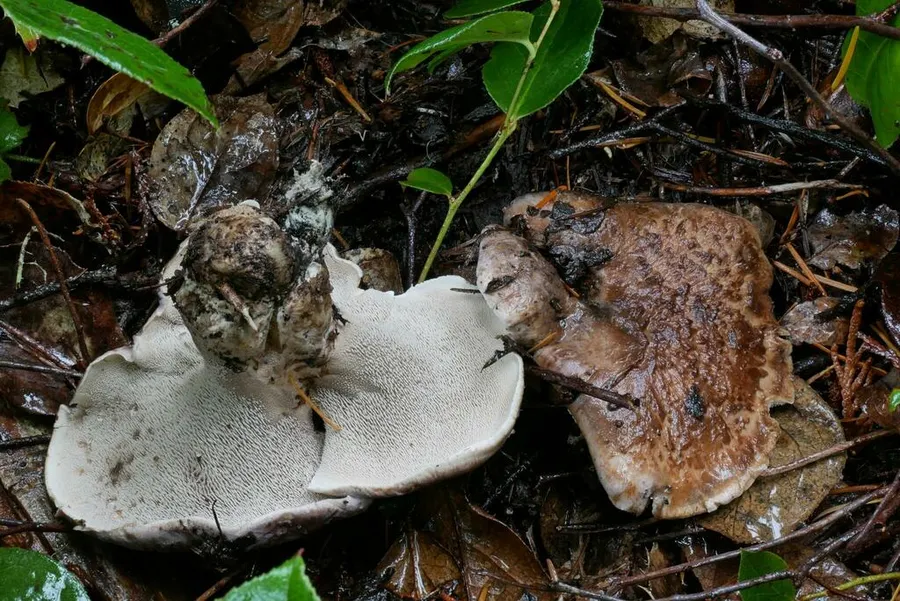
Hydnellum illudens produces stalked fruit bodies (basidiocarps) with caps (pilei) up to 7 cm across. Young caps are evenly velutinate—that is, covered in a fine, velvet‑like down—but as they mature the surface breaks into flat‑lying scales whose tips stand proud. Initial cap colour is pinkish‑violet, darkening through blackish tones to deep brown with age. Beneath the cap, the hymenophore (the fertile, spore-bearing surface) consists of slender, downward‑pointing spines (or "teeth") up to 5 mm long. These begin white and soon darken to purplish‑brown. The flesh (context) is uniformly white. The stipe measures up to 5 cm in height and 1.5 cm in thickness. It is initially minutely tomentose—clothed in fine hairs—but becomes smooth (glabrous) over time, retaining occasional fibre‑like threads (fibrils). Its colour mirrors the cap, starting brownish‑white and turning deep brown at maturity. Under the microscope, the vegetative hyphae are simple‑septate (divided by single cross‑walls), typically 2–6 micrometre (μm) wide but reaching up to 22 μm in the cap tissue. The basidiospores are elliptic, coarsely tuberculate (bearing wart‑like projections), and measure 6.3–7 by 3.6–4.5 μm when mature.
Habitat dan peran ekologis
Hydnellum illudens occurs throughout central Europe, with its northern range extending to central Norway. It forms ectomycorrhizal associations with hardwood trees.
- Habitat atau konteks temuan
- Informasi belum tersedia pada sumber rilis ini.
- Substrat
- Informasi belum tersedia pada sumber rilis ini.
- Peran atau konteks
- Mitra tumbuhan
Reproduksi
Hydnellum illudens produces stalked fruit bodies (basidiocarps) with caps (pilei) up to 7 cm across. Young caps are evenly velutinate—that is, covered in a fine, velvet‑like down—but as they mature the surface breaks into flat‑lying scales whose tips stand proud. Initial cap colour is pinkish‑violet, darkening through blackish tones to deep brown with age. Beneath the cap, the hymenophore (the fertile, spore-bearing surface) consists of slender, downward‑pointing spines (or "teeth") up to 5 mm long. These begin white and soon darken to purplish‑brown. The flesh (context) is uniformly white. Under the microscope, the vegetative hyphae are simple‑septate (divided by single cross‑walls), typically 2–6 micrometre (μm) wide but reaching up to 22 μm in the cap tissue.
Catatan identitas dan cakupan
- Nama diterima mengikuti Catalogue of Life Base2026-09-11; uraian mempertahankan konsep dan nama sumber aslinya.
- Original geographic, specimen and life-cycle scope retained; source import awaits individual editorial review.
- Impor dan terjemahan otomatis belum diperiksa editorial per profil. Struktur reproduktif yang disebutkan tidak membuktikan seluruh siklus hidup diketahui.
- Pengukuran pada uraian mengikuti spesimen, kultur, dan metode sumber; angka tidak diperluas ke semua populasi.
Catatan distribusi dalam narasi mengikuti sumbernya. Dokumentasi spesimen atau foto mengikuti catatan sumber. Bukti wilayah Indonesia dan penilaian konservasi tidak disimpulkan dari gambar.
Melihat dengan konteks
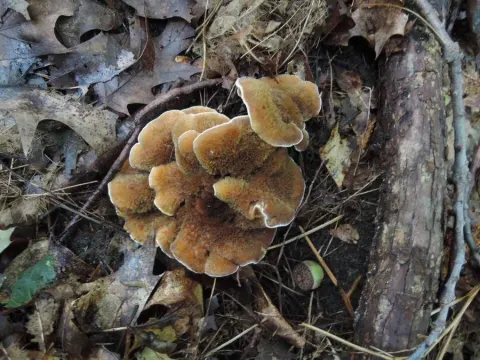
Dokumentasi Hydnellum illudens menurut asosiasi foto pada record takson iNaturalist. Kredit: Garrett Taylor. Identitas mengikuti sumber; bukan penentuan spesimen independen.
- Jenis
- Fotografi
- Kredit
- no rights reserved, uploaded by Garrett Taylor
- Lisensi
- CC0 1.0
- Sumber media
- Buka entri sumber
Sumber profil
- [1] Hydnellum illudens — Wikipedia (en)
- [2] Catalogue of Life Base2026-09-11 — Hydnellum illudens
- [3] Dokumentasi visual — Hydnellum illudens
Rujukan halaman ini
Fungi. Hydnellum illudens. Rilis data fungi-2026-10-12-expansion-2. https://fungi-atlas.mgadib.chatgpt.site/jamur/hydnellum-illudens/.
Status: impor sumber; pemeriksaan editorial per profil belum selesai. Untuk klaim biologis, gunakan rujukan pada bagian terkait dan periksa konteks sumber aslinya.