Ciri dan struktur
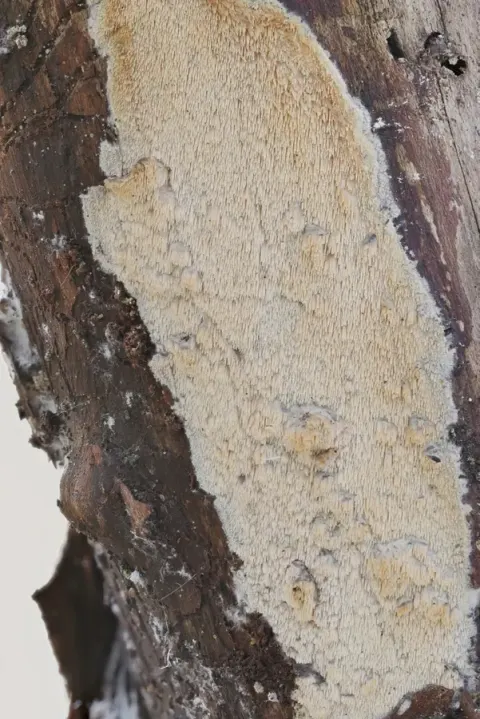
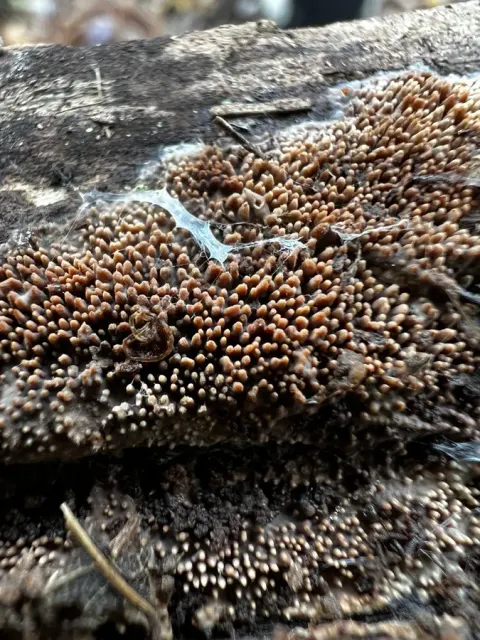
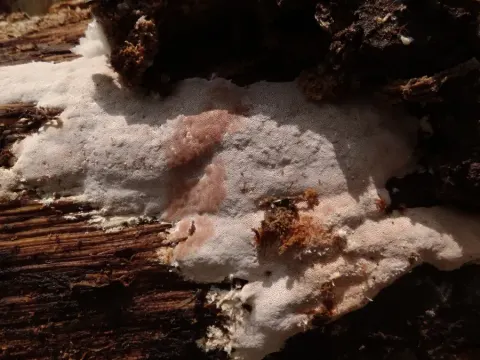
Basidiocarps annual, effused, adnate, ceraceous, somewhat brittle, 50–200 μm thick in section (aculei excluded). Hymenial surface initially buff, with age turning ochraceous to pale brown, no colour changes in KOH, tuberculate to grandinioid when young, becoming odontioid to hydnoid with age, extensively cracked; margin paler to whitish, fairly determinate. Aculei conical to cylindrical, usually separate, with obtuse to acute apex, 1–4 per mm, up to 100–700 × 100–250 μm. Hyphal system basically monomitic, some specimens with quasi-binding hyphae near substratum; generative hyphae simple-septate. Subiculum fairly uniform, composed of a basal layer of compact texture; generative hyphae mainly horizontal, colourless, 4–6 μm diam., with 0.8–1 µm thick walls; quasi-binding hyphae sometimes present near substratum, colourless, 1–3 µm diam. Hymenial layer thickening, with compact texture, generative hyphae somewhat vertical, colourless, 3–6 μm diam., slightly thick-walled. Trama of aculei of compact texture; generative hyphae mainly vertical, other features similar to those in subiculum; crystal masses present near apex. Cystidia lacking, but projecting hyphal ends in the hymenium may be present. Basidia clavate, 14–18 × 4.5–5.5 μm, 4-sterigmate. Basidiospores narrowly ellipsoid to cylindrical, adaxially slightly concave, smooth, thin-walled, homogeneous, inamyloid, non-dextrinoid, acyanophilous, 6–8.1 × 2.5–3.3 μm (Table 2). See also Wu (2000) for descriptions and illustrations.
Habitat dan peran ekologis
On fallen branches of angiosperms or gymnosperms. Hitherto known from subtropical to temperate regions of China (Yunnan), Japan, Taiwan and Vietnam.
- Habitat atau konteks temuan
- Informasi belum tersedia pada sumber rilis ini.
- Substrat
- kayu
- Peran atau konteks
- Belum dikategorikan pada rilis ini.
Reproduksi
Basidiocarps annual, effused, adnate, ceraceous, somewhat brittle, 50–200 μm thick in section (aculei excluded). Hymenial surface initially buff, with age turning ochraceous to pale brown, no colour changes in KOH, tuberculate to grandinioid when young, becoming odontioid to hydnoid with age, extensively cracked; margin paler to whitish, fairly determinate. Aculei conical to cylindrical, usually separate, with obtuse to acute apex, 1–4 per mm, up to 100–700 × 100–250 μm. Hyphal system basically monomitic, some specimens with quasi-binding hyphae near substratum; generative hyphae simple-septate. Subiculum fairly uniform, composed of a basal layer of compact texture; generative hyphae mainly horizontal, colourless, 4–6 μm diam., with 0.8–1 µm thick walls; quasi-binding hyphae sometimes present near substratum, colourless, 1–3 µm diam.
Catatan identitas dan cakupan
- Nama diterima mengikuti Catalogue of Life Base2026-09-11; uraian mempertahankan konsep dan nama sumber aslinya.
- Preserve original treatment localities, hosts and substrate scope. Materials examined describe documented specimens, not the full global range.
- Impor dan terjemahan otomatis belum diperiksa editorial per profil. Struktur reproduktif yang disebutkan tidak membuktikan seluruh siklus hidup diketahui.
- Pengukuran pada uraian mengikuti spesimen, kultur, dan metode sumber; angka tidak diperluas ke semua populasi.
Catatan distribusi dalam narasi mengikuti sumbernya. Dokumentasi spesimen atau foto mengikuti catatan sumber. Bukti wilayah Indonesia dan penilaian konservasi tidak disimpulkan dari gambar.
Melihat dengan konteks
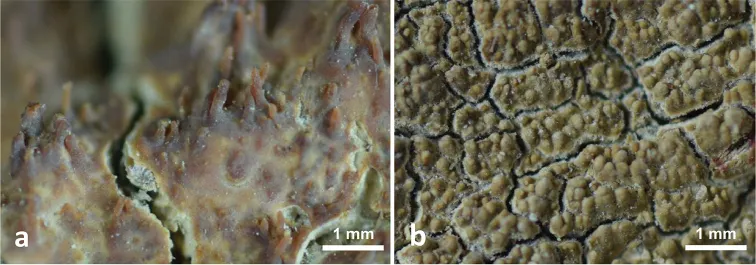
Basidiocarp surfaces a Hydnophanerochaete odontoidea (holotype of Phanerochaete subodontoidea, CWN 00776) b Odontoefibula orientalis (holotype, Wu 0910-57). Scale bar: 1 mm.
- Jenis
- Pelat ilmiah
- Kredit
- Che-Chih Chen, Sheng-Hua Wu, Chi-Yu Chen
- Lisensi
- CC BY 4.0
- Sumber media
- Buka entri sumber
Dokumentasi tambahan
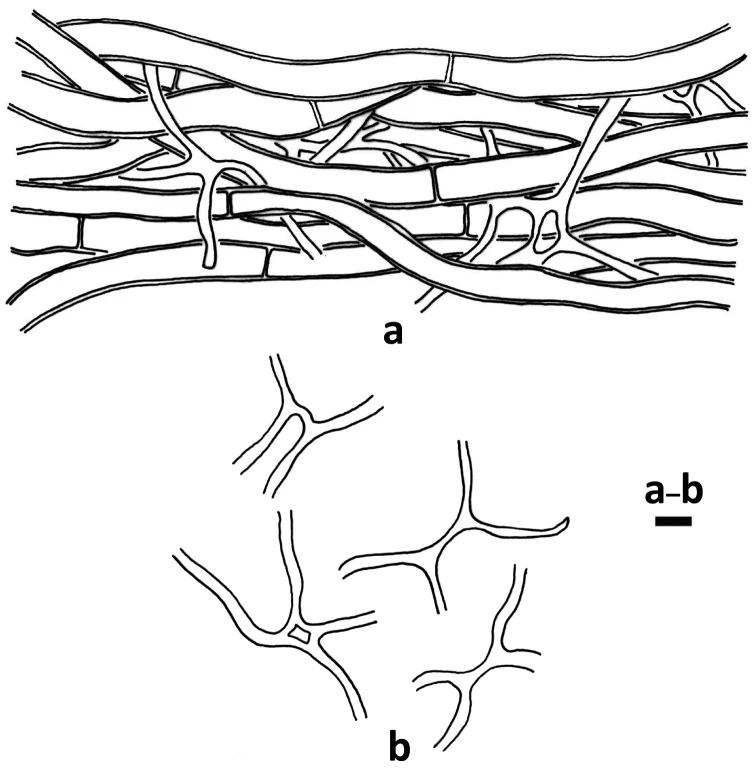
Hydnophanerochaete odontoidea (holotype of Phanerochaete subodontoidea, CWN 00776) a Part of the vertical section of subiculum near substratum b Quasi-binding hyphae. Scale bar: 5 μm (a–b).
Kredit dan penggunaan
Che-Chih Chen, Sheng-Hua Wu, Chi-Yu Chen
Ukuran dan format gambar disesuaikan tanpa pemotongan, retus, atau penambahan skala. Lisensi sumber dipertahankan.
Sumber profil
- [1] Hydnophanerochaete and Odontoefibula, two new genera of phanerochaetoid fungi (Polyporales, Basidiomycota) from East Asia — Hydnophanerochaete odontoidea
- [2] Catalogue of Life Base2026-09-11 — Hydnophanerochaete odontoidea
- [3] Dokumentasi visual — Hydnophanerochaete odontoidea
- [4] Dokumentasi visual — Hydnophanerochaete odontoidea
Rujukan halaman ini
Fungi. Hydnophanerochaete odontoidea. Rilis data fungi-2026-10-12-expansion-2. https://fungi-atlas.mgadib.chatgpt.site/jamur/hydnophanerochaete-odontoidea/.
Status: impor sumber; pemeriksaan editorial per profil belum selesai. Untuk klaim biologis, gunakan rujukan pada bagian terkait dan periksa konteks sumber aslinya.