01 / Morfologi

Ciri dan struktur

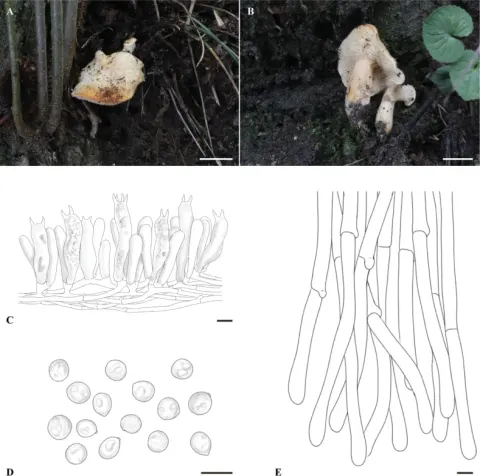
Pileus 30–45 mm wide, round, convex when young, becoming plano-convex to funnel-shaped; surface dry, glabrous or matted-tomentose, bright orange to tan (“Zinc Orange” to “Ochraceous-Tawny”) becoming subzonate towards margin, sometimes distinctly umbilicate at center; margin incurved at first, becoming decurved, wavy, and lightening in color. Spines 1–7mm long, decurrent, pinkish cream with white tips. Stipe 25–45 × 5–8 mm, central or eccentric, equal or enlarging downwards, texture firm, smooth, with aborted spines at stipe apex and some texturing below, cream white, sometimes with small white cottony patches, staining orange when handled, a dense mat of basal mycelium present at base. Context not observed. Odor mild or pleasant. Taste not distinctive. Basidiospores 6.5– 7.7 –8.5 μm × (5.5)6– 7.1 –8.5 μm, Q =1.00– 1.08 –1.19(1.24) (n=46/3), subglobose, smooth, hyaline in KOH. Basidia 52–60 × 7.5–9.5 μm with 3–4(5) sterigmata. Pileipellis an interwoven cutis, hyphae smooth, cylindrical, thin-walled, mostly 4–6 μm wide. Clamp connections present.

Sebagian uraian ditampilkan dalam bahasa sumber; terjemahannya belum tersedia atau belum lolos pemeriksaan.

Rujukan: [1]

Pengukuran mengikuti objek, spesimen atau kultur, dan metode yang disebutkan sumber. Baca uraian asli untuk konteks lengkap.

02 / Kehidupan

Habitat dan peran ekologis

Eastern U.S. and Central Europe – Ohio, Virginia, North Carolina, Tennessee (GenBank AJ547885, AJ547868, AJ783969), and Slovenia (type), Switzerland (GenBank KU612545, KX086216). In deciduous or mixed forests with Quercus. July to September.

Sebagian uraian ditampilkan dalam bahasa sumber; terjemahannya belum tersedia atau belum lolos pemeriksaan.

Rujukan: [1]

Habitat atau konteks temuan
hutan
Substrat
Informasi belum tersedia pada sumber rilis ini.
Peran atau konteks
Belum dikategorikan pada rilis ini.
Temukan hubungan serupa
03 / Siklus hidup

Reproduksi

Pileus 30–45 mm wide, round, convex when young, becoming plano-convex to funnel-shaped; surface dry, glabrous or matted-tomentose, bright orange to tan (“Zinc Orange” to “Ochraceous-Tawny”) becoming subzonate towards margin, sometimes distinctly umbilicate at center; margin incurved at first, becoming decurved, wavy, and lightening in color. Spines 1–7mm long, decurrent, pinkish cream with white tips. Stipe 25–45 × 5–8 mm, central or eccentric, equal or enlarging downwards, texture firm, smooth, with aborted spines at stipe apex and some texturing below, cream white, sometimes with small white cottony patches, staining orange when handled, a dense mat of basal mycelium present at base. Context not observed.

Sebagian uraian ditampilkan dalam bahasa sumber; terjemahannya belum tersedia atau belum lolos pemeriksaan.

Rujukan: [1]

04 / Batas informasi

Catatan identitas dan cakupan

  • Nama diterima mengikuti Catalogue of Life Base2026-09-11; uraian mempertahankan konsep dan nama sumber aslinya.
  • Preserve original treatment localities, hosts and substrate scope. Materials examined describe documented specimens, not the full global range.
  • Impor dan terjemahan otomatis belum diperiksa editorial per profil. Struktur reproduktif yang disebutkan tidak membuktikan seluruh siklus hidup diketahui.
  • Pengukuran pada uraian mengikuti spesimen, kultur, dan metode sumber; angka tidak diperluas ke semua populasi.

Catatan distribusi dalam narasi mengikuti sumbernya. Dokumentasi spesimen atau foto mengikuti catatan sumber. Bukti wilayah Indonesia dan penilaian konservasi tidak disimpulkan dari gambar.

05 / Dokumentasi

Melihat dengan konteks

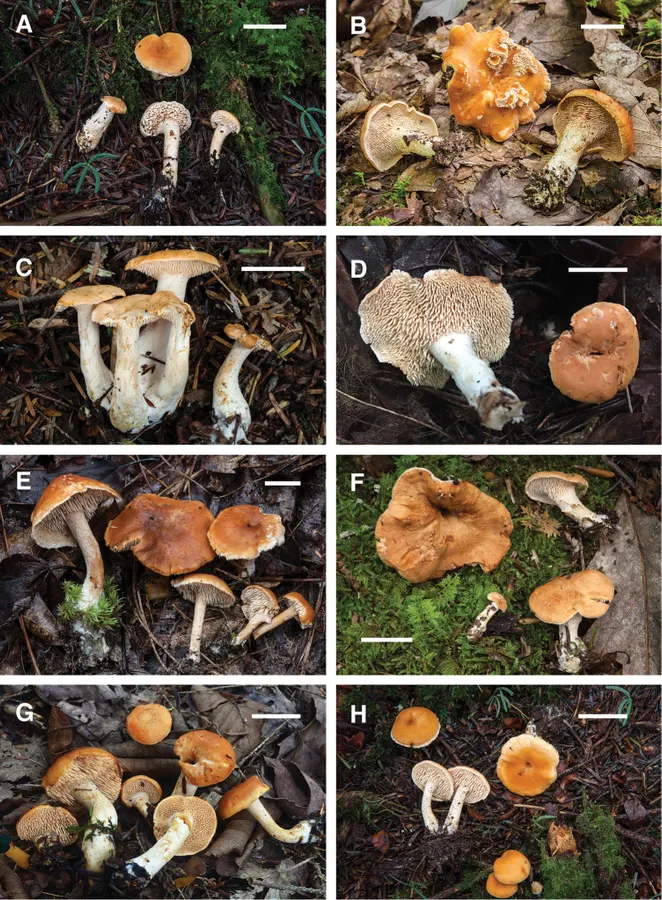
Basidiomes of Hydnum species. A H. canadense RAS100 (TENN 073010, photo R.A. Swenie) B H. mulsicolor RAS023 (TENN 070321, photo R.A. Swenie) C H. subconnatum RAS235 (TENN 073064, holotype, photo R.A. Swenie) D H. subconnatum RAS169 (TENN 073048, photo R.A. Swenie) E H. cuspidatum RAS246 (TENN 073086, holotype, photo R.A. Swenie) F H. cuspidatum RAS150 (TENN 073037, photo R.A. Swenie) G H. umbilicatum 10651TJB (CORT 012241, epitype, photo T.J. Baroni) H H. umbilicatum RAS101 (TENN 073011, photo R.A. Swenie). Scale bar: 20 mm.

Jenis
Pelat ilmiah
Kredit
Rachel A. Swenie, Timothy J. Baroni, P. Brandon Matheny
Lisensi
CC BY 4.0
Sumber media
Buka entri sumber

Gambar menunjukkan objek menurut identifikasi sumber, bukan verifikasi independen spesimen oleh Fungi. Tidak ada skala baru yang ditambahkan.

06 / Rujukan

Sumber profil

  1. [1] Six new species and reports of Hydnum (Cantharellales) from eastern North America — Hydnum mulsicolorBagian sumber: PMC6286385_section_85
    Tanggal penghimpunan sumber: 2026-10-12
    Teks sumber: CC BY 4.0 · Swenie RA, Baroni TJ, Matheny PB.
  2. [2] Catalogue of Life Base2026-09-11 — Hydnum mulsicolorBagian sumber: ColDP NameUsage.tsv ID 3N24W; accepted species; source 2073
    Tanggal penghimpunan sumber: 2026-10-12
  3. [3] Dokumentasi visual — Hydnum mulsicolorBagian sumber: Individual media record; identification follows the source, not independent determination
    Tanggal penghimpunan sumber: 2026-10-12
    Media sumber: CC BY 4.0 · Rachel A. Swenie, Timothy J. Baroni, P. Brandon Matheny

Adaptasi teks: CC BY 4.0. Swenie RA, Baroni TJ, Matheny PB. — Six new species and reports of Hydnum (Cantharellales) from eastern North America — Hydnum mulsicolor

Uraian asli dan riwayat sumber

Riwayat atau halaman sumber

Ringkasan sumber

Pileus 30–45 mm wide, round, convex when young, becoming plano-convex to funnel-shaped; surface dry, glabrous or matted-tomentose, bright orange to tan (“Zinc Orange” to “Ochraceous-Tawny”) becoming subzonate towards margin, sometimes distinctly umbilicate at center; margin incurved at first, becoming decurved, wavy, and lightening in color. Spines 1–7mm long, decurrent, pinkish cream with white tips. Stipe 25–45 × 5–8 mm, central or eccentric, equal or enlarging downwards, texture firm, smooth, with aborted spines at stipe apex and some texturing below, cream white, sometimes with small white cottony patches, staining orange when handled, a dense mat of basal mycelium present at base.

Revisi sumber

Morfologi sumber

Pileus 30–45 mm wide, round, convex when young, becoming plano-convex to funnel-shaped; surface dry, glabrous or matted-tomentose, bright orange to tan (“Zinc Orange” to “Ochraceous-Tawny”) becoming subzonate towards margin, sometimes distinctly umbilicate at center; margin incurved at first, becoming decurved, wavy, and lightening in color. Spines 1–7mm long, decurrent, pinkish cream with white tips. Stipe 25–45 × 5–8 mm, central or eccentric, equal or enlarging downwards, texture firm, smooth, with aborted spines at stipe apex and some texturing below, cream white, sometimes with small white cottony patches, staining orange when handled, a dense mat of basal mycelium present at base. Context not observed. Odor mild or pleasant. Taste not distinctive. Basidiospores 6.5– 7.7 –8.5 μm × (5.5)6– 7.1 –8.5 μm, Q =1.00– 1.08 –1.19(1.24) (n=46/3), subglobose, smooth, hyaline in KOH. Basidia 52–60 × 7.5–9.5 μm with 3–4(5) sterigmata. Pileipellis an interwoven cutis, hyphae smooth, cylindrical, thin-walled, mostly 4–6 μm wide. Clamp connections present.

Revisi sumber

Ekologi sumber

Eastern U.S. and Central Europe – Ohio, Virginia, North Carolina, Tennessee (GenBank AJ547885, AJ547868, AJ783969), and Slovenia (type), Switzerland (GenBank KU612545, KX086216). In deciduous or mixed forests with Quercus. July to September.

Revisi sumber

Struktur reproduksi sumber

Pileus 30–45 mm wide, round, convex when young, becoming plano-convex to funnel-shaped; surface dry, glabrous or matted-tomentose, bright orange to tan (“Zinc Orange” to “Ochraceous-Tawny”) becoming subzonate towards margin, sometimes distinctly umbilicate at center; margin incurved at first, becoming decurved, wavy, and lightening in color. Spines 1–7mm long, decurrent, pinkish cream with white tips. Stipe 25–45 × 5–8 mm, central or eccentric, equal or enlarging downwards, texture firm, smooth, with aborted spines at stipe apex and some texturing below, cream white, sometimes with small white cottony patches, staining orange when handled, a dense mat of basal mycelium present at base. Context not observed.

Revisi sumber

Rujukan halaman ini

Fungi. Hydnum mulsicolor. Rilis data fungi-2026-10-12-expansion-2. https://fungi-atlas.mgadib.chatgpt.site/jamur/hydnum-mulsicolor/.

Status: impor sumber; pemeriksaan editorial per profil belum selesai. Untuk klaim biologis, gunakan rujukan pada bagian terkait dan periksa konteks sumber aslinya.