01 / Morfologi

Ciri dan struktur

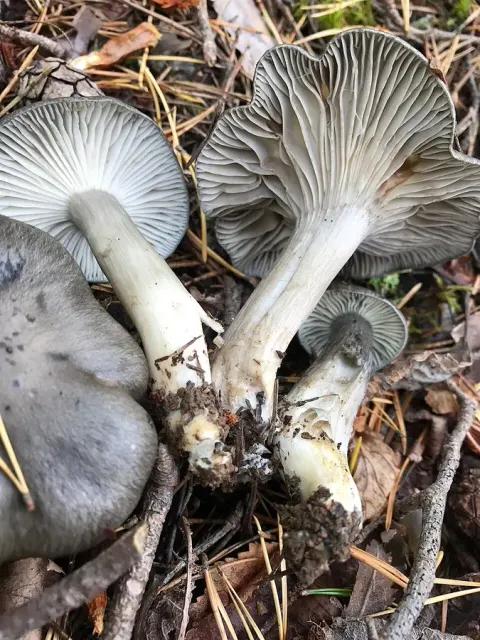
The cap is 3–10 cm in diameter, and initially convex with the edges rolled inwards. As it ages and the cap expands, it becomes flat, sometimes with the center slightly depressed, or sometimes with a slight central elevation. The color is a dull ashy gray, and when moist, the cap surface is sticky or tacky to the touch. It is smooth, although the edges can have a layer of minute, soft hairs. The flesh is soft, and whitish or watery gray. Hygrophorus agathosmus has a pronounced fragrant odor resembling cherry pits or bitter almonds (occasionally the odor is weak). The gills have an adnate attachment to the stem, but in maturity the attachment becomes adnate-decurrent, meaning the gills start to extend down the length of the stem. The gills are white, but become grayish in maturity, close to distant (40–50 reach the stem), moderately narrow, rather thin. The stem is 4–15 cm long by 0.6–2 cm thick, whitish at first, and colored pale ashy in age. It is the same thickness throughout or somewhat narrowed toward the base. It is solid, dry or moist but has no gelatinous universal veil present. When young, the stem surface is evenly covered with tiny fibrils and a fine whitish powder; over time it loses the hairs and the powder and becomes smooth. When viewed in mass, such as with a spore print, the spores appear to be white. Viewed with a light microscope, the basidiospores are 8–10.5 by 4.5–5.5 μm, ellipsoid, smooth, and yellowish in Melzer's reagent. The spore-bearing cells, the basidia, are four-spored and measure 48–65 long by 6–8 μm thick. Pleurocystidia and cheilocystidia (specialized cystidia found on the gill faces and edges, respectively) are absent in this species.

Sebagian uraian ditampilkan dalam bahasa sumber; terjemahannya belum tersedia atau belum lolos pemeriksaan.

Rujukan: [1]

Pengukuran mengikuti objek, spesimen atau kultur, dan metode yang disebutkan sumber. Baca uraian asli untuk konteks lengkap.

02 / Kehidupan

Habitat dan peran ekologis

Hygrophorus agathosmus adalah jamur ektomikoriza, dan telah diisolasi, dibudidayakan, dan dipertahankan sebagai tanaman murni dari vaksin jamur vegetatif untuk mikorosi buatan dari tanaman di kebun binatang hutan. Fruiting bodies ditemukan berkeliaran di bawah pohon pinus dan pohon pinus dan di hutan campuran di Amerika Serikat. Jamur ini juga ditemukan di Eropa (Czech Republic, Polandia, Rusia, Turki, dan Inggris), Afrika, dan India.

Rujukan: [1]

Habitat atau konteks temuan
hutan; kultur yang didokumentasikan
Substrat
Informasi belum tersedia pada sumber rilis ini.
Peran atau konteks
Mitra tumbuhan
Temukan hubungan serupa
03 / Siklus hidup

Reproduksi

When viewed in mass, such as with a spore print, the spores appear to be white. Viewed with a light microscope, the basidiospores are 8–10.5 by 4.5–5.5 μm, ellipsoid, smooth, and yellowish in Melzer's reagent. The spore-bearing cells, the basidia, are four-spored and measure 48–65 long by 6–8 μm thick. Pleurocystidia and cheilocystidia (specialized cystidia found on the gill faces and edges, respectively) are absent in this species. The pileipellis (cap cuticle) is made of a broad (175–350 μm) gelatinous zone, composed of loosely interwoven, slender (1.5–4 μm) hyphae; the surface hyphae are a fuscous—a dark brownish-gray color. This hyphal arrangement is called an ixocutis, in which the hyphal walls swell up and gelatinize, giving a translucence to the layer that stands out in contrast to the underlying flesh.

Sebagian uraian ditampilkan dalam bahasa sumber; terjemahannya belum tersedia atau belum lolos pemeriksaan.

Rujukan: [1]

Sinonim menurut acuan taksonomi rilis: Agaricus agathosmus; Agaricus pustulatus var. agathosmus; Hygrophorus agathosmus f. albus; Hygrophorus agathosmus f. aureofloccosus; Hygrophorus agathosmus var. aureofloccosus; Hygrophorus cerasinus; Hygrophorus hyacinthinus f. murinus; Limacium agathosmum; Limacium cerasinum; Limacium pustulatum var. agathosmum
04 / Batas informasi

Catatan identitas dan cakupan

  • Nama diterima mengikuti Catalogue of Life Base2026-09-11; uraian mempertahankan konsep dan nama sumber aslinya.
  • Original geographic, specimen and life-cycle scope retained; source import awaits individual editorial review.
  • Impor dan terjemahan otomatis belum diperiksa editorial per profil. Struktur reproduktif yang disebutkan tidak membuktikan seluruh siklus hidup diketahui.
  • Pengukuran pada uraian mengikuti spesimen, kultur, dan metode sumber; angka tidak diperluas ke semua populasi.

Catatan distribusi dalam narasi mengikuti sumbernya. Dokumentasi spesimen atau foto mengikuti catatan sumber. Bukti wilayah Indonesia dan penilaian konservasi tidak disimpulkan dari gambar.

05 / Dokumentasi

Melihat dengan konteks

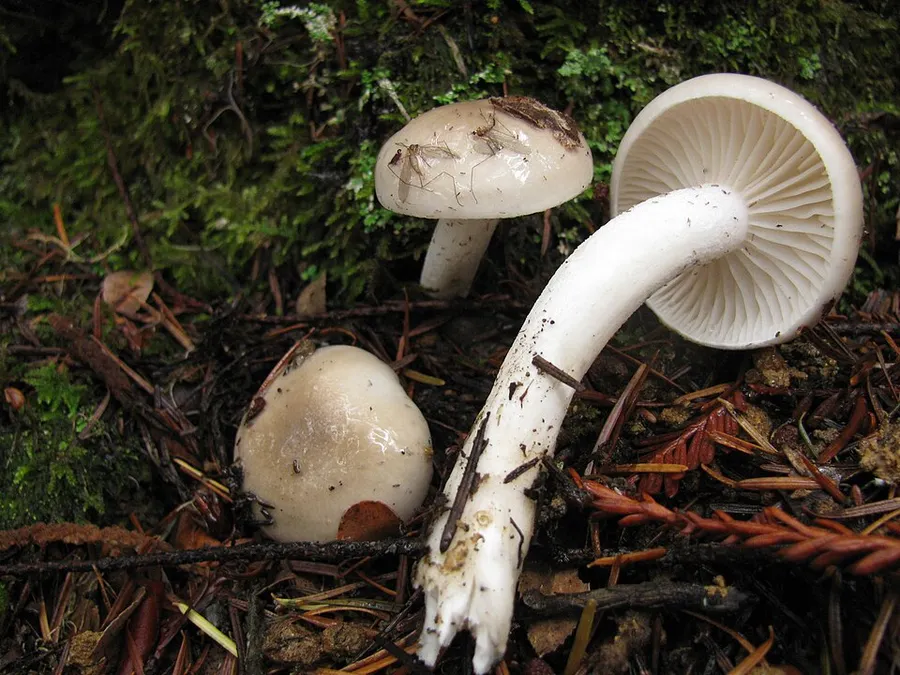
Dokumentasi Hygrophorus agathosmus dari Wikimedia Commons. The mushroom Hygrophorus agathosmus (Fr.) Fr. Specimens photographed in Montgomery Woods State Park, Mendocino Co, California, USA. Identifikasi mengikuti record berkas sumber.

Jenis
Fotografi
Kredit
This image was created by user Ryane Snow (snowman) at Mushroom Observer , a source for mycological images. You can contact this user here .
Sumber media
Buka entri sumber

Gambar menunjukkan objek menurut identifikasi sumber, bukan verifikasi independen spesimen oleh Fungi. Tidak ada skala baru yang ditambahkan.

06 / Rujukan

Sumber profil

  1. [1] Hygrophorus agathosmus — Wikipedia (en)Bagian sumber: Frozen revision 1343885604
    Tanggal penghimpunan sumber: 2026-10-12
    Teks sumber: CC BY-SA4.0 · Wikipedia contributors
  2. [2] Catalogue of Life Base2026-09-11 — Hygrophorus agathosmusBagian sumber: ColDP NameUsage.tsv ID 6MLQD; accepted species; source 2073
    Tanggal penghimpunan sumber: 2026-10-12
  3. [3] Dokumentasi visual — Hygrophorus agathosmusBagian sumber: Individual media record; identification follows the source, not independent determination
    Tanggal penghimpunan sumber: 2026-10-12
    Media sumber: CC BY-SA 3.0 · This image was created by user Ryane Snow (snowman) at Mushroom Observer , a source for mycological images. You can contact this user here .

Adaptasi teks: CC BY-SA 4.0. Wikipedia contributors — Hygrophorus agathosmus — Wikipedia (en)

Uraian asli dan riwayat sumber

Riwayat atau halaman sumber

Ringkasan sumber

Hygrophorus agathosmus, commonly known as the gray almond waxy cap or the almond woodwax, is a species of fungus in the family Hygrophoraceae. It was first described by Elias Magnus Fries in 1815; Fries gave it its current name in 1838. The fruit bodies are characterized by a light grayish cap that measures up to 8 cm in diameter, waxy gills, a dry stem, and the distinct odor of bitter almonds. A widespread species, it is distributed in the United States, Europe, Africa, and India, and is found growing under spruce and pine in mixed forests.

Revisi sumber

Morfologi sumber

The cap is 3–10 cm in diameter, and initially convex with the edges rolled inwards. As it ages and the cap expands, it becomes flat, sometimes with the center slightly depressed, or sometimes with a slight central elevation. The color is a dull ashy gray, and when moist, the cap surface is sticky or tacky to the touch. It is smooth, although the edges can have a layer of minute, soft hairs. The flesh is soft, and whitish or watery gray. Hygrophorus agathosmus has a pronounced fragrant odor resembling cherry pits or bitter almonds (occasionally the odor is weak). The gills have an adnate attachment to the stem, but in maturity the attachment becomes adnate-decurrent, meaning the gills start to extend down the length of the stem. The gills are white, but become grayish in maturity, close to distant (40–50 reach the stem), moderately narrow, rather thin. The stem is 4–15 cm long by 0.6–2 cm thick, whitish at first, and colored pale ashy in age. It is the same thickness throughout or somewhat narrowed toward the base. It is solid, dry or moist but has no gelatinous universal veil present. When young, the stem surface is evenly covered with tiny fibrils and a fine whitish powder; over time it loses the hairs and the powder and becomes smooth. When viewed in mass, such as with a spore print, the spores appear to be white. Viewed with a light microscope, the basidiospores are 8–10.5 by 4.5–5.5 μm, ellipsoid, smooth, and yellowish in Melzer's reagent. The spore-bearing cells, the basidia, are four-spored and measure 48–65 long by 6–8 μm thick. Pleurocystidia and cheilocystidia (specialized cystidia found on the gill faces and edges, respectively) are absent in this species.

Revisi sumber

Ekologi sumber

Hygrophorus agathosmus is an ectomycorrhizal fungus, and it has been isolated, cultivated, and maintained as pure cultures of vegetative fungal inocula for artificial mycorrhization of planting stock in forest nurseries. Fruiting bodies are found scattered under spruce and pine and in mixed woods in the United States. The fungus is also found in Europe (Czech Republic, Poland, Russia, Turkey, and the United Kingdom), Africa, and India.

Revisi sumber

Struktur reproduksi sumber

When viewed in mass, such as with a spore print, the spores appear to be white. Viewed with a light microscope, the basidiospores are 8–10.5 by 4.5–5.5 μm, ellipsoid, smooth, and yellowish in Melzer's reagent. The spore-bearing cells, the basidia, are four-spored and measure 48–65 long by 6–8 μm thick. Pleurocystidia and cheilocystidia (specialized cystidia found on the gill faces and edges, respectively) are absent in this species. The pileipellis (cap cuticle) is made of a broad (175–350 μm) gelatinous zone, composed of loosely interwoven, slender (1.5–4 μm) hyphae; the surface hyphae are a fuscous—a dark brownish-gray color. This hyphal arrangement is called an ixocutis, in which the hyphal walls swell up and gelatinize, giving a translucence to the layer that stands out in contrast to the underlying flesh.

Revisi sumber

Rujukan halaman ini

Fungi. Hygrophorus agathosmus. Rilis data fungi-2026-10-12-expansion-2. https://fungi-atlas.mgadib.chatgpt.site/jamur/hygrophorus-agathosmus/.

Status: impor sumber; pemeriksaan editorial per profil belum selesai. Untuk klaim biologis, gunakan rujukan pada bagian terkait dan periksa konteks sumber aslinya.