01 / Morfologi

Ciri dan struktur

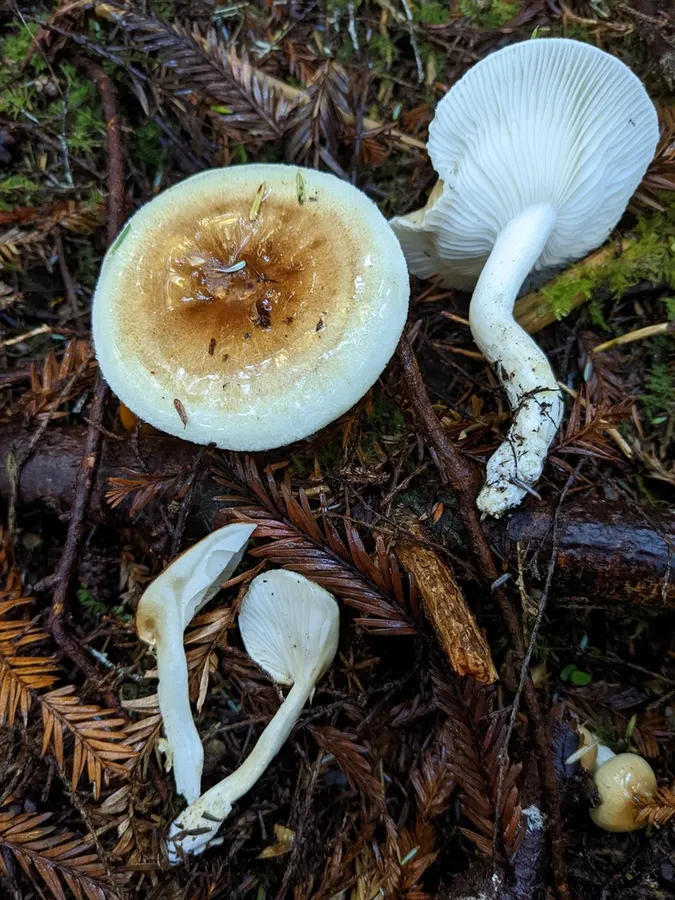
Young fruit bodies have rounded caps with cottony margins that are rolled inward; as the mushrooms mature the caps flatten out and the margins may lift upward. The diameter of the cap reaches between 4 and 15 cm. The center of the cap is colored yellow-brown, tawny or amber, reducing to nearly white at the margin. The cap surface is slimy when wet, and sticky as it gets older and dries out. Beneath the slime layer are hairs that are plastered tightly to the surface, which clump together a few at a time to form many little streaks. The firm white flesh of the cap is thick—1 cm near the stem attachment—and tapers evenly to the margin. It does not change color when cut or bruised. It has a mild taste and a characteristic fragrant odor that resembles almonds, or "crushed peach pits". The waxy gills are decurrent or bluntly attached to the stem. The gill spacing is close to subdistant—between 56 and 88 individual gills reach the stem, with 2–3 tiers of short lamellulae (shorter gills that do not extend fully from the cap margin to the stem). The gills have even edges, and are narrow but become broad in large caps (8–12 mm), ranging in color from creamy white to pinkish-buff. They do not discolor when they are bruised. Young specimens often have drops of a clear liquid beaded on the gills. The gills of dried specimens darken considerably. The stem is 7 to 14 cm long, 0.8 to 2.5 cm thick at the apex, solid (i.e., not hollow), and either equal in width throughout or narrowed downward. Its color is white to pale pinkish-buff, with a dry surface. The top portion of young specimens have a cottony, fine whitish powder near the top, but this sloughs off as it matures.

Sebagian uraian ditampilkan dalam bahasa sumber; terjemahannya belum tersedia atau belum lolos pemeriksaan.

Rujukan: [1]

Pengukuran mengikuti objek, spesimen atau kultur, dan metode yang disebutkan sumber. Baca uraian asli untuk konteks lengkap.

02 / Kehidupan

Habitat dan peran ekologis

Hygrophorus bakerensis adalah spesies ektomikoriza, dan membentuk hubungan mutualistik dengan tanaman inang yang kompatibel dengan membentuk sarang di sekitar ujung akar mereka. Dengan cara ini, jamur mendapatkan karbon dan zat organik penting lainnya dari pohon dan sebagai gantinya membantu pohon menyerap air, garam mineral dan metabolit. Ia juga dapat melawan parasit dan predator seperti nematode dan patogen tanah. Associated tree spesies termasuk Douglas-fir. The fruit bodies of H. bakerensis grow scattered, clustered, or in groups on the forest floor under conifers. They are umum di ketinggian 1000 sampai 4000 kaki di seluruh Pasifik Northwest region Amerika Serikat States and Pegunungan Rocky utara, dan telah dikumpulkan dari California, Idaho, Washington, dan Oregon. Hal ini telah ditemukan sejauh utara Hazelton, British Columbia, timur ke Quebec, Kanada. Fruit bodies biasanya muncul dari September to Desember, dan mereka bisa sangat umum.

Sebagian uraian ditampilkan dalam bahasa sumber; terjemahannya belum tersedia atau belum lolos pemeriksaan.

Rujukan: [1]

Habitat atau konteks temuan
hutan
Substrat
Informasi belum tersedia pada sumber rilis ini.
Peran atau konteks
Mitra tumbuhan
Temukan hubungan serupa
03 / Siklus hidup

Reproduksi

The spores are ellipsoid, smooth, and measure 7–9 by 4.5–5 μm. They are yellowish when stained with Melzer's reagent. The basidia (spore-bearing cells in the hymenium) are four-spored, and measure 40–54 by 6–8 μm. There are no cystidia on the gill faces or edges. The cap cuticle is an ixotrichoderm—a layer of gelatinized tissue where the distal portion of the filamentous hyphae are different lengths and the hyphae themselves are arranged perpendicular to the surface; this layer of gelatinous hyphae is between 100 and 250 μm thick. Clamp connections are present in the hyphae of the cuticle and the gill tissue.

Sebagian uraian ditampilkan dalam bahasa sumber; terjemahannya belum tersedia atau belum lolos pemeriksaan.

Rujukan: [1]

04 / Batas informasi

Catatan identitas dan cakupan

  • Nama diterima mengikuti Catalogue of Life Base2026-09-11; uraian mempertahankan konsep dan nama sumber aslinya.
  • Original geographic, specimen and life-cycle scope retained; source import awaits individual editorial review.
  • Impor dan terjemahan otomatis belum diperiksa editorial per profil. Struktur reproduktif yang disebutkan tidak membuktikan seluruh siklus hidup diketahui.
  • Pengukuran pada uraian mengikuti spesimen, kultur, dan metode sumber; angka tidak diperluas ke semua populasi.

Catatan distribusi dalam narasi mengikuti sumbernya. Dokumentasi spesimen atau foto mengikuti catatan sumber. Bukti wilayah Indonesia dan penilaian konservasi tidak disimpulkan dari gambar.

05 / Dokumentasi

Melihat dengan konteks

Dokumentasi Hygrophorus bakerensis menurut asosiasi foto pada record takson iNaturalist. Kredit: Trevor Van Loon. Identitas mengikuti sumber; bukan penentuan spesimen independen.

Jenis
Fotografi
Kredit
(c) Trevor Van Loon, some rights reserved (CC BY), uploaded by Trevor Van Loon
Lisensi
CC BY 4.0
Sumber media
Buka entri sumber

Gambar menunjukkan objek menurut identifikasi sumber, bukan verifikasi independen spesimen oleh Fungi. Tidak ada skala baru yang ditambahkan.

06 / Rujukan

Sumber profil

  1. [1] Hygrophorus bakerensis — Wikipedia (en)Bagian sumber: Frozen revision 1343884976
    Tanggal penghimpunan sumber: 2026-10-12
    Teks sumber: CC BY-SA4.0 · Wikipedia contributors
  2. [2] Catalogue of Life Base2026-09-11 — Hygrophorus bakerensisBagian sumber: ColDP NameUsage.tsv ID 3NBVK; accepted species; source 2073
    Tanggal penghimpunan sumber: 2026-10-12
  3. [3] Dokumentasi visual — Hygrophorus bakerensisBagian sumber: Individual media record; identification follows the source, not independent determination
    Tanggal penghimpunan sumber: 2026-10-12
    Media sumber: CC BY 4.0 · (c) Trevor Van Loon, some rights reserved (CC BY), uploaded by Trevor Van Loon

Adaptasi teks: CC BY-SA 4.0. Wikipedia contributors — Hygrophorus bakerensis — Wikipedia (en)

Uraian asli dan riwayat sumber

Riwayat atau halaman sumber

Ringkasan sumber

Hygrophorus bakerensis, commonly known as the Mt. Baker waxy cap, the brown almond waxy cap or the tawny almond waxy cap, is a species of fungus in the family Hygrophoraceae. It is characterized by its medium to large, relatively slender-statured fruit bodies with an almond odor, and growth often on or near rotting conifer wood. The slimy cap is brown in the center and cream to white near its curved edges. The gills and the stem are white, and in moist environments are often covered with droplets of a translucent liquid.

Revisi sumber

Morfologi sumber

Young fruit bodies have rounded caps with cottony margins that are rolled inward; as the mushrooms mature the caps flatten out and the margins may lift upward. The diameter of the cap reaches between 4 and 15 cm. The center of the cap is colored yellow-brown, tawny or amber, reducing to nearly white at the margin. The cap surface is slimy when wet, and sticky as it gets older and dries out. Beneath the slime layer are hairs that are plastered tightly to the surface, which clump together a few at a time to form many little streaks. The firm white flesh of the cap is thick—1 cm near the stem attachment—and tapers evenly to the margin. It does not change color when cut or bruised. It has a mild taste and a characteristic fragrant odor that resembles almonds, or "crushed peach pits". The waxy gills are decurrent or bluntly attached to the stem. The gill spacing is close to subdistant—between 56 and 88 individual gills reach the stem, with 2–3 tiers of short lamellulae (shorter gills that do not extend fully from the cap margin to the stem). The gills have even edges, and are narrow but become broad in large caps (8–12 mm), ranging in color from creamy white to pinkish-buff. They do not discolor when they are bruised. Young specimens often have drops of a clear liquid beaded on the gills. The gills of dried specimens darken considerably. The stem is 7 to 14 cm long, 0.8 to 2.5 cm thick at the apex, solid (i.e., not hollow), and either equal in width throughout or narrowed downward. Its color is white to pale pinkish-buff, with a dry surface. The top portion of young specimens have a cottony, fine whitish powder near the top, but this sloughs off as it matures.

Revisi sumber

Ekologi sumber

Hygrophorus bakerensis is an ectomycorrhizal species, and forms a mutualistic relationship with compatible host plant by forming a sheath around their root tips. In this way, the fungus gains carbon and other essential organic substances from the tree and in return helps the trees take up water, mineral salts and metabolites. It can also fight off parasites and predators such as nematodes and soil pathogens. Associated tree species include Douglas-fir. The fruit bodies of H. bakerensis grow scattered, clustered, or in groups on the forest floor under conifers. They are common at elevations of 1000 to 4000 ft throughout the Pacific Northwest region of the United States and the northern Rocky Mountains, and have been collected from California, Idaho, Washington, and Oregon. It has been found as far north as Hazelton, British Columbia, east to Quebec, Canada. Fruit bodies typically appear from September to December, and they can be very common.

Revisi sumber

Struktur reproduksi sumber

The spores are ellipsoid, smooth, and measure 7–9 by 4.5–5 μm. They are yellowish when stained with Melzer's reagent. The basidia (spore-bearing cells in the hymenium) are four-spored, and measure 40–54 by 6–8 μm. There are no cystidia on the gill faces or edges. The cap cuticle is an ixotrichoderm—a layer of gelatinized tissue where the distal portion of the filamentous hyphae are different lengths and the hyphae themselves are arranged perpendicular to the surface; this layer of gelatinous hyphae is between 100 and 250 μm thick. Clamp connections are present in the hyphae of the cuticle and the gill tissue.

Revisi sumber

Rujukan halaman ini

Fungi. Hygrophorus bakerensis. Rilis data fungi-2026-10-12-expansion-2. https://fungi-atlas.mgadib.chatgpt.site/jamur/hygrophorus-bakerensis/.

Status: impor sumber; pemeriksaan editorial per profil belum selesai. Untuk klaim biologis, gunakan rujukan pada bagian terkait dan periksa konteks sumber aslinya.