01 / Morfologi

Ciri dan struktur

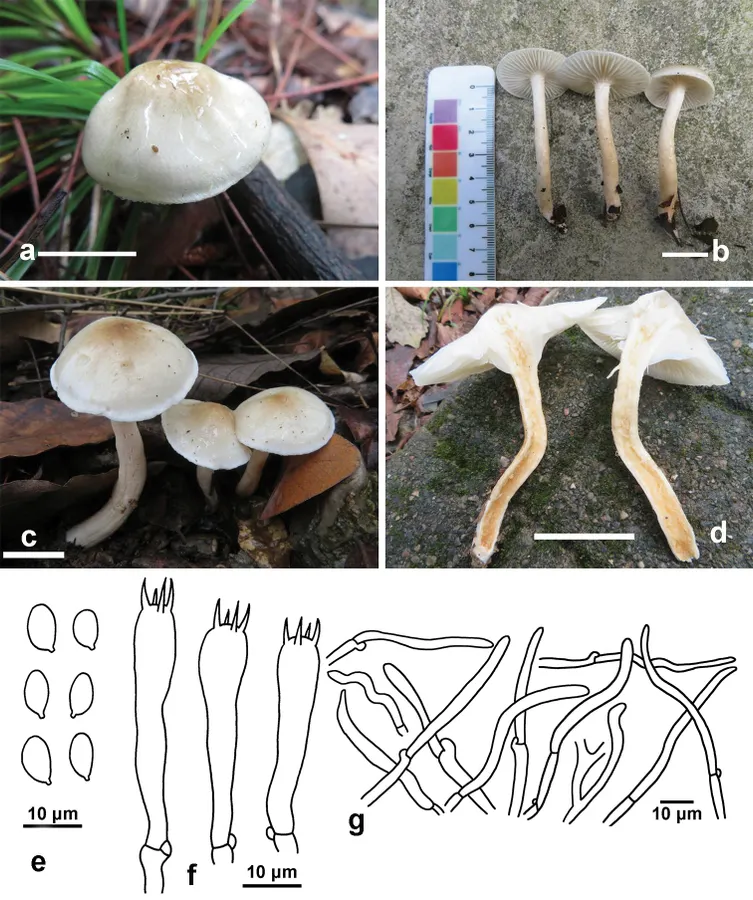
Hygrophorus brunneodiscus differs from H. cossus by the smaller pileus (20–50 mm broad), brownish pileus disc, thinner stipe (4–7 mm wide) and the shorter basidia (32–48 µm long); differs from H. fuscopapillatus and H. griseodiscus by the low elevation distribution and brown pileus disc. Pileus 20–50 mm broad, hemispherical or conical with a slightly involute or slightly revolute margin when young, becoming convex with an expanded margin when mature, whitish to brownish as a whole, brownish-orange, light brown, yellowish-brown (5C4–5, 5D4–5, 5E5–8) at the disc (about one fourth part of the radius from the centre to the margin), becoming paler to greyish-yellow (4B3–4), greyish-white (4B1) or whitish outwards and white at the margin or with a white marginal zone of 1–2 mm wide, viscid, covered with a glutinous layer of transparent materials when wet. Lamellae short decurrent to decurrent, white, waxy, with 36–40 complete lamellae and 1–3 lamellulae between two complete lamellae; lamella edge concolorous, entire. Stipe 40–90 × 4–7 mm, cylindrical, hollow, nearly equal to slightly thinner at apex and tapering towards the base; pale yellow to greyish-yellow (4A3, 4B3), white to yellowish-white (4A2) at apex, sometimes white at base; sticky, covered with a layer of transparent materials when wet, easily-sticking debris on the slime layer, usually fibrillose or with scattered white fibrillose dots at apex. Context thin, white to light brown, with slight fishy odour. Basidiospores (6.5)7–9(9.5) × 4–5.5(6) μm [mean length = 7.6 µm, mean width = 4.6 µm], Q = (1.3)1.4–2(2.1), Qm = 1.68, ellipsoid to oblong, smooth.

Sebagian uraian ditampilkan dalam bahasa sumber; terjemahannya belum tersedia atau belum lolos pemeriksaan.

Rujukan: [1]

Pengukuran mengikuti objek, spesimen atau kultur, dan metode yang disebutkan sumber. Baca uraian asli untuk konteks lengkap.

02 / Kehidupan

Habitat dan peran ekologis

Solitary to scattered, on the ground of subtropical broad-leaf forest dominated by Quercus, so far only known from Hunan Province in South Central China.

Sebagian uraian ditampilkan dalam bahasa sumber; terjemahannya belum tersedia atau belum lolos pemeriksaan.

Rujukan: [1]

Habitat atau konteks temuan
hutan
Substrat
tanah
Peran atau konteks
Belum dikategorikan pada rilis ini.
Temukan hubungan serupa
03 / Siklus hidup

Reproduksi

Hygrophorus brunneodiscus differs from H. cossus by the smaller pileus (20–50 mm broad), brownish pileus disc, thinner stipe (4–7 mm wide) and the shorter basidia (32–48 µm long); differs from H. fuscopapillatus and H. griseodiscus by the low elevation distribution and brown pileus disc. Pileus 20–50 mm broad, hemispherical or conical with a slightly involute or slightly revolute margin when young, becoming convex with an expanded margin when mature, whitish to brownish as a whole, brownish-orange, light brown, yellowish-brown (5C4–5, 5D4–5, 5E5–8) at the disc (about one fourth part of the radius from the centre to the margin), becoming paler to greyish-yellow (4B3–4), greyish-white (4B1) or whitish outwards and white at the margin or with a white marginal zone of 1–2 mm wide, viscid, covered with a glutinous layer of transparent materials when wet.

Sebagian uraian ditampilkan dalam bahasa sumber; terjemahannya belum tersedia atau belum lolos pemeriksaan.

Rujukan: [1]

04 / Batas informasi

Catatan identitas dan cakupan

  • Nama diterima mengikuti Catalogue of Life Base2026-09-11; uraian mempertahankan konsep dan nama sumber aslinya.
  • Preserve original treatment localities, hosts and substrate scope. Materials examined describe documented specimens, not the full global range.
  • Impor dan terjemahan otomatis belum diperiksa editorial per profil. Struktur reproduktif yang disebutkan tidak membuktikan seluruh siklus hidup diketahui.
  • Pengukuran pada uraian mengikuti spesimen, kultur, dan metode sumber; angka tidak diperluas ke semua populasi.

Catatan distribusi dalam narasi mengikuti sumbernya. Dokumentasi spesimen atau foto mengikuti catatan sumber. Bukti wilayah Indonesia dan penilaian konservasi tidak disimpulkan dari gambar.

05 / Dokumentasi

Melihat dengan konteks

Hygrophorus brunneodiscus. a, b Basidiomata (GDGM73213, Holotype) c, d Basidiomata (GDGM75489) e Basidiospores (GDGM73213) f Basidia (GDGM73213) g Elements of pileipellis (GDGM73213). Scale bars: 2 cm (a–d).

Jenis
Pelat ilmiah
Kredit
Chao-Qun Wang, Tai-Hui Li, Ming Zhang, Xiao-Lan He, Wei-Qiang Qin, Tie-Zhi Liu, Nian-Kai Zeng, Xiang-Hua Wang, Jian-Wei Liu, Tie-Zheng Wei, Jiang Xu, Yue-Qiu Li, Ya-Heng Shen
Lisensi
CC BY 4.0
Sumber media
Buka entri sumber

Gambar menunjukkan objek menurut identifikasi sumber, bukan verifikasi independen spesimen oleh Fungi. Tidak ada skala baru yang ditambahkan.

06 / Rujukan

Sumber profil

  1. [1] Hygrophorus subsection Hygrophorus (Hygrophoraceae, Agaricales) in China — Hygrophorus brunneodiscusBagian sumber: PMC7334244_section_9
    Tanggal penghimpunan sumber: 2026-10-12
    Teks sumber: CC BY 4.0 · Wang CQ, Li TH, Zhang M, He XL, Qin WQ, Liu TZ, Zeng NK, Wang XH, Liu JW, Wei TZ, Xu J, Li YQ, Shen YH.
  2. [2] Catalogue of Life Base2026-09-11 — Hygrophorus brunneodiscusBagian sumber: ColDP NameUsage.tsv ID 9Z95M; accepted species; source 2073
    Tanggal penghimpunan sumber: 2026-10-12
  3. [3] Dokumentasi visual — Hygrophorus brunneodiscusBagian sumber: Individual media record; identification follows the source, not independent determination
    Tanggal penghimpunan sumber: 2026-10-12
    Media sumber: CC BY 4.0 · Chao-Qun Wang, Tai-Hui Li, Ming Zhang, Xiao-Lan He, Wei-Qiang Qin, Tie-Zhi Liu, Nian-Kai Zeng, Xiang-Hua Wang, Jian-Wei Liu, Tie-Zheng Wei, Jiang Xu, Yue-Qiu Li, Ya-Heng Shen

Adaptasi teks: CC BY 4.0. Wang CQ, Li TH, Zhang M, He XL, Qin WQ, Liu TZ, Zeng NK, Wang XH, Liu JW, Wei TZ, Xu J, Li YQ, Shen YH. — Hygrophorus subsection Hygrophorus (Hygrophoraceae, Agaricales) in China — Hygrophorus brunneodiscus

Uraian asli dan riwayat sumber

Riwayat atau halaman sumber

Ringkasan sumber

Hygrophorus brunneodiscus differs from H. cossus by the smaller pileus (20–50 mm broad), brownish pileus disc, thinner stipe (4–7 mm wide) and the shorter basidia (32–48 µm long); differs from H. fuscopapillatus and H. griseodiscus by the low elevation distribution and brown pileus disc. Pileus 20–50 mm broad, hemispherical or conical with a slightly involute or slightly revolute margin when young, becoming convex with an expanded margin when mature, whitish to brownish as a whole, brownish-orange, light brown, yellowish-brown (5C4–5, 5D4–5, 5E5–8) at the disc (about one fourth part of the radius from the centre to the margin), becoming paler to greyish-yellow (4B3–4), greyish-white (4B1) or whitish outwards and white at the margin or with a white marginal zone of 1–2 mm wide, viscid, covered with a glutinous layer of transparent materials when wet.

Revisi sumber

Morfologi sumber

Hygrophorus brunneodiscus differs from H. cossus by the smaller pileus (20–50 mm broad), brownish pileus disc, thinner stipe (4–7 mm wide) and the shorter basidia (32–48 µm long); differs from H. fuscopapillatus and H. griseodiscus by the low elevation distribution and brown pileus disc. Pileus 20–50 mm broad, hemispherical or conical with a slightly involute or slightly revolute margin when young, becoming convex with an expanded margin when mature, whitish to brownish as a whole, brownish-orange, light brown, yellowish-brown (5C4–5, 5D4–5, 5E5–8) at the disc (about one fourth part of the radius from the centre to the margin), becoming paler to greyish-yellow (4B3–4), greyish-white (4B1) or whitish outwards and white at the margin or with a white marginal zone of 1–2 mm wide, viscid, covered with a glutinous layer of transparent materials when wet. Lamellae short decurrent to decurrent, white, waxy, with 36–40 complete lamellae and 1–3 lamellulae between two complete lamellae; lamella edge concolorous, entire. Stipe 40–90 × 4–7 mm, cylindrical, hollow, nearly equal to slightly thinner at apex and tapering towards the base; pale yellow to greyish-yellow (4A3, 4B3), white to yellowish-white (4A2) at apex, sometimes white at base; sticky, covered with a layer of transparent materials when wet, easily-sticking debris on the slime layer, usually fibrillose or with scattered white fibrillose dots at apex. Context thin, white to light brown, with slight fishy odour. Basidiospores (6.5)7–9(9.5) × 4–5.5(6) μm [mean length = 7.6 µm, mean width = 4.6 µm], Q = (1.3)1.4–2(2.1), Qm = 1.68, ellipsoid to oblong, smooth.

Revisi sumber

Ekologi sumber

Solitary to scattered, on the ground of subtropical broad-leaf forest dominated by Quercus, so far only known from Hunan Province in South Central China.

Revisi sumber

Struktur reproduksi sumber

Hygrophorus brunneodiscus differs from H. cossus by the smaller pileus (20–50 mm broad), brownish pileus disc, thinner stipe (4–7 mm wide) and the shorter basidia (32–48 µm long); differs from H. fuscopapillatus and H. griseodiscus by the low elevation distribution and brown pileus disc. Pileus 20–50 mm broad, hemispherical or conical with a slightly involute or slightly revolute margin when young, becoming convex with an expanded margin when mature, whitish to brownish as a whole, brownish-orange, light brown, yellowish-brown (5C4–5, 5D4–5, 5E5–8) at the disc (about one fourth part of the radius from the centre to the margin), becoming paler to greyish-yellow (4B3–4), greyish-white (4B1) or whitish outwards and white at the margin or with a white marginal zone of 1–2 mm wide, viscid, covered with a glutinous layer of transparent materials when wet.

Revisi sumber

Rujukan halaman ini

Fungi. Hygrophorus brunneodiscus. Rilis data fungi-2026-10-12-expansion-2. https://fungi-atlas.mgadib.chatgpt.site/jamur/hygrophorus-brunneodiscus/.

Status: impor sumber; pemeriksaan editorial per profil belum selesai. Untuk klaim biologis, gunakan rujukan pada bagian terkait dan periksa konteks sumber aslinya.