Ciri dan struktur
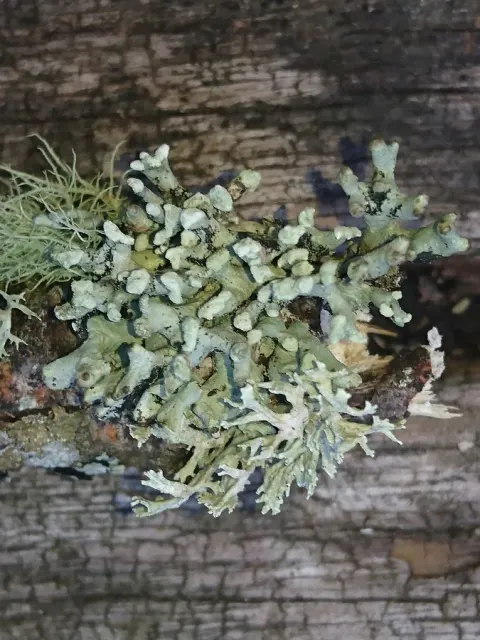
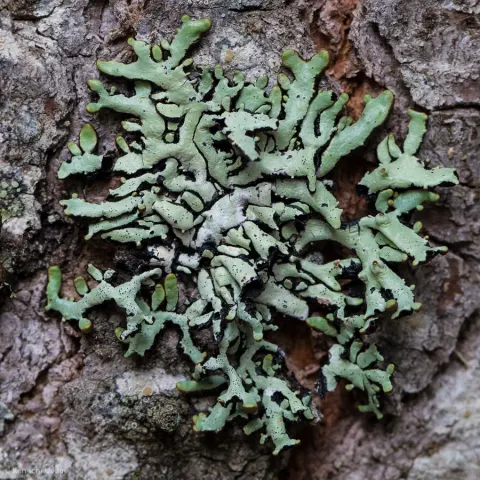
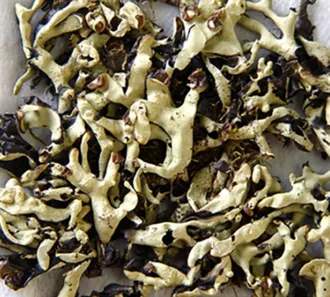
The lichen has a foliose (leafy) pale yellowish-green thallus up to 20 cm broad. Soredia, isidia, and lobules are absent from the thallus surface. Apothecia are common; they have a reddish-brown disc in an urn-shaped receptacle, and measure up to 17 mm in diameter. The ascospores are more or less spherical, measuring 5.5 by 5.0 μm. Pycnidia are also common; the pycnidiospores are cylindrical, with dimensions of 5.5–5.0 long by 0.5–0.8 μm thick. The expected results of chemical spot tests are: cortex P−, C−, KC+ (yellow); medulla P+ (orange-red), K−, C−, KC−. It contains the secondary compounds usnic acid and physodalic acid as major components, and protocetraric acid as a minor component. Hypogymnia hypotrypa is morphologically and chemically similar to Hypogymnia flavida, but it lacks apothecia and instead has soredia. These two species are one of three fertile/sorediate species pairs in genus Hypogymnia. H. hypotrypa has a wider range and greater altitudinal distribution, as it is found in locales at altitudes between 65 – 4300 m height, compared with 2150 – 4300 m for H. flavida.
Habitat dan peran ekologis
Hypogymnia flavida frequently occurs on both the bark and wood of conifers as well as Rhododendron, but it also occurs less frequently on hardwoods, such as oak. In China, it has been recorded from Sichuan, Tibet, and Yunnan. It also occurs in Nepal and Taiwan.
- Habitat atau konteks temuan
- Informasi belum tersedia pada sumber rilis ini.
- Substrat
- Informasi belum tersedia pada sumber rilis ini.
- Peran atau konteks
- Pembentuk liken
Reproduksi
The lichen has a foliose (leafy) pale yellowish-green thallus up to 20 cm broad. Soredia, isidia, and lobules are absent from the thallus surface. Apothecia are common; they have a reddish-brown disc in an urn-shaped receptacle, and measure up to 17 mm in diameter. The ascospores are more or less spherical, measuring 5.5 by 5.0 μm. Pycnidia are also common; the pycnidiospores are cylindrical, with dimensions of 5.5–5.0 long by 0.5–0.8 μm thick. The expected results of chemical spot tests are: cortex P−, C−, KC+ (yellow); medulla P+ (orange-red), K−, C−, KC−. It contains the secondary compounds usnic acid and physodalic acid as major components, and protocetraric acid as a minor component. Hypogymnia hypotrypa is morphologically and chemically similar to Hypogymnia flavida, but it lacks apothecia and instead has soredia.
Catatan identitas dan cakupan
- Nama diterima mengikuti Catalogue of Life Base2026-09-11; uraian mempertahankan konsep dan nama sumber aslinya.
- Original geographic, specimen and life-cycle scope retained; source import awaits individual editorial review.
- Impor dan terjemahan otomatis belum diperiksa editorial per profil. Struktur reproduktif yang disebutkan tidak membuktikan seluruh siklus hidup diketahui.
- Pengukuran pada uraian mengikuti spesimen, kultur, dan metode sumber; angka tidak diperluas ke semua populasi.
Catatan distribusi dalam narasi mengikuti sumbernya. Dokumentasi spesimen atau foto mengikuti catatan sumber. Bukti wilayah Indonesia dan penilaian konservasi tidak disimpulkan dari gambar.
Melihat dengan konteks
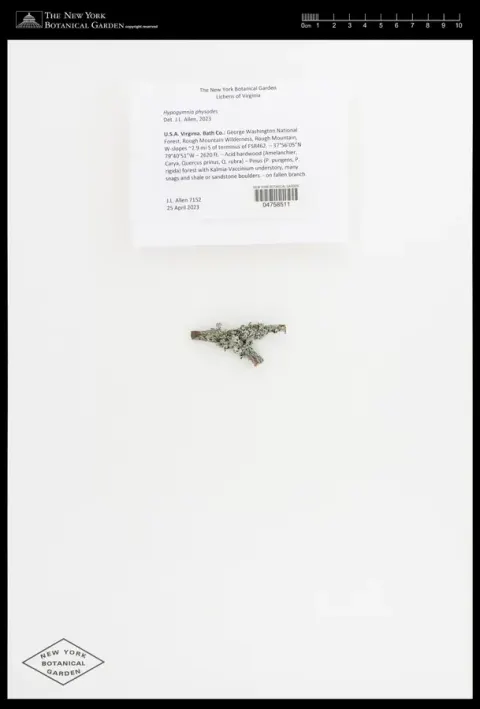
Dokumentasi Hypogymnia flavida dari Wikimedia Commons. The holotype specimen of the lichen foliose Hypogymnia flavida , held at Oregon State University. Specimen collected from China. Identifikasi mengikuti record berkas sumber.
- Jenis
- Fotografi
- Kredit
- Xinli Wei
- Lisensi
- CC BY-SA 4.0
- Sumber media
- Buka entri sumber
Sumber profil
- [1] Hypogymnia flavida — Wikipedia (en)
- [2] Catalogue of Life Base2026-09-11 — Hypogymnia flavida
- [3] Dokumentasi visual — Hypogymnia flavida
Rujukan halaman ini
Fungi. Hypogymnia flavida. Rilis data fungi-2026-10-12-expansion-2. https://fungi-atlas.mgadib.chatgpt.site/jamur/hypogymnia-flavida/.
Status: impor sumber; pemeriksaan editorial per profil belum selesai. Untuk klaim biologis, gunakan rujukan pada bagian terkait dan periksa konteks sumber aslinya.