01 / Morfologi

Ciri dan struktur

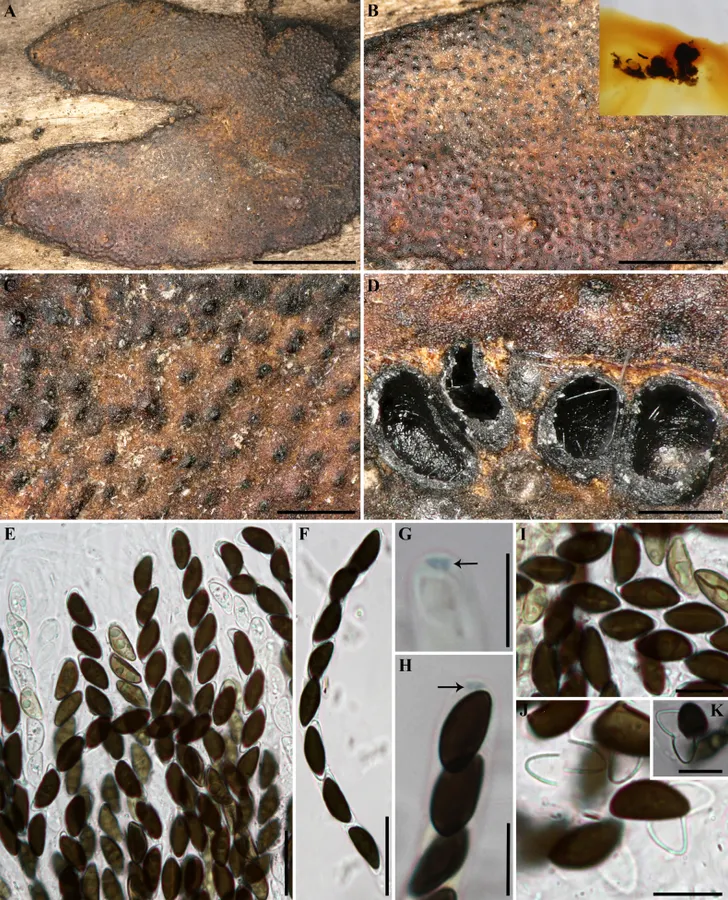
Stromata superficial, effused-pulvinate, up to 8 cm long × 0.4–2 cm wide, with conspicuous perithecial mounds; surface Orange (7), Sienna (8), Apricot (42) in young stromata, Bay (6) to Sepia (63) in mature stromata; orange red granules immediately beneath surface and between perithecia, with KOH-extractable pigments Orange (7). Perithecia obovoid to slightly tubular, 0.2–0.5 mm high × 0.2–0.4 mm wide. Ostioles lower than or at the same level as the stromatal surface. Asci 8-spored, cylindrical, with discoid apical apparatus lightly bluing or bluing in Melzer’s iodine reagent, 0.5–1 µm high × 2–2.5 µm wide, stipe up to 100 µm, and spore-bearing portion 70–96 × 7–9 µm. Ascospores smooth, unicellular, brown to dark brown, ellipsoid-inequilateral, with narrowly rounded ends, 11–15(–15.8) × 5–6.8 µm, with straight to slightly sigmoid germ slit spore-length on convex side; perispore dehiscent in 10% KOH, inconspicuously to conspicuously striated; epispore smooth. With thin, effused, dull orange-brown stromata, orange-yellow stromatal pigments, and dense orange KOH-extractable pigments, combined with dark brown inequilateral ascospores with a straight germ slit, this Hypoxylon specimen keys out to H. crocopeplum or H. subgilvum. H. crocopeplum differs from the latter by the ostioles being lower than or at the same level as the stromatal surface vs. ostioles umbilicate and inconspicuous, the size of ascospores [(13.4–)13.8–17.1(–17.5) × (7.1–)7.3–8.3(–8.6) vs. (8.9–)9.1–9.9(–10.6) × (4.2–)4.5–5.0(–5.1) μm], and the anamorphic structure [a virgariella-like conidiogenous structure was observed in culture on YMG (unpublished data) and on JF-03233, vs. on the natural substrate with a virgariella- to nodulisporium-like conidiogenous structure, in culture on OA nodulisporium-like] (Fournier et al. 2015).

Sebagian uraian ditampilkan dalam bahasa sumber; terjemahannya belum tersedia atau belum lolos pemeriksaan.

Rujukan: [1]

Pengukuran mengikuti objek, spesimen atau kultur, dan metode yang disebutkan sumber. Baca uraian asli untuk konteks lengkap.

02 / Kehidupan

Habitat dan peran ekologis

USA • South Carolina, on corticated wood of oak?, as Sphaeria crocopepla, H. W. Ravenel, Car. Inf. 1906 Berk. & M. A. Curtis, ined. (K, holotype); Iran • Guilan Province, Chaboksar County, Sarvelat forest, 36°57'23"N, 50°32'56"E, 590 m elev., on dead branches (host unknown), 23 September 2016, M.J. Pourmoghaddam (GUM 1611).

Sebagian uraian ditampilkan dalam bahasa sumber; terjemahannya belum tersedia atau belum lolos pemeriksaan.

Rujukan: [1]

Habitat atau konteks temuan
Informasi belum tersedia pada sumber rilis ini.
Substrat
Informasi belum tersedia pada sumber rilis ini.
Peran atau konteks
Belum dikategorikan pada rilis ini.
Temukan hubungan serupa
03 / Siklus hidup

Reproduksi

Stromata superficial, effused-pulvinate, up to 8 cm long × 0.4–2 cm wide, with conspicuous perithecial mounds; surface Orange (7), Sienna (8), Apricot (42) in young stromata, Bay (6) to Sepia (63) in mature stromata; orange red granules immediately beneath surface and between perithecia, with KOH-extractable pigments Orange (7). Perithecia obovoid to slightly tubular, 0.2–0.5 mm high × 0.2–0.4 mm wide. Ostioles lower than or at the same level as the stromatal surface. Asci 8-spored, cylindrical, with discoid apical apparatus lightly bluing or bluing in Melzer’s iodine reagent, 0.5–1 µm high × 2–2.5 µm wide, stipe up to 100 µm, and spore-bearing portion 70–96 × 7–9 µm. Ascospores smooth, unicellular, brown to dark brown, ellipsoid-inequilateral, with narrowly rounded ends, 11–15(–15.8) × 5–6.8 µm, with straight to slightly sigmoid germ slit spore-length on convex side; perispore dehiscent in 10% KOH, inconspicuously to conspicuously striated; epispore smooth.

Sebagian uraian ditampilkan dalam bahasa sumber; terjemahannya belum tersedia atau belum lolos pemeriksaan.

Rujukan: [1]

Sinonim menurut acuan taksonomi rilis: Hypoxylon crocatum; Hypoxylon ferrugineorufum; Hypoxylon haematostroma subsp. haematozonum; Hypoxylon ochraceofulvum; Hypoxylon polyporoideum
04 / Batas informasi

Catatan identitas dan cakupan

  • Nama diterima mengikuti Catalogue of Life Base2026-09-11; uraian mempertahankan konsep dan nama sumber aslinya.
  • Preserve original treatment localities, hosts and substrate scope. Materials examined describe documented specimens, not the full global range.
  • Impor dan terjemahan otomatis belum diperiksa editorial per profil. Struktur reproduktif yang disebutkan tidak membuktikan seluruh siklus hidup diketahui.
  • Pengukuran pada uraian mengikuti spesimen, kultur, dan metode sumber; angka tidak diperluas ke semua populasi.

Catatan distribusi dalam narasi mengikuti sumbernya. Dokumentasi spesimen atau foto mengikuti catatan sumber. Bukti wilayah Indonesia dan penilaian konservasi tidak disimpulkan dari gambar.

05 / Dokumentasi

Melihat dengan konteks

Hypoxylon crocopeplum (GUM 1611). A. Stromatal habit; B. Close-up view of stromatal surface, with stromatal pigments in 10% KOH; C. Section of stroma showing conspicuous perithecial mounds; D. Stroma in horizontal section showing perithecia, granules beneath the surface and between perithecia and ostioles; E. Immature and mature asci in 10% KOH; F. Ascus in water; G. Immature ascus tip in Melzer’s reagent; H. Mature ascus tip in Melzer’s reagent; I. Ascospores in 10% KOH with straight to slightly sigmoid germ slit spore-length on convex side; J. Ascospores in 10% KOH with dehiscent perispore; K. Detail of striated perispore. Scale bars: 5 mm (A); 2 mm (B); 0.5 mm (C); 0.25 mm (D); 20 µm (E, F); 10 µm (G–K).

Jenis
Pelat ilmiah
Kredit
Mohammad Javad Pourmoghaddam, Christopher Lambert, Hermann Voglmayr, Seyed Akbar Khodaparast, Marc Stadler
Lisensi
CC BY 4.0
Sumber media
Buka entri sumber

Gambar menunjukkan objek menurut identifikasi sumber, bukan verifikasi independen spesimen oleh Fungi. Tidak ada skala baru yang ditambahkan.

06 / Rujukan

Sumber profil

  1. [1] A polyphasic study of Hypoxylaceae (Xylariales, Ascomycota) in Iran: new species and records from Hyrcanian forests — Hypoxylon crocopeplumBagian sumber: PMC13084264_section_19
    Tanggal penghimpunan sumber: 2026-10-12
    Teks sumber: CC BY 4.0 · Pourmoghaddam MJ, Lambert C, Voglmayr H, Khodaparast SA, Stadler M.
  2. [2] Catalogue of Life Base2026-09-11 — Hypoxylon crocopeplumBagian sumber: ColDP NameUsage.tsv ID 3P2DH; accepted species; source 2073
    Tanggal penghimpunan sumber: 2026-10-12
  3. [3] Dokumentasi visual — Hypoxylon crocopeplumBagian sumber: Individual media record; identification follows the source, not independent determination
    Tanggal penghimpunan sumber: 2026-10-12
    Media sumber: CC BY 4.0 · Mohammad Javad Pourmoghaddam, Christopher Lambert, Hermann Voglmayr, Seyed Akbar Khodaparast, Marc Stadler

Adaptasi teks: CC BY 4.0. Pourmoghaddam MJ, Lambert C, Voglmayr H, Khodaparast SA, Stadler M. — A polyphasic study of Hypoxylaceae (Xylariales, Ascomycota) in Iran: new species and records from Hyrcanian forests — Hypoxylon crocopeplum

Uraian asli dan riwayat sumber

Riwayat atau halaman sumber

Ringkasan sumber

Stromata superficial, effused-pulvinate, up to 8 cm long × 0.4–2 cm wide, with conspicuous perithecial mounds; surface Orange (7), Sienna (8), Apricot (42) in young stromata, Bay (6) to Sepia (63) in mature stromata; orange red granules immediately beneath surface and between perithecia, with KOH-extractable pigments Orange (7). Perithecia obovoid to slightly tubular, 0.2–0.5 mm high × 0.2–0.4 mm wide. Ostioles lower than or at the same level as the stromatal surface. Asci 8-spored, cylindrical, with discoid apical apparatus lightly bluing or bluing in Melzer’s iodine reagent, 0.5–1 µm high × 2–2.5 µm wide, stipe up to 100 µm, and spore-bearing portion 70–96 × 7–9 µm.

Revisi sumber

Morfologi sumber

Stromata superficial, effused-pulvinate, up to 8 cm long × 0.4–2 cm wide, with conspicuous perithecial mounds; surface Orange (7), Sienna (8), Apricot (42) in young stromata, Bay (6) to Sepia (63) in mature stromata; orange red granules immediately beneath surface and between perithecia, with KOH-extractable pigments Orange (7). Perithecia obovoid to slightly tubular, 0.2–0.5 mm high × 0.2–0.4 mm wide. Ostioles lower than or at the same level as the stromatal surface. Asci 8-spored, cylindrical, with discoid apical apparatus lightly bluing or bluing in Melzer’s iodine reagent, 0.5–1 µm high × 2–2.5 µm wide, stipe up to 100 µm, and spore-bearing portion 70–96 × 7–9 µm. Ascospores smooth, unicellular, brown to dark brown, ellipsoid-inequilateral, with narrowly rounded ends, 11–15(–15.8) × 5–6.8 µm, with straight to slightly sigmoid germ slit spore-length on convex side; perispore dehiscent in 10% KOH, inconspicuously to conspicuously striated; epispore smooth. With thin, effused, dull orange-brown stromata, orange-yellow stromatal pigments, and dense orange KOH-extractable pigments, combined with dark brown inequilateral ascospores with a straight germ slit, this Hypoxylon specimen keys out to H. crocopeplum or H. subgilvum. H. crocopeplum differs from the latter by the ostioles being lower than or at the same level as the stromatal surface vs. ostioles umbilicate and inconspicuous, the size of ascospores [(13.4–)13.8–17.1(–17.5) × (7.1–)7.3–8.3(–8.6) vs. (8.9–)9.1–9.9(–10.6) × (4.2–)4.5–5.0(–5.1) μm], and the anamorphic structure [a virgariella-like conidiogenous structure was observed in culture on YMG (unpublished data) and on JF-03233, vs. on the natural substrate with a virgariella- to nodulisporium-like conidiogenous structure, in culture on OA nodulisporium-like] (Fournier et al. 2015).

Revisi sumber

Ekologi sumber

USA • South Carolina, on corticated wood of oak?, as Sphaeria crocopepla, H. W. Ravenel, Car. Inf. 1906 Berk. & M. A. Curtis, ined. (K, holotype); Iran • Guilan Province, Chaboksar County, Sarvelat forest, 36°57'23"N, 50°32'56"E, 590 m elev., on dead branches (host unknown), 23 September 2016, M.J. Pourmoghaddam (GUM 1611).

Revisi sumber

Struktur reproduksi sumber

Stromata superficial, effused-pulvinate, up to 8 cm long × 0.4–2 cm wide, with conspicuous perithecial mounds; surface Orange (7), Sienna (8), Apricot (42) in young stromata, Bay (6) to Sepia (63) in mature stromata; orange red granules immediately beneath surface and between perithecia, with KOH-extractable pigments Orange (7). Perithecia obovoid to slightly tubular, 0.2–0.5 mm high × 0.2–0.4 mm wide. Ostioles lower than or at the same level as the stromatal surface. Asci 8-spored, cylindrical, with discoid apical apparatus lightly bluing or bluing in Melzer’s iodine reagent, 0.5–1 µm high × 2–2.5 µm wide, stipe up to 100 µm, and spore-bearing portion 70–96 × 7–9 µm. Ascospores smooth, unicellular, brown to dark brown, ellipsoid-inequilateral, with narrowly rounded ends, 11–15(–15.8) × 5–6.8 µm, with straight to slightly sigmoid germ slit spore-length on convex side; perispore dehiscent in 10% KOH, inconspicuously to conspicuously striated; epispore smooth.

Revisi sumber

Rujukan halaman ini

Fungi. Hypoxylon crocopeplum. Rilis data fungi-2026-10-12-expansion-2. https://fungi-atlas.mgadib.chatgpt.site/jamur/hypoxylon-crocopeplum/.

Status: impor sumber; pemeriksaan editorial per profil belum selesai. Untuk klaim biologis, gunakan rujukan pada bagian terkait dan periksa konteks sumber aslinya.