01 / Morfologi

Ciri dan struktur

The species differs from K. isidiata in forming lacinules as vegetative dispersal units, not isidia, and from the other species in the genus in producing sekikaic and homosekikaic acid. Thallus effuse, squamulose; squamules up to 1 mm wide, deeply divided into 0.1–0.2 wide lobes, ascending, imbricate, flattened, elongated to partly linear, often slightly laterally constricted, greyish-green with patches of red (K+ purple) spots, epruinose, glabrous; margin concolorous with upper side, not fibrillose; lower side white; lacinules formed by tips of the lobes. Upper cortex composed of a single layer of thick-walled cells with angular to shortly cylindrical lumina (resembling Eschatogonia -type), not containing crystals (polarised light!); algal layer 30–40 µm thick, filled with crystals dissolving in K; medulla composed of loosely interwoven hyphae, not containing crystals dissolving in K; lower cortex resembling upper cortex, both continuing over the edge of the squamule; prothallus brownish-black, often well developed. Apothecia (present in the holotype only) up to 0.6 mm diam. when simple, forming aggregates up to 1.5 mm diam., medium brown with red patches or entirely reddish-brown, more or less plane, with an indistinct, slightly paler, often flexuose margin; excipulum pale brown to colourless, composed of radiating, closely conglutinated hyphae, in inner part containing colourless crystals dissolving in K; hypothecium partly to entirely stained by a blood red pigment which dissolves in K with a purple effusion; epithecium colourless, not containing crystals. Ascospores filiform, curved, non-septate, spirally arranged in ascus, 20–31 × ca. 1.0 µm (n=10, from holotype).

Sebagian uraian ditampilkan dalam bahasa sumber; terjemahannya belum tersedia atau belum lolos pemeriksaan.

Rujukan: [1]

Pengukuran mengikuti objek, spesimen atau kultur, dan metode yang disebutkan sumber. Baca uraian asli untuk konteks lengkap.

02 / Kehidupan

Habitat dan peran ekologis

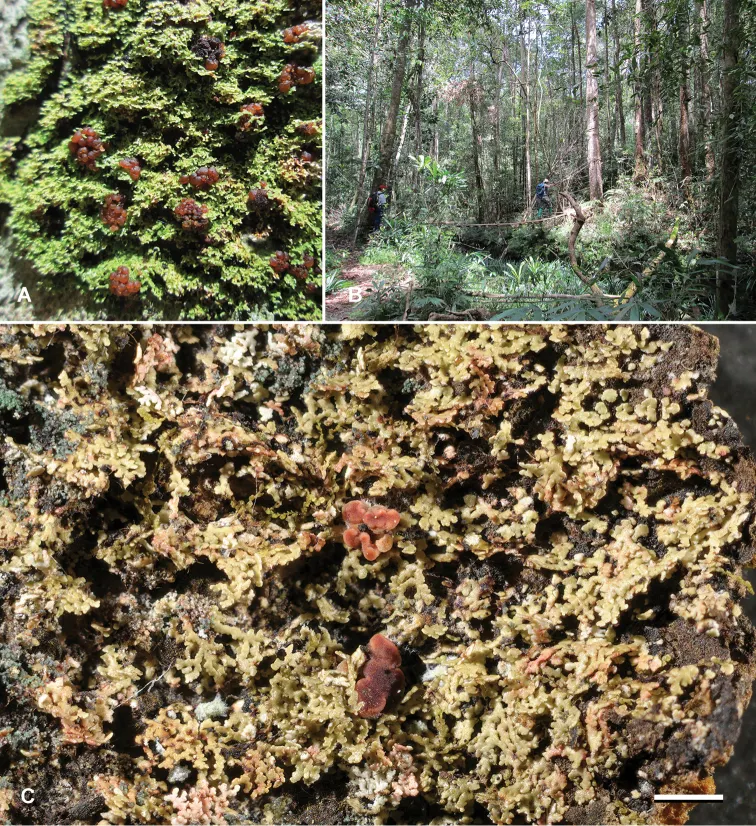
The species is known from five localities in Borneo. Ecology. The species occurred in rather low "Kerangas" (heath) forest vegetation or on transition vegetation between the heath and oak/conifer (particularly Agathis) forest at higher elevations (ca. 1000 m) on very poor soils on sandstone (Fig. 2B). The species always grew on the rather smooth barked, middle-sized trees together with various Pyrenulaceae and Graphidaceae.

Sebagian uraian ditampilkan dalam bahasa sumber; terjemahannya belum tersedia atau belum lolos pemeriksaan.

Rujukan: [1]

Habitat atau konteks temuan
hutan
Substrat
Informasi belum tersedia pada sumber rilis ini.
Peran atau konteks
Pembentuk liken
Temukan hubungan serupa
03 / Siklus hidup

Reproduksi

The species differs from K. isidiata in forming lacinules as vegetative dispersal units, not isidia, and from the other species in the genus in producing sekikaic and homosekikaic acid. Thallus effuse, squamulose; squamules up to 1 mm wide, deeply divided into 0.1–0.2 wide lobes, ascending, imbricate, flattened, elongated to partly linear, often slightly laterally constricted, greyish-green with patches of red (K+ purple) spots, epruinose, glabrous; margin concolorous with upper side, not fibrillose; lower side white; lacinules formed by tips of the lobes. Upper cortex composed of a single layer of thick-walled cells with angular to shortly cylindrical lumina (resembling Eschatogonia -type), not containing crystals (polarised light!); algal layer 30–40 µm thick, filled with crystals dissolving in K; medulla composed of loosely interwoven hyphae, not containing crystals dissolving in K; lower cortex resembling upper cortex, both continuing over the edge of the squamule; prothallus brownish-black, often well developed.

Sebagian uraian ditampilkan dalam bahasa sumber; terjemahannya belum tersedia atau belum lolos pemeriksaan.

Rujukan: [1]

04 / Batas informasi

Catatan identitas dan cakupan

  • Nama diterima mengikuti Catalogue of Life Base2026-09-11; uraian mempertahankan konsep dan nama sumber aslinya.
  • Preserve original treatment localities, hosts and substrate scope. Materials examined describe documented specimens, not the full global range.
  • Impor dan terjemahan otomatis belum diperiksa editorial per profil. Struktur reproduktif yang disebutkan tidak membuktikan seluruh siklus hidup diketahui.
  • Pengukuran pada uraian mengikuti spesimen, kultur, dan metode sumber; angka tidak diperluas ke semua populasi.

Catatan distribusi dalam narasi mengikuti sumbernya. Dokumentasi spesimen atau foto mengikuti catatan sumber. Bukti wilayah Indonesia dan penilaian konservasi tidak disimpulkan dari gambar.

05 / Dokumentasi

Melihat dengan konteks

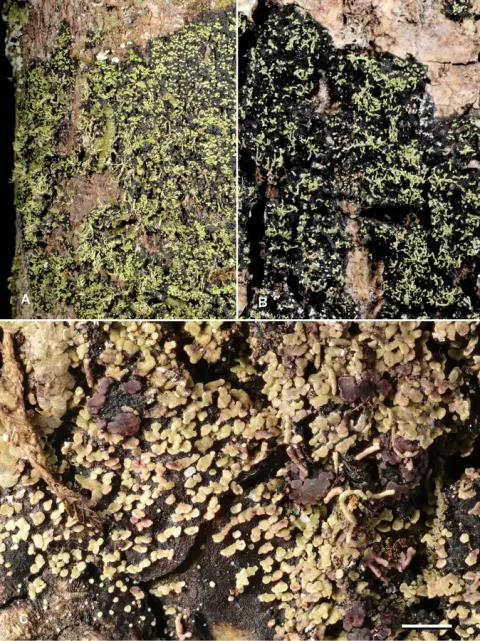
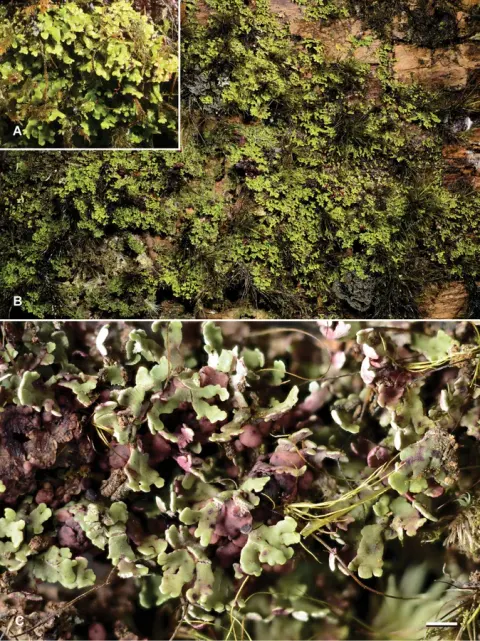
Krogia borneensis. A Field photograph of the holotype B habitat at type locality C herbarium photograph of holotype. Scale bar: 1 mm. Photo: H. Thüs (A, B), E. Timdal (C).

Jenis
Pelat ilmiah
Kredit
Sonja Kistenich, Jouko K. Rikkinen, Holger Thüs, Charles S. Vairappan, Patricia A. Wolseley, Einar Timdal
Lisensi
CC BY 4.0
Sumber media
Buka entri sumber

Gambar menunjukkan objek menurut identifikasi sumber, bukan verifikasi independen spesimen oleh Fungi. Tidak ada skala baru yang ditambahkan.

06 / Rujukan

Sumber profil

  1. [1] Three new species of Krogia (Ramalinaceae, lichenised Ascomycota) from the Paleotropics — Krogia borneensisBagian sumber: PMC6170524_section_12
    Tanggal penghimpunan sumber: 2026-10-12
    Teks sumber: CC BY 4.0 · Kistenich S, Rikkinen JK, Thüs H, Vairappan CS, Wolseley PA, Timdal E.
  2. [2] Catalogue of Life Base2026-09-11 — Krogia borneensisBagian sumber: ColDP NameUsage.tsv ID 6NNQ6; accepted species; source 2073
    Tanggal penghimpunan sumber: 2026-10-12
  3. [3] Dokumentasi visual — Krogia borneensisBagian sumber: Individual media record; identification follows the source, not independent determination
    Tanggal penghimpunan sumber: 2026-10-12
    Media sumber: CC BY 4.0 · Sonja Kistenich, Jouko K. Rikkinen, Holger Thüs, Charles S. Vairappan, Patricia A. Wolseley, Einar Timdal

Adaptasi teks: CC BY 4.0. Kistenich S, Rikkinen JK, Thüs H, Vairappan CS, Wolseley PA, Timdal E. — Three new species of Krogia (Ramalinaceae, lichenised Ascomycota) from the Paleotropics — Krogia borneensis

Uraian asli dan riwayat sumber

Riwayat atau halaman sumber

Ringkasan sumber

The species differs from K. isidiata in forming lacinules as vegetative dispersal units, not isidia, and from the other species in the genus in producing sekikaic and homosekikaic acid. Thallus effuse, squamulose; squamules up to 1 mm wide, deeply divided into 0.1–0.2 wide lobes, ascending, imbricate, flattened, elongated to partly linear, often slightly laterally constricted, greyish-green with patches of red (K+ purple) spots, epruinose, glabrous; margin concolorous with upper side, not fibrillose; lower side white; lacinules formed by tips of the lobes.

Revisi sumber

Morfologi sumber

The species differs from K. isidiata in forming lacinules as vegetative dispersal units, not isidia, and from the other species in the genus in producing sekikaic and homosekikaic acid. Thallus effuse, squamulose; squamules up to 1 mm wide, deeply divided into 0.1–0.2 wide lobes, ascending, imbricate, flattened, elongated to partly linear, often slightly laterally constricted, greyish-green with patches of red (K+ purple) spots, epruinose, glabrous; margin concolorous with upper side, not fibrillose; lower side white; lacinules formed by tips of the lobes. Upper cortex composed of a single layer of thick-walled cells with angular to shortly cylindrical lumina (resembling Eschatogonia -type), not containing crystals (polarised light!); algal layer 30–40 µm thick, filled with crystals dissolving in K; medulla composed of loosely interwoven hyphae, not containing crystals dissolving in K; lower cortex resembling upper cortex, both continuing over the edge of the squamule; prothallus brownish-black, often well developed. Apothecia (present in the holotype only) up to 0.6 mm diam. when simple, forming aggregates up to 1.5 mm diam., medium brown with red patches or entirely reddish-brown, more or less plane, with an indistinct, slightly paler, often flexuose margin; excipulum pale brown to colourless, composed of radiating, closely conglutinated hyphae, in inner part containing colourless crystals dissolving in K; hypothecium partly to entirely stained by a blood red pigment which dissolves in K with a purple effusion; epithecium colourless, not containing crystals. Ascospores filiform, curved, non-septate, spirally arranged in ascus, 20–31 × ca. 1.0 µm (n=10, from holotype).

Revisi sumber

Ekologi sumber

The species is known from five localities in Borneo. Ecology. The species occurred in rather low "Kerangas" (heath) forest vegetation or on transition vegetation between the heath and oak/conifer (particularly Agathis) forest at higher elevations (ca. 1000 m) on very poor soils on sandstone (Fig. 2B). The species always grew on the rather smooth barked, middle-sized trees together with various Pyrenulaceae and Graphidaceae.

Revisi sumber

Struktur reproduksi sumber

The species differs from K. isidiata in forming lacinules as vegetative dispersal units, not isidia, and from the other species in the genus in producing sekikaic and homosekikaic acid. Thallus effuse, squamulose; squamules up to 1 mm wide, deeply divided into 0.1–0.2 wide lobes, ascending, imbricate, flattened, elongated to partly linear, often slightly laterally constricted, greyish-green with patches of red (K+ purple) spots, epruinose, glabrous; margin concolorous with upper side, not fibrillose; lower side white; lacinules formed by tips of the lobes. Upper cortex composed of a single layer of thick-walled cells with angular to shortly cylindrical lumina (resembling Eschatogonia -type), not containing crystals (polarised light!); algal layer 30–40 µm thick, filled with crystals dissolving in K; medulla composed of loosely interwoven hyphae, not containing crystals dissolving in K; lower cortex resembling upper cortex, both continuing over the edge of the squamule; prothallus brownish-black, often well developed.

Revisi sumber

Rujukan halaman ini

Fungi. Krogia borneensis. Rilis data fungi-2026-10-12-expansion-2. https://fungi-atlas.mgadib.chatgpt.site/jamur/krogia-borneensis/.

Status: impor sumber; pemeriksaan editorial per profil belum selesai. Untuk klaim biologis, gunakan rujukan pada bagian terkait dan periksa konteks sumber aslinya.