Ciri dan struktur
The species differs from all other species of the genus in forming larger (up to 3 mm wide, vs. up to 0.3–1.5 mm wide in the other species) squamules and, except for K. coralloides, in producing an unknown compound resembling boninic acid. Thallus effuse, squamulose; squamules up to 3 mm wide, at first rounded, later becoming incised and deeply divided into up to 1 mm wide lobes, ascending even when young, often imbricate, flattened or with an up-turned tip, greyish-green, with patches of purple (K+ bluish-black) spots, epruinose, glabrous; margin concolorous with upper side, not fibrillose; lower side white; isidia (present in one specimen) attached marginally to the squamules, simple or sparingly branched, up to 1.6 mm long and 0.2 mm wide. Upper cortex composed of thick-walled, irregularly orientated hyphae with angular to cylindrical lumina, 50–80 µm thick, lacking an epinecral layer, not containing crystals (polarised light!); algal layer 25–35 µm thick, filled with crystals dissolving in K; medulla composed of loosely interwoven hyphae, upper part containing crystals dissolving in K; lower cortex lacking; prothallus lacking. Apothecia up to 1 mm diam. when simple, often forming aggregates up to 6 mm diam., pale to medium brown, with purple patches, plane to weakly convex, with an indistinct, slightly paler, often flexuose margin; excipulum pale brown to colourless, composed of radiating, closely conglutinated, thick-walled hyphae with narrowly cylindrical lumina, not containing crystals; hypothecium pale brown to colourless, composed of closely conglutinated, thick-walled hyphae with narrowly cylindrical lumina, not containing crystals; epithecium colourless, not containing crystals; purple pigment occurring patchily in exciple, hypothecium and hymenium.
Habitat dan peran ekologis
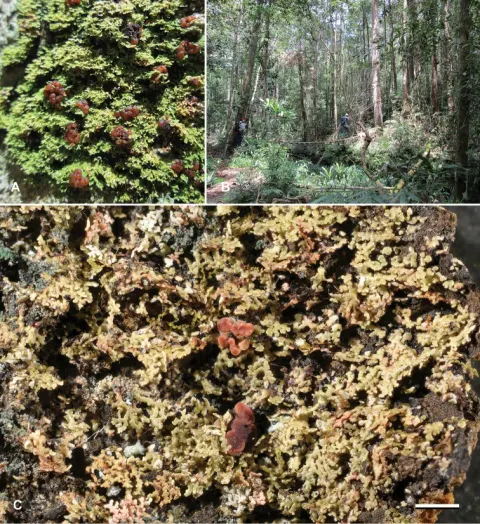
The species is known from three localities in New Caledonia. The species grows on tree trunks in moist or wet tropical forests (Figs 5A–C). Two collections are from montane mist forests and one from a low-elevation rainforest, all on ultramafic soils typical of the southern part of Grande Terre (main island of New Caledonia). It prefers shaded basal trunks that are otherwise mainly dominated by epiphytic bryophytes and/or leprarioid lichens.
- Habitat atau konteks temuan
- hutan
- Substrat
- Informasi belum tersedia pada sumber rilis ini.
- Peran atau konteks
- Pembentuk liken
Reproduksi
Thallus effuse, squamulose; squamules up to 3 mm wide, at first rounded, later becoming incised and deeply divided into up to 1 mm wide lobes, ascending even when young, often imbricate, flattened or with an up-turned tip, greyish-green, with patches of purple (K+ bluish-black) spots, epruinose, glabrous; margin concolorous with upper side, not fibrillose; lower side white; isidia (present in one specimen) attached marginally to the squamules, simple or sparingly branched, up to 1.6 mm long and 0.2 mm wide. Upper cortex composed of thick-walled, irregularly orientated hyphae with angular to cylindrical lumina, 50–80 µm thick, lacking an epinecral layer, not containing crystals (polarised light!); algal layer 25–35 µm thick, filled with crystals dissolving in K; medulla composed of loosely interwoven hyphae, upper part containing crystals dissolving in K; lower cortex lacking; prothallus lacking.
Catatan identitas dan cakupan
- Nama diterima mengikuti Catalogue of Life Base2026-09-11; uraian mempertahankan konsep dan nama sumber aslinya.
- Preserve original treatment localities, hosts and substrate scope. Materials examined describe documented specimens, not the full global range.
- Impor dan terjemahan otomatis belum diperiksa editorial per profil. Struktur reproduktif yang disebutkan tidak membuktikan seluruh siklus hidup diketahui.
- Pengukuran pada uraian mengikuti spesimen, kultur, dan metode sumber; angka tidak diperluas ke semua populasi.
Catatan distribusi dalam narasi mengikuti sumbernya. Dokumentasi spesimen atau foto mengikuti catatan sumber. Bukti wilayah Indonesia dan penilaian konservasi tidak disimpulkan dari gambar.
Melihat dengan konteks
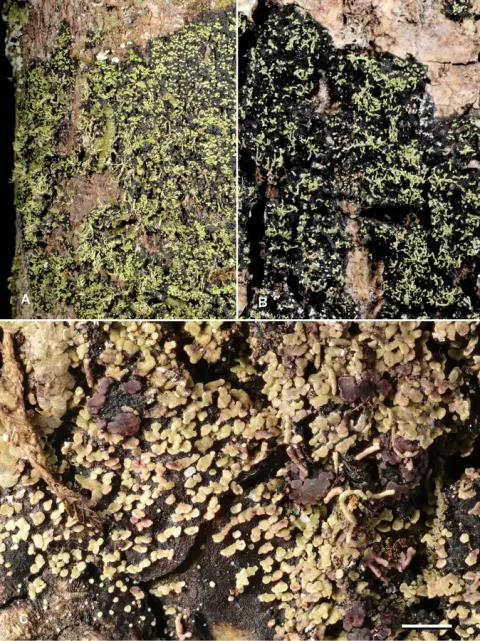
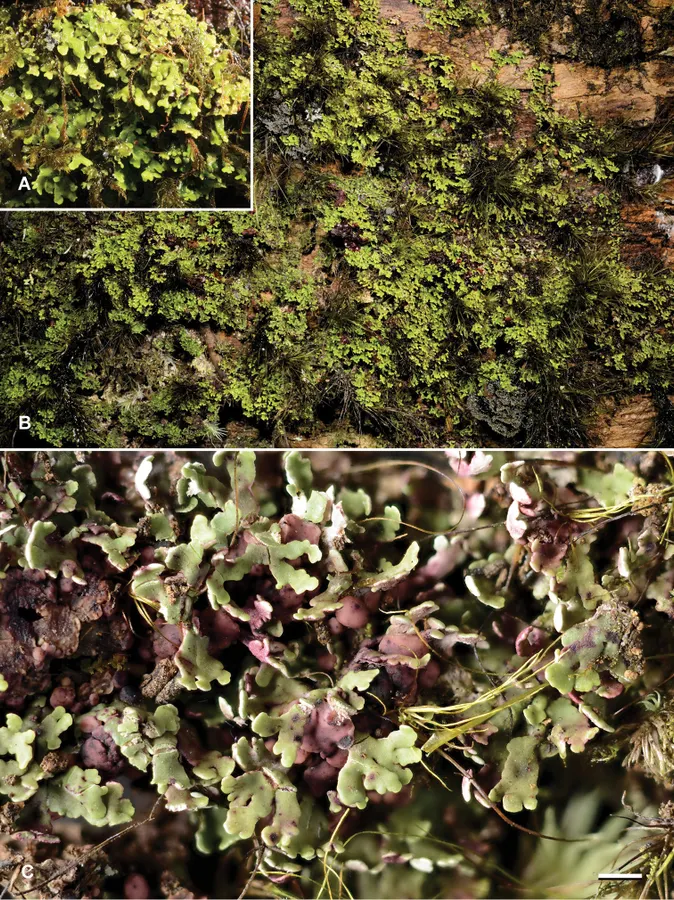
Krogia macrophylla A field photograph of JR36047 B field photograph of holotype C herbarium photograph of holotype. Scale bar: 1 mm. Photo: J. Rikkinen (A, B), E. Timdal (C).
- Jenis
- Pelat ilmiah
- Kredit
- Sonja Kistenich, Jouko K. Rikkinen, Holger Thüs, Charles S. Vairappan, Patricia A. Wolseley, Einar Timdal
- Lisensi
- CC BY 4.0
- Sumber media
- Buka entri sumber
Sumber profil
- [1] Three new species of Krogia (Ramalinaceae, lichenised Ascomycota) from the Paleotropics — Krogia macrophylla
- [2] Catalogue of Life Base2026-09-11 — Krogia macrophylla
- [3] Dokumentasi visual — Krogia macrophylla
Rujukan halaman ini
Fungi. Krogia macrophylla. Rilis data fungi-2026-10-12-expansion-2. https://fungi-atlas.mgadib.chatgpt.site/jamur/krogia-macrophylla/.
Status: impor sumber; pemeriksaan editorial per profil belum selesai. Untuk klaim biologis, gunakan rujukan pada bagian terkait dan periksa konteks sumber aslinya.