01 / Morfologi

Ciri dan struktur

Morphologically similar to Laboulbenia vulgaris Peyr., but the insertion cell is attached to the lower fifth of the posterior margin of the perithecial wall and the outer appendage is composed of 4–6(–8) branches resulting from successive dichotomies starting at the suprabasal cell, which is poorly pigmented or nearly hyaline. The LSU sequence shares 89.7–98.0% identity with other sequenced taxa of Laboulbenia, 97.4% with L. flagellata from Agonum nigrum, 97.5–98.0% with L. flagellata from Limodromus assimilis, 97.0–98.0% with L. flagellata from Agonum emarginatum / A. micans / Loricera pilicornis / Oxypselaphus obscurus, and 97.0–97.7% with L. vulgaris from Bembidion tetracolum / Ocys harpaloides. Unique molecular synapomorphies in the LSU at positions 503, 545. Thallus 300–465 µm long from foot to perithecial tip; colored hyaline at the lower receptacular cells (I and II) and the inner appendage, otherwise pigmented light to dark brown; especially the upper receptacular cells (III, IV and V), cell VI, and the perithecium darkening with age. Cell I elongated, usually straight, 56–107 × 22–33 µm; sometimes bent and then wider at the upper end. Cell II slender, mostly with parallel margins, longer than cell I, 73–160 × 29–40 µm, anterior margin shorter than posterior. Cells III and VI side by side, with septum II–III always much shorter than septum II–VI. Cell III with a narrow base, 29–43 µm long, widening upwards and then 22–29 µm wide at the apex. Cell VI more or less rectangular, 30–34 × 23–30 µm. Cell IV more or less rectangular, slightly broader than long, 20–32 × 25–30 µm.

Sebagian uraian ditampilkan dalam bahasa sumber; terjemahannya belum tersedia atau belum lolos pemeriksaan.

Rujukan: [1]

Pengukuran mengikuti objek, spesimen atau kultur, dan metode yang disebutkan sumber. Baca uraian asli untuk konteks lengkap.

02 / Kehidupan

Habitat dan peran ekologis

Thus far only known on Bembidion biguttatum from the type locality in Belgium. Reported as Laboulbenia sp. nov. in De Weggheleire (2019).

Sebagian uraian ditampilkan dalam bahasa sumber; terjemahannya belum tersedia atau belum lolos pemeriksaan.

Rujukan: [1]

Habitat atau konteks temuan
Informasi belum tersedia pada sumber rilis ini.
Substrat
Informasi belum tersedia pada sumber rilis ini.
Peran atau konteks
Pembentuk liken
Temukan hubungan serupa
03 / Siklus hidup

Reproduksi

Thallus 300–465 µm long from foot to perithecial tip; colored hyaline at the lower receptacular cells (I and II) and the inner appendage, otherwise pigmented light to dark brown; especially the upper receptacular cells (III, IV and V), cell VI, and the perithecium darkening with age. Cell I elongated, usually straight, 56–107 × 22–33 µm; sometimes bent and then wider at the upper end. Cell II slender, mostly with parallel margins, longer than cell I, 73–160 × 29–40 µm, anterior margin shorter than posterior. Cells III and VI side by side, with septum II–III always much shorter than septum II–VI. Cell III with a narrow base, 29–43 µm long, widening upwards and then 22–29 µm wide at the apex. Cell VI more or less rectangular, 30–34 × 23–30 µm.

Sebagian uraian ditampilkan dalam bahasa sumber; terjemahannya belum tersedia atau belum lolos pemeriksaan.

Rujukan: [1]

04 / Batas informasi

Catatan identitas dan cakupan

  • Nama diterima mengikuti Catalogue of Life Base2026-09-11; uraian mempertahankan konsep dan nama sumber aslinya.
  • Preserve original treatment localities, hosts and substrate scope. Materials examined describe documented specimens, not the full global range.
  • Impor dan terjemahan otomatis belum diperiksa editorial per profil. Struktur reproduktif yang disebutkan tidak membuktikan seluruh siklus hidup diketahui.
  • Pengukuran pada uraian mengikuti spesimen, kultur, dan metode sumber; angka tidak diperluas ke semua populasi.

Catatan distribusi dalam narasi mengikuti sumbernya. Dokumentasi spesimen atau foto mengikuti catatan sumber. Bukti wilayah Indonesia dan penilaian konservasi tidak disimpulkan dari gambar.

05 / Dokumentasi

Melihat dengan konteks

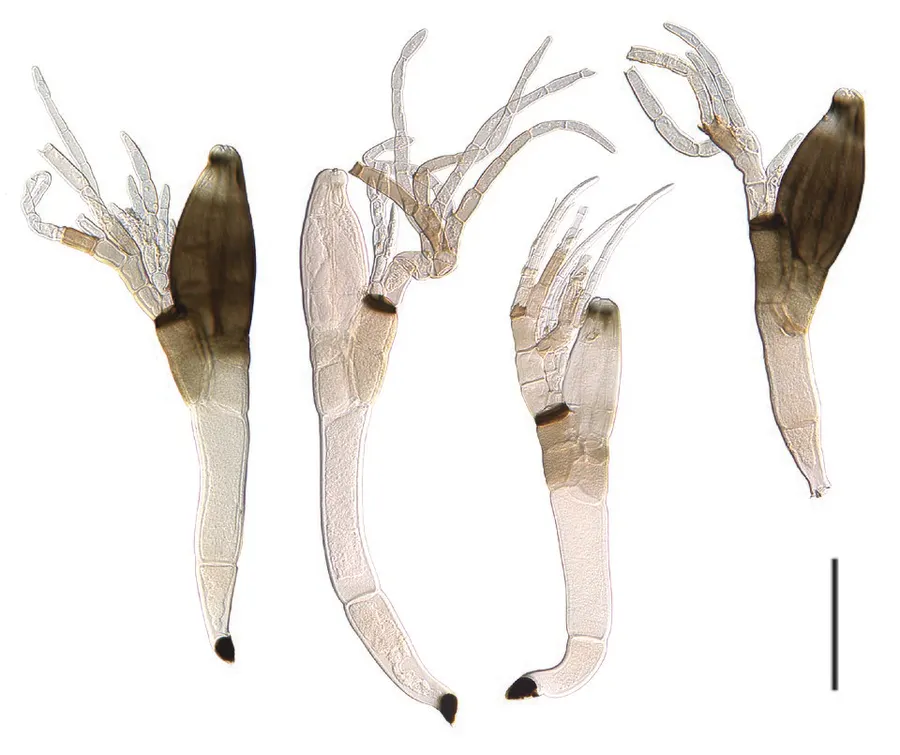
Dokumentasi Laboulbenia quarantenae dari Wikimedia Commons. Four thalli of Laboulbenia quarantenae, removed from a Bembidion biguttatum beetle (Coleoptera, Carabidae) collected on April 26 2019 at Domein van Bouchout, Belgium. Scale bar 100 μm. Identifikasi mengikuti record berkas sumber.

Jenis
Fotografi
Kredit
Dhaelewa
Sumber media
Buka entri sumber

Gambar menunjukkan objek menurut identifikasi sumber, bukan verifikasi independen spesimen oleh Fungi. Tidak ada skala baru yang ditambahkan.

06 / Rujukan

Sumber profil

  1. [1] Checklist of thallus-forming Laboulbeniomycetes from Belgium and the Netherlands, including Hesperomyces halyziae and Laboulbenia quarantenae spp. nov. — Laboulbenia quarantenaeBagian sumber: PMC7410850_section_17
    Tanggal penghimpunan sumber: 2026-10-12
    Teks sumber: CC BY 4.0 · Haelewaters D, Kesel A.
  2. [2] Catalogue of Life Base2026-09-11 — Laboulbenia quarantenaeBagian sumber: ColDP NameUsage.tsv ID 9Z9NQ; accepted species; source 2073
    Tanggal penghimpunan sumber: 2026-10-12
  3. [3] Dokumentasi visual — Laboulbenia quarantenaeBagian sumber: Individual media record; identification follows the source, not independent determination
    Tanggal penghimpunan sumber: 2026-10-12
    Media sumber: CC BY-SA 4.0 · Dhaelewa

Adaptasi teks: CC BY 4.0. Haelewaters D, Kesel A. — Checklist of thallus-forming Laboulbeniomycetes from Belgium and the Netherlands, including Hesperomyces halyziae and Laboulbenia quarantenae spp. nov. — Laboulbenia quarantenae

Uraian asli dan riwayat sumber

Riwayat atau halaman sumber

Ringkasan sumber

Morphologically similar to Laboulbenia vulgaris Peyr., but the insertion cell is attached to the lower fifth of the posterior margin of the perithecial wall and the outer appendage is composed of 4–6(–8) branches resulting from successive dichotomies starting at the suprabasal cell, which is poorly pigmented or nearly hyaline. The LSU sequence shares 89.7–98.0% identity with other sequenced taxa of Laboulbenia, 97.4% with L. flagellata from Agonum nigrum, 97.5–98.0% with L. flagellata from Limodromus assimilis, 97.0–98.0% with L. flagellata from Agonum emarginatum / A. micans / Loricera pilicornis / Oxypselaphus obscurus, and 97.0–97.7% with L. vulgaris from Bembidion tetracolum / Ocys harpaloides.

Revisi sumber

Morfologi sumber

Morphologically similar to Laboulbenia vulgaris Peyr., but the insertion cell is attached to the lower fifth of the posterior margin of the perithecial wall and the outer appendage is composed of 4–6(–8) branches resulting from successive dichotomies starting at the suprabasal cell, which is poorly pigmented or nearly hyaline. The LSU sequence shares 89.7–98.0% identity with other sequenced taxa of Laboulbenia, 97.4% with L. flagellata from Agonum nigrum, 97.5–98.0% with L. flagellata from Limodromus assimilis, 97.0–98.0% with L. flagellata from Agonum emarginatum / A. micans / Loricera pilicornis / Oxypselaphus obscurus, and 97.0–97.7% with L. vulgaris from Bembidion tetracolum / Ocys harpaloides. Unique molecular synapomorphies in the LSU at positions 503, 545. Thallus 300–465 µm long from foot to perithecial tip; colored hyaline at the lower receptacular cells (I and II) and the inner appendage, otherwise pigmented light to dark brown; especially the upper receptacular cells (III, IV and V), cell VI, and the perithecium darkening with age. Cell I elongated, usually straight, 56–107 × 22–33 µm; sometimes bent and then wider at the upper end. Cell II slender, mostly with parallel margins, longer than cell I, 73–160 × 29–40 µm, anterior margin shorter than posterior. Cells III and VI side by side, with septum II–III always much shorter than septum II–VI. Cell III with a narrow base, 29–43 µm long, widening upwards and then 22–29 µm wide at the apex. Cell VI more or less rectangular, 30–34 × 23–30 µm. Cell IV more or less rectangular, slightly broader than long, 20–32 × 25–30 µm.

Revisi sumber

Ekologi sumber

Thus far only known on Bembidion biguttatum from the type locality in Belgium. Reported as Laboulbenia sp. nov. in De Weggheleire (2019).

Revisi sumber

Struktur reproduksi sumber

Thallus 300–465 µm long from foot to perithecial tip; colored hyaline at the lower receptacular cells (I and II) and the inner appendage, otherwise pigmented light to dark brown; especially the upper receptacular cells (III, IV and V), cell VI, and the perithecium darkening with age. Cell I elongated, usually straight, 56–107 × 22–33 µm; sometimes bent and then wider at the upper end. Cell II slender, mostly with parallel margins, longer than cell I, 73–160 × 29–40 µm, anterior margin shorter than posterior. Cells III and VI side by side, with septum II–III always much shorter than septum II–VI. Cell III with a narrow base, 29–43 µm long, widening upwards and then 22–29 µm wide at the apex. Cell VI more or less rectangular, 30–34 × 23–30 µm.

Revisi sumber

Rujukan halaman ini

Fungi. Laboulbenia quarantenae. Rilis data fungi-2026-10-12-expansion-2. https://fungi-atlas.mgadib.chatgpt.site/jamur/laboulbenia-quarantenae/.

Status: impor sumber; pemeriksaan editorial per profil belum selesai. Untuk klaim biologis, gunakan rujukan pada bagian terkait dan periksa konteks sumber aslinya.