01 / Morfologi

Ciri dan struktur

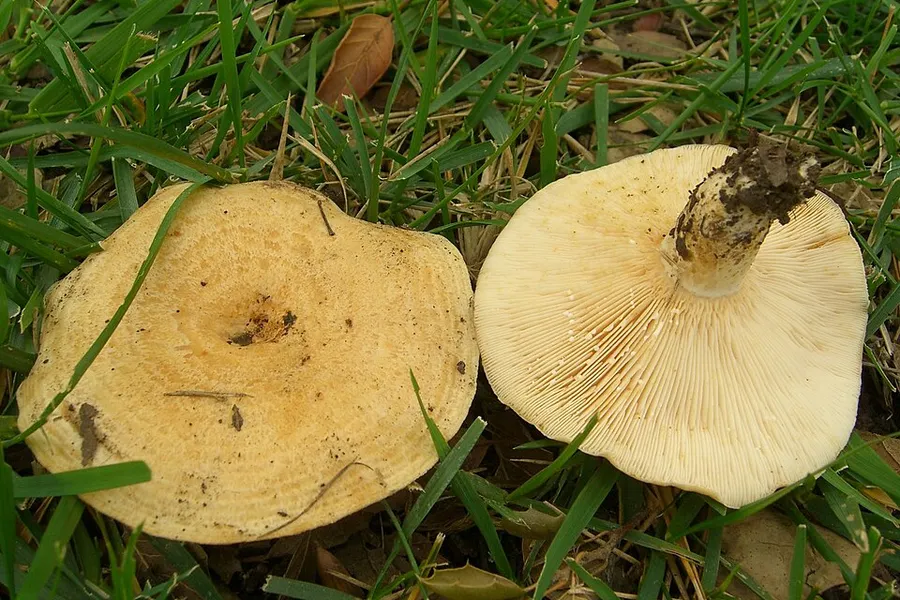
The cap is 6–20 cm wide, initially convex but becoming depressed to funnel-shaped in maturity. The cap margin is initially rolled inward, then becomes uplifted as the cap expands. The cap surface is sticky to slimy, and near the margin there are matted "hairs" beneath the slimy or sticky layer. The color of the cap surface is yellow-ochre, sometimes with concentric bands of lighter and darker shades; the color becomes paler near the margin. The gills are adnate (squarely attached to the stem) to decurrent (attached to and running down the length of the stem), narrow, and crowded closely together. Forked near the stem, the gills are initially whitish before becoming pale ochraceous-buff. There are many lamellulae—small gills that do not extend completely to the stem. The stem is 3–6 cm long and 2–3 cm thick, nearly equal in width throughout or tapered downward, dry, hard, coarsely pitted, and whitish to cream yellowish. It is initially solid, then becomes hollow with age. The flesh is thick, hard, whitish, and slowly stains pale yellow after the mushroom has been cut open. It has no distinctive odor, while the taste is immediately acrid. The latex is sparse, white on exposure to air, and unchanging or very slowly changing color to yellow. It stains cut flesh yellow, and tastes acrid. According to mycologist David Arora, the oak-loving central and southern Californian population of this species has a more latent acrid taste. The spore print may range slightly in color: thin deposits are white, thick deposits are more yellow. The mushroom is considered inedible because of the intensely peppery taste.

Sebagian uraian ditampilkan dalam bahasa sumber; terjemahannya belum tersedia atau belum lolos pemeriksaan.

Rujukan: [1]

Pengukuran mengikuti objek, spesimen atau kultur, dan metode yang disebutkan sumber. Baca uraian asli untuk konteks lengkap.

02 / Kehidupan

Habitat dan peran ekologis

Lactarius alnicola adalah spesies ektomikoriza, dan terlibat dalam hubungan mutualistik dengan spesies tumbuhan tertentu. In this association, the hyphae of the fungus permeate large volumes of soil and obtain scarce elements, especially phosphorus—which is often limiting for plant growth—which they pass on to the plant in exchange for metabolic products of the plant's photosynthesis. Ektomikorria yang terbentuk jamur dalam hubungan dengan Picea engelmannii telah terbukti mengandung laktis (sel-sel yang memproduksi lateks) dan pigmen yang mirip dengan tubuh buah. Fruit bodies jamur tumbuh dalam kelompok di tanah di bawah pohon alders dan konifer, biasanya muncul antara July and Oktober. Ini adalah spesies yang cukup umum di barat Amerika Serikat States and Baja California. Additional collection lokasi di Mexico include Veracruz, Villarreal, dan Tapia. Populasi di tengah dan selatan California is yang dikenal terkait dengan pohon ek. Di Rocky Mountains it dikaitkan dengan spesies pohon subalpine Engelmann Spruce (Picea engelmannii), sementara di ketinggian yang lebih rendah biasanya ditemukan dengan pohon spruce putih (Picea glauca). Hal ini juga dikenal untuk berhubungan dengan Ponderosa Pine (Pinus ponderosa) dan Douglas-fir (genus Pseudotsuga).

Sebagian uraian ditampilkan dalam bahasa sumber; terjemahannya belum tersedia atau belum lolos pemeriksaan.

Rujukan: [1]

Habitat atau konteks temuan
Informasi belum tersedia pada sumber rilis ini.
Substrat
tanah
Peran atau konteks
Mitra tumbuhan
Temukan hubungan serupa
03 / Siklus hidup

Reproduksi

The stem is 3–6 cm long and 2–3 cm thick, nearly equal in width throughout or tapered downward, dry, hard, coarsely pitted, and whitish to cream yellowish. It is initially solid, then becomes hollow with age. The flesh is thick, hard, whitish, and slowly stains pale yellow after the mushroom has been cut open. It has no distinctive odor, while the taste is immediately acrid. The latex is sparse, white on exposure to air, and unchanging or very slowly changing color to yellow. It stains cut flesh yellow, and tastes acrid. According to mycologist David Arora, the oak-loving central and southern Californian population of this species has a more latent acrid taste. The spore print may range slightly in color: thin deposits are white, thick deposits are more yellow.

Sebagian uraian ditampilkan dalam bahasa sumber; terjemahannya belum tersedia atau belum lolos pemeriksaan.

Rujukan: [1]

Sinonim menurut acuan taksonomi rilis: Lactarius alnicola var. pitkinensis; Lactarius alnicola var. pungens
04 / Batas informasi

Catatan identitas dan cakupan

  • Nama diterima mengikuti Catalogue of Life Base2026-09-11; uraian mempertahankan konsep dan nama sumber aslinya.
  • Original geographic, specimen and life-cycle scope retained; source import awaits individual editorial review.
  • Impor dan terjemahan otomatis belum diperiksa editorial per profil. Struktur reproduktif yang disebutkan tidak membuktikan seluruh siklus hidup diketahui.
  • Pengukuran pada uraian mengikuti spesimen, kultur, dan metode sumber; angka tidak diperluas ke semua populasi.

Catatan distribusi dalam narasi mengikuti sumbernya. Dokumentasi spesimen atau foto mengikuti catatan sumber. Bukti wilayah Indonesia dan penilaian konservasi tidak disimpulkan dari gambar.

05 / Dokumentasi

Melihat dengan konteks

Dokumentasi Lactarius alnicola dari Wikimedia Commons. The mushroom Lactarius alnicola A.H. Sm. Specimen photographed in Madison Heights, Pasadena, Los Angeles Co., California, USA. Identifikasi mengikuti record berkas sumber.

Jenis
Fotografi
Kredit
This image was created by user Jason Hollinger (jason) at Mushroom Observer , a source for mycological images. You can contact this user here .
Sumber media
Buka entri sumber

Gambar menunjukkan objek menurut identifikasi sumber, bukan verifikasi independen spesimen oleh Fungi. Tidak ada skala baru yang ditambahkan.

06 / Rujukan

Sumber profil

  1. [1] Lactarius alnicola — Wikipedia (en)Bagian sumber: Frozen revision 1368459847
    Tanggal penghimpunan sumber: 2026-10-12
    Teks sumber: CC BY-SA4.0 · Wikipedia contributors
  2. [2] Catalogue of Life Base2026-09-11 — Lactarius alnicolaBagian sumber: ColDP NameUsage.tsv ID 3RRL7; accepted species; source 2073
    Tanggal penghimpunan sumber: 2026-10-12
  3. [3] Dokumentasi visual — Lactarius alnicolaBagian sumber: Individual media record; identification follows the source, not independent determination
    Tanggal penghimpunan sumber: 2026-10-12
    Media sumber: CC BY-SA 3.0 · This image was created by user Jason Hollinger (jason) at Mushroom Observer , a source for mycological images. You can contact this user here .

Adaptasi teks: CC BY-SA 4.0. Wikipedia contributors — Lactarius alnicola — Wikipedia (en)

Uraian asli dan riwayat sumber

Riwayat atau halaman sumber

Ringkasan sumber

Lactarius alnicola, commonly known as the golden milkcap, is a species of fungus in the family Russulaceae. The fruit bodies produced by the fungus are characterized by a sticky, vanilla-colored cap up to 20 cm wide with a mixture of yellow tones arranged in faint concentric bands. The stem is up to 5 cm long and has yellow-brown spots. When it is cut or injured, the mushroom oozes a white latex, which has an intensely peppery taste. The acrid taste of the fruit bodies renders them unpalatable. Two varieties have been named: var. pitkinensis, known from Colorado, and var. pungens, from Michigan.

Revisi sumber

Morfologi sumber

The cap is 6–20 cm wide, initially convex but becoming depressed to funnel-shaped in maturity. The cap margin is initially rolled inward, then becomes uplifted as the cap expands. The cap surface is sticky to slimy, and near the margin there are matted "hairs" beneath the slimy or sticky layer. The color of the cap surface is yellow-ochre, sometimes with concentric bands of lighter and darker shades; the color becomes paler near the margin. The gills are adnate (squarely attached to the stem) to decurrent (attached to and running down the length of the stem), narrow, and crowded closely together. Forked near the stem, the gills are initially whitish before becoming pale ochraceous-buff. There are many lamellulae—small gills that do not extend completely to the stem. The stem is 3–6 cm long and 2–3 cm thick, nearly equal in width throughout or tapered downward, dry, hard, coarsely pitted, and whitish to cream yellowish. It is initially solid, then becomes hollow with age. The flesh is thick, hard, whitish, and slowly stains pale yellow after the mushroom has been cut open. It has no distinctive odor, while the taste is immediately acrid. The latex is sparse, white on exposure to air, and unchanging or very slowly changing color to yellow. It stains cut flesh yellow, and tastes acrid. According to mycologist David Arora, the oak-loving central and southern Californian population of this species has a more latent acrid taste. The spore print may range slightly in color: thin deposits are white, thick deposits are more yellow. The mushroom is considered inedible because of the intensely peppery taste.

Revisi sumber

Ekologi sumber

Lactarius alnicola is an ectomycorrhizal species, and engages in a mutualistic association with certain plant species. In this association, the hyphae of the fungus permeate large volumes of soil and obtain scarce elements, especially phosphorus—which is often limiting for plant growth—which they pass on to the plant in exchange for metabolic products of the plant's photosynthesis. The ectomycorrhizae that the fungus forms in association with Picea engelmannii have been shown to contain lactifers (latex-producing cells) and pigments similar to the fruit body. Fruit bodies of the fungus grow in groups on the ground under alders and conifers, usually appearing between July and October. It is a fairly common species in the western United States and Baja California. Additional collection locations in Mexico include Veracruz, Villarreal, and Tapia. A population in central and southern California is known to associate with oak trees. In the Rocky Mountains it is associated with the subalpine tree species Engelmann Spruce (Picea engelmannii), while at lower elevations it is commonly found with white spruce (Picea glauca). It is also known to associate with Ponderosa Pine (Pinus ponderosa) and Douglas-fir (genus Pseudotsuga).

Revisi sumber

Struktur reproduksi sumber

The stem is 3–6 cm long and 2–3 cm thick, nearly equal in width throughout or tapered downward, dry, hard, coarsely pitted, and whitish to cream yellowish. It is initially solid, then becomes hollow with age. The flesh is thick, hard, whitish, and slowly stains pale yellow after the mushroom has been cut open. It has no distinctive odor, while the taste is immediately acrid. The latex is sparse, white on exposure to air, and unchanging or very slowly changing color to yellow. It stains cut flesh yellow, and tastes acrid. According to mycologist David Arora, the oak-loving central and southern Californian population of this species has a more latent acrid taste. The spore print may range slightly in color: thin deposits are white, thick deposits are more yellow.

Revisi sumber

Rujukan halaman ini

Fungi. Lactarius alnicola. Rilis data fungi-2026-10-12-expansion-2. https://fungi-atlas.mgadib.chatgpt.site/jamur/lactarius-alnicola/.

Status: impor sumber; pemeriksaan editorial per profil belum selesai. Untuk klaim biologis, gunakan rujukan pada bagian terkait dan periksa konteks sumber aslinya.