01 / Morfologi

Ciri dan struktur

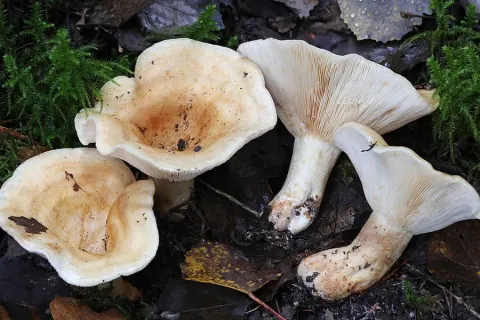
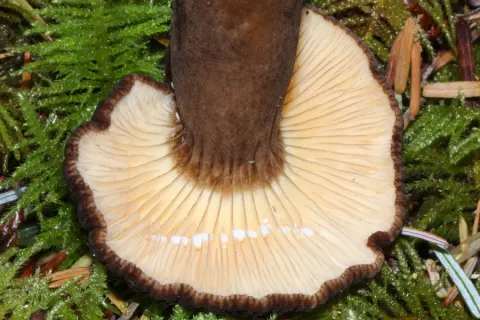
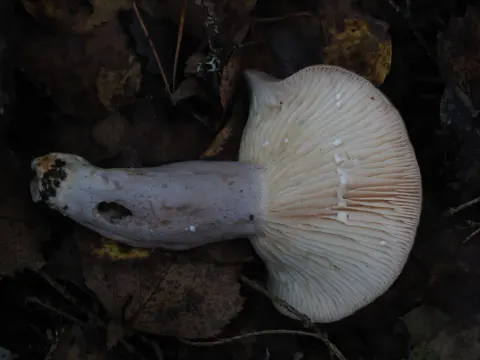
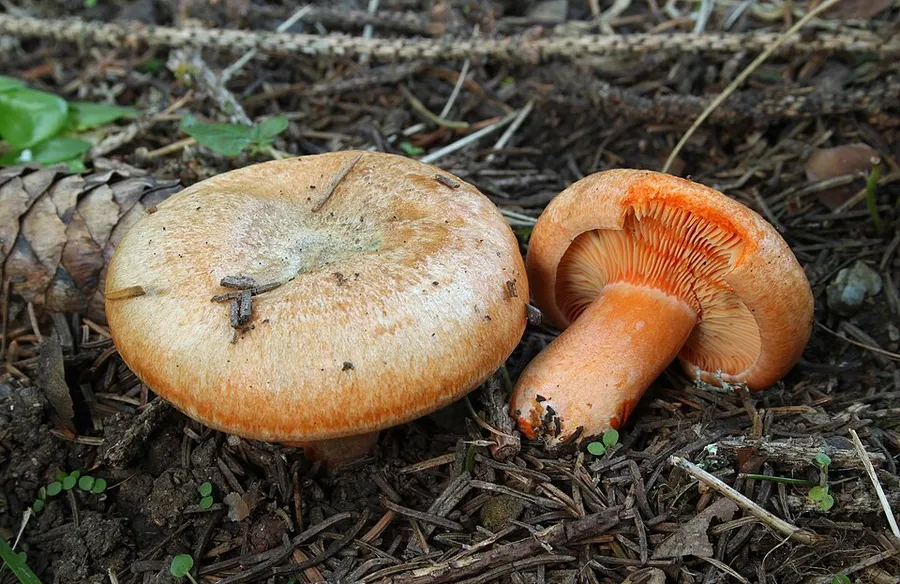
The cap is 3 to 10 cm, rarely up to 12 cm wide and more or less centrifugal-shaped and round. It is at early stage convex, furled on the edge, and depressed in the centre. Later it is flat, funnel-shaped, and depressed. The cap skin is bare, greasy in moist weather and slightly shiny when dry. The cap is tangerine to orange-brown, darker zoned towards the edges and dulls mainly yellow-brown. In old age or after cold or frost it changes the colour more or less to dirty greenish or green-spotted. The dense, bow-like lamellae are pale-orange to pale-ochre and on the stipe basifixed or slightly decurrent. They are brittle and intermixed with shorter lamellulae (short gills that do not extend fully from the cap margin to the stem) as well as partly forking near the stem. In old age or in cases of injury they receive initially dark red, later grey green spots. The spore print is pale ochre. The mainly long and cylindrical stipe is reddish orange. It is 4 to 8 cm (rarely 10 cm) long, 1 to 1.5 cm wide and barely foveate or blotchy. On the basis it is often slightly thickened or pompous and becomes hollow inside. A bloomy circular zones is found on the lamella disposition. The milk is first carrot-red and becomes a maroon colour within 10 to 30 minutes. The brittle and pale-yellowish flesh is often infested with maggots. If cut or injured it becomes, as the milk, first carrot-red, then maroon and within hours dirty green. The fruit body smells harsh, fruit-like and first tastes mild, but then slightly resinous-bitter and nearly spicy or somewhat astringent. The rotund to ellipsoid spores are 7.5–10 μm long and 6–7.6 μm wide.

Sebagian uraian ditampilkan dalam bahasa sumber; terjemahannya belum tersedia atau belum lolos pemeriksaan.

Rujukan: [1]

Pengukuran mengikuti objek, spesimen atau kultur, dan metode yang disebutkan sumber. Baca uraian asli untuk konteks lengkap.

02 / Kehidupan

Habitat dan peran ekologis

Lactarius deterrimus terutama didistribusikan di Eropa, tetapi jamur ini juga ditemukan di daerah Asia (Turki, India, Pakistan). According to penelitian biologis molekul baru-baru ini, Utara yang mirip American species dari Amerika Serikat States and Mexico are tidak terkait erat dengan European species. In Europe, the fungus is especially common in Northern, North-East and Central Europe; in the UK, it may be found from July through to November. Di selatan dan barat, ini umum di daerah pegunungan. Di timur, wilayahnya mencapai Rusia. Lactarius deterrimus secara tradisional dianggap memiliki spesifikitas host mikoriza yang ketat dengan Norway spruce. Pada 2006, dilaporkan bahwa jamur juga dapat membentuk mycorrhiza arbutoid dengan bearberry (Arctostaphylos uva-ursi). Asosiasi Arbutoid mycorrhizal adalah varian ektomikoriza yang ditemukan pada tumbuhan tertentu di Ericaceae characterised oleh hifa koil di sel epidermis. Mikorhiza yang terbentuk oleh L. deterrimus pada bearberry dan Norway spruce menunjukkan ciri khas seperti mantel hifa dan Hartig net; karakteristik yang membedakan antara simbiosis mikoriza dengan inang yang berbeda adalah bahwa hifa menembus sel epidermal bearberry, meskipun ada juga beberapa perbedaan dalam bentuk Hartig net, pola cabang, dan warna.

Sebagian uraian ditampilkan dalam bahasa sumber; terjemahannya belum tersedia atau belum lolos pemeriksaan.

Rujukan: [1]

Habitat atau konteks temuan
Informasi belum tersedia pada sumber rilis ini.
Substrat
Informasi belum tersedia pada sumber rilis ini.
Peran atau konteks
Mitra tumbuhan
Temukan hubungan serupa
03 / Siklus hidup

Reproduksi

The dense, bow-like lamellae are pale-orange to pale-ochre and on the stipe basifixed or slightly decurrent. They are brittle and intermixed with shorter lamellulae (short gills that do not extend fully from the cap margin to the stem) as well as partly forking near the stem. In old age or in cases of injury they receive initially dark red, later grey green spots. The spore print is pale ochre. The rotund to ellipsoid spores are 7.5–10 μm long and 6–7.6 μm wide. The surface ornamentation extends to 0.5 μm high and is mainly from warts and short, wide ridges, which are linked through few fine lines to form an incomplete net (reticulum). The suprahilar area, a distinctly limited zone above the apiculus, is weakly amyloid.

Sebagian uraian ditampilkan dalam bahasa sumber; terjemahannya belum tersedia atau belum lolos pemeriksaan.

Rujukan: [1]

Sinonim menurut acuan taksonomi rilis: Lactarius deliciosus var. deterrimus
04 / Batas informasi

Catatan identitas dan cakupan

  • Nama diterima mengikuti Catalogue of Life Base2026-09-11; uraian mempertahankan konsep dan nama sumber aslinya.
  • Original geographic, specimen and life-cycle scope retained; source import awaits individual editorial review.
  • Impor dan terjemahan otomatis belum diperiksa editorial per profil. Struktur reproduktif yang disebutkan tidak membuktikan seluruh siklus hidup diketahui.
  • Pengukuran pada uraian mengikuti spesimen, kultur, dan metode sumber; angka tidak diperluas ke semua populasi.

Catatan distribusi dalam narasi mengikuti sumbernya. Dokumentasi spesimen atau foto mengikuti catatan sumber. Bukti wilayah Indonesia dan penilaian konservasi tidak disimpulkan dari gambar.

05 / Dokumentasi

Melihat dengan konteks

Dokumentasi Lactarius deterrimus dari Wikimedia Commons. False Saffron Milk-Cap, Lactarius deterrimus , Family: Russulaceae, Location: Germany, Oberstdorf Identifikasi mengikuti record berkas sumber.

Jenis
Fotografi
Kredit
Holger Krisp
Lisensi
CC BY 3.0
Sumber media
Buka entri sumber

Gambar menunjukkan objek menurut identifikasi sumber, bukan verifikasi independen spesimen oleh Fungi. Tidak ada skala baru yang ditambahkan.

06 / Rujukan

Sumber profil

  1. [1] Lactarius deterrimus — Wikipedia (en)Bagian sumber: Frozen revision 1372051819
    Tanggal penghimpunan sumber: 2026-10-12
    Teks sumber: CC BY-SA4.0 · Wikipedia contributors
  2. [2] Catalogue of Life Base2026-09-11 — Lactarius deterrimusBagian sumber: ColDP NameUsage.tsv ID 3RRSG; accepted species; source 2073
    Tanggal penghimpunan sumber: 2026-10-12
  3. [3] Dokumentasi visual — Lactarius deterrimusBagian sumber: Individual media record; identification follows the source, not independent determination
    Tanggal penghimpunan sumber: 2026-10-12
    Media sumber: CC BY 3.0 · Holger Krisp

Adaptasi teks: CC BY-SA 4.0. Wikipedia contributors — Lactarius deterrimus — Wikipedia (en)

Uraian asli dan riwayat sumber

Riwayat atau halaman sumber

Ringkasan sumber

Lactarius deterrimus, also known as false saffron milkcap or orange milkcap, is a species of fungus in the family Russulaceae. The fungus produces medium-sized fruit bodies (mushrooms) with orangish caps up to 12 cm wide that develop green spots in old age or if injured. Its orange-coloured latex stains maroon within 30 minutes. Lactarius deterrimus is a mycorrhizal fungus that associates with Norway spruce and bearberry. The species is distributed in Europe, but has also found in parts of Asia.

Revisi sumber

Morfologi sumber

The cap is 3 to 10 cm, rarely up to 12 cm wide and more or less centrifugal-shaped and round. It is at early stage convex, furled on the edge, and depressed in the centre. Later it is flat, funnel-shaped, and depressed. The cap skin is bare, greasy in moist weather and slightly shiny when dry. The cap is tangerine to orange-brown, darker zoned towards the edges and dulls mainly yellow-brown. In old age or after cold or frost it changes the colour more or less to dirty greenish or green-spotted. The dense, bow-like lamellae are pale-orange to pale-ochre and on the stipe basifixed or slightly decurrent. They are brittle and intermixed with shorter lamellulae (short gills that do not extend fully from the cap margin to the stem) as well as partly forking near the stem. In old age or in cases of injury they receive initially dark red, later grey green spots. The spore print is pale ochre. The mainly long and cylindrical stipe is reddish orange. It is 4 to 8 cm (rarely 10 cm) long, 1 to 1.5 cm wide and barely foveate or blotchy. On the basis it is often slightly thickened or pompous and becomes hollow inside. A bloomy circular zones is found on the lamella disposition. The milk is first carrot-red and becomes a maroon colour within 10 to 30 minutes. The brittle and pale-yellowish flesh is often infested with maggots. If cut or injured it becomes, as the milk, first carrot-red, then maroon and within hours dirty green. The fruit body smells harsh, fruit-like and first tastes mild, but then slightly resinous-bitter and nearly spicy or somewhat astringent. The rotund to ellipsoid spores are 7.5–10 μm long and 6–7.6 μm wide.

Revisi sumber

Ekologi sumber

Lactarius deterrimus is mainly distributed in Europe, but the fungus has also found in areas of Asia (Turkey, India, Pakistan). According to recent molecular biologic research, the similar North American species from the United States and Mexico are not closely related to the European species. In Europe, the fungus is especially common in Northern, North-East and Central Europe; in the UK, it may be found from July through to November. In the south and west it is common in mountainous areas. In the east, its range extends to Russia. Lactarius deterrimus has traditionally been considered to have a strict mycorrhizal host specificity with Norway spruce. In 2006, it was reported that the fungus can also form arbutoid mycorrhiza with bearberry (Arctostaphylos uva-ursi). Arbutoid mycorrhizal associations are variants of ectomycorrhiza found in certain plants in the Ericaceae characterised by hyphal coils in epidermal cells. The mycorrhiza formed by L. deterrimus on both bearberry and Norway spruce show typical features such as a hyphal mantle and a Hartig net; the distinguishing characteristic between the mycorrhizal symbioses with the different hosts is that the hyphae penetrate the epidermal cells of bearberry, although there are also some differences in the form of the Hartig net, branching pattern, and colour.

Revisi sumber

Struktur reproduksi sumber

The dense, bow-like lamellae are pale-orange to pale-ochre and on the stipe basifixed or slightly decurrent. They are brittle and intermixed with shorter lamellulae (short gills that do not extend fully from the cap margin to the stem) as well as partly forking near the stem. In old age or in cases of injury they receive initially dark red, later grey green spots. The spore print is pale ochre. The rotund to ellipsoid spores are 7.5–10 μm long and 6–7.6 μm wide. The surface ornamentation extends to 0.5 μm high and is mainly from warts and short, wide ridges, which are linked through few fine lines to form an incomplete net (reticulum). The suprahilar area, a distinctly limited zone above the apiculus, is weakly amyloid.

Revisi sumber

Rujukan halaman ini

Fungi. Lactarius deterrimus. Rilis data fungi-2026-10-12-expansion-2. https://fungi-atlas.mgadib.chatgpt.site/jamur/lactarius-deterrimus/.

Status: impor sumber; pemeriksaan editorial per profil belum selesai. Untuk klaim biologis, gunakan rujukan pada bagian terkait dan periksa konteks sumber aslinya.