Ciri dan struktur
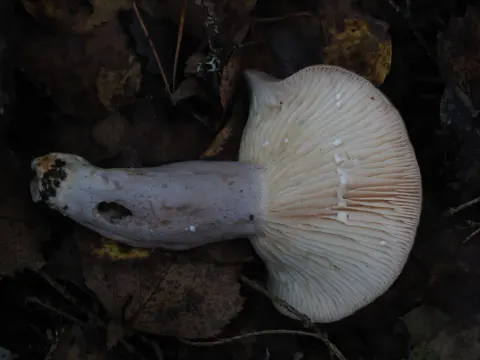
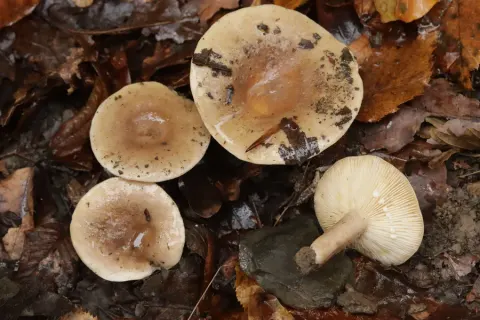
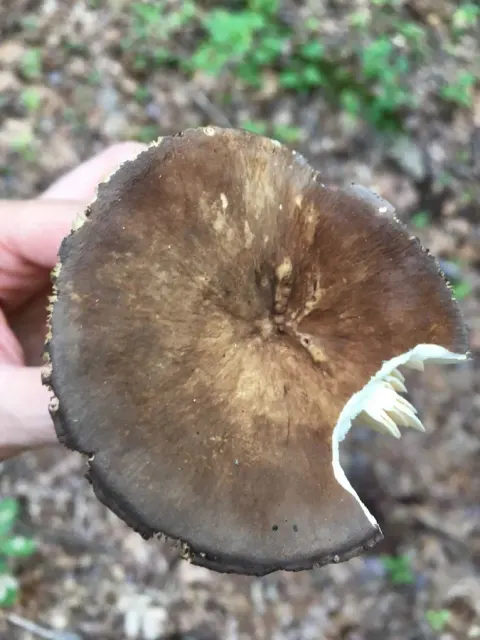
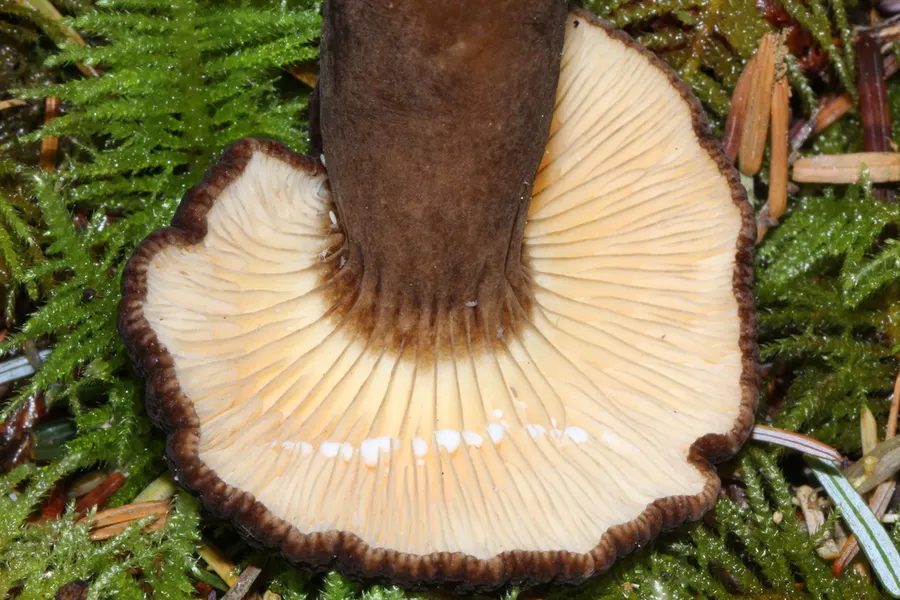
The cap of L. fallax is 2 – 9 cm wide, ranging in shape from convex to nearly flat with a small umbo, expanding to plane or becoming shallowly depressed, with or without the umbo. The margin (cap edge) is even or scalloped. The cap surface is dry and velvety, finely wrinkled over the center, azonate (without concentric lines), and dark sooty brown to blackish. The gills are attached to subdecurrent (running shortly down the length of the stem), narrow, crowded, not forked, white at first, and become creamy buff with age. The edges of the gills are brown like the cap, and slowly stain vinaceous (redwine-colored) when bruised. There are several tiers of lamellulae (short gills that do not reach the stem) interspersed among the full-length gills. The stem is 2.5 – 8 cm long, 5 – 15 mm thick, nearly equal in width throughout, dry, solid, unpolished or velvety, and a paler brown than the cap. The flesh is thin, brittle, staining pale vinaceous. The odor is not distinctive, and the taste mild or faintly acrid. The latex is copious, white on exposure, unchanging, slowly staining flesh and gills vinaceous. The spore print is yellowish-white. The edibility of the mushroom is unknown. The species is one of several brown to nearly black milkcaps that are, according to David Arora, "notable for their beauty, and therefore likely to attract the attention of even the casual collector". The variety Lactarius fallax var. concolor is nearly identical to the main species in appearance and distribution, but has gill edges that are colored like the gill face. The spores are spherical, and ornamented with warts and ridges that form a partial reticulum (a net-like pattern of lines) with prominences up to 2 μm high.
Habitat dan peran ekologis
Tubuh buah L. fallax tumbuh terpecah-pecah dan dikelompokkan bersama di tanah, atau di atas batang konifer yang sangat busuk di daerah alpine di bawah konifer berdiri. They are juga ditemukan di hutan pohon cemara. They are cukup umum, dan biasanya ditemukan antara August and Oktober. L. fallax terbagi di barat Kanada Serikat States and, dengan rentang utara yang membentang ke Alaska; rentang timur dibatasi di timur oleh Dataran Tinggi. Field observations menunjukkan bahwa jamur dapat membentuk ektomikoriza asosiasi dengan Tsuga heterophylla. Hesler and Smith noted bahwa varietas warna konkolor yang dominan di antara spesies Fir.
- Habitat atau konteks temuan
- hutan
- Substrat
- tanah
- Peran atau konteks
- Mitra tumbuhan
Reproduksi
The cap of L. fallax is 2 – 9 cm wide, ranging in shape from convex to nearly flat with a small umbo, expanding to plane or becoming shallowly depressed, with or without the umbo. The margin (cap edge) is even or scalloped. The cap surface is dry and velvety, finely wrinkled over the center, azonate (without concentric lines), and dark sooty brown to blackish. The gills are attached to subdecurrent (running shortly down the length of the stem), narrow, crowded, not forked, white at first, and become creamy buff with age. The edges of the gills are brown like the cap, and slowly stain vinaceous (redwine-colored) when bruised. There are several tiers of lamellulae (short gills that do not reach the stem) interspersed among the full-length gills.
Catatan identitas dan cakupan
- Nama diterima mengikuti Catalogue of Life Base2026-09-11; uraian mempertahankan konsep dan nama sumber aslinya.
- Original geographic, specimen and life-cycle scope retained; source import awaits individual editorial review.
- Impor dan terjemahan otomatis belum diperiksa editorial per profil. Struktur reproduktif yang disebutkan tidak membuktikan seluruh siklus hidup diketahui.
- Pengukuran pada uraian mengikuti spesimen, kultur, dan metode sumber; angka tidak diperluas ke semua populasi.
Catatan distribusi dalam narasi mengikuti sumbernya. Dokumentasi spesimen atau foto mengikuti catatan sumber. Bukti wilayah Indonesia dan penilaian konservasi tidak disimpulkan dari gambar.
Melihat dengan konteks
Dokumentasi Lactarius fallax menurut asosiasi foto pada record takson iNaturalist. Kredit: Alan Rockefeller. Identitas mengikuti sumber; bukan penentuan spesimen independen.
- Jenis
- Fotografi
- Kredit
- (c) Alan Rockefeller, some rights reserved (CC BY), uploaded by Alan Rockefeller
- Lisensi
- CC BY 4.0
- Sumber media
- Buka entri sumber
Dokumentasi tambahan
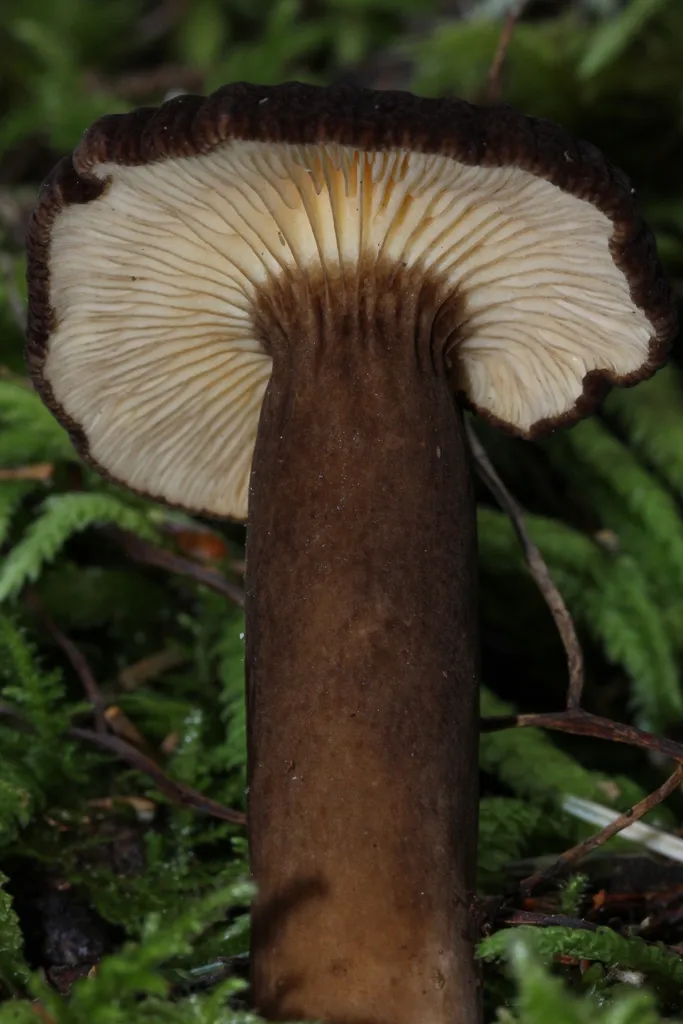
Foto yang diasosiasikan dengan Lactarius fallax pada iNaturalist. Identifikasi mengikuti sumber; bukan penentuan spesimen independen.
Kredit dan penggunaan
(c) Alan Rockefeller, some rights reserved (CC BY), uploaded by Alan Rockefeller
Ukuran dan format gambar disesuaikan tanpa pemotongan, retus, atau penambahan skala. Lisensi sumber dipertahankan.
Sumber profil
- [1] Lactarius fallax — Wikipedia (en)
- [2] Catalogue of Life Base2026-09-11 — Lactarius fallax
- [3] Dokumentasi visual — Lactarius fallax
- [4] Dokumentasi visual — Lactarius fallax
Rujukan halaman ini
Fungi. Lactarius fallax. Rilis data fungi-2026-10-12-expansion-2. https://fungi-atlas.mgadib.chatgpt.site/jamur/lactarius-fallax/.
Status: impor sumber; pemeriksaan editorial per profil belum selesai. Untuk klaim biologis, gunakan rujukan pada bagian terkait dan periksa konteks sumber aslinya.