01 / Morfologi

Ciri dan struktur

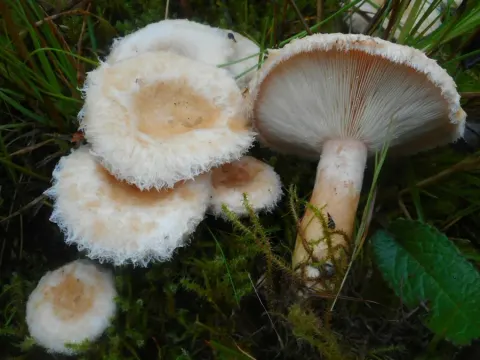
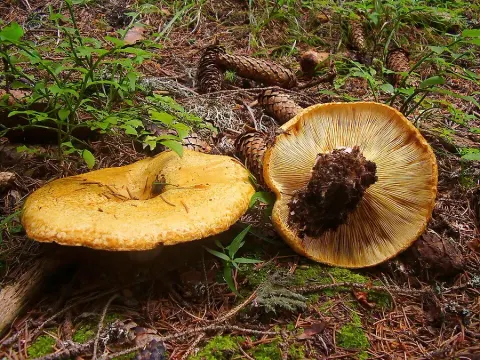
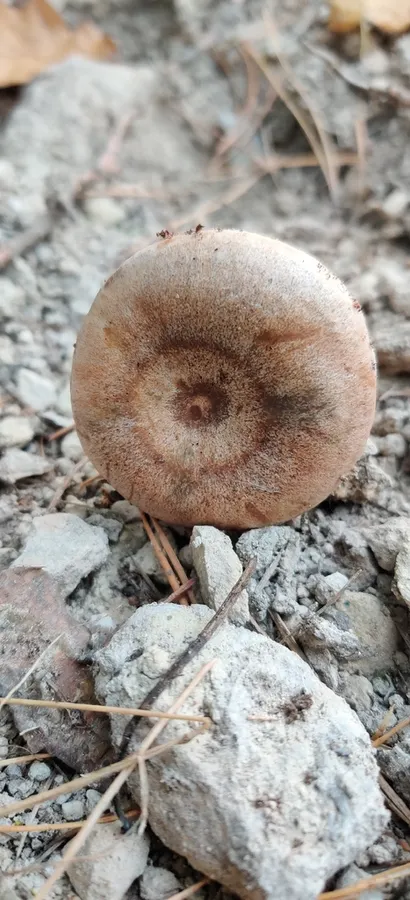
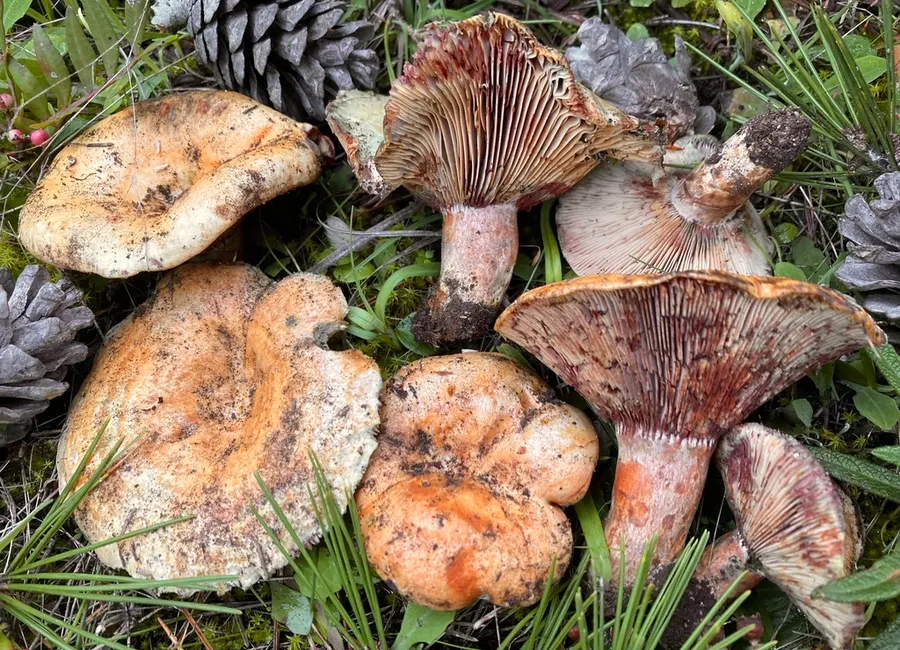
The fruit bodies have convex caps with a central depression, reaching a diameter of 4 – 7.5 cm. The cap surface is smooth and sticky, and the margins are curved downward, even as the mushroom matures. Its color is pinkish-buff to orangish, sometimes with patches of grayish or pale greenish-gray, especially where the surface has been bruised. The somewhat crowded gills have an adnate to slightly decurrent attachment to the stipe. They are pale vinaceous with a pale pinkish-buff edge. The cylindrical stipe measures 2.0 – 3.5 cm long by 1 – 2 cm thick. Its smooth surface is colored pale pinkish-buff to pale greyish-buff, sometimes with brownish irregular dots. The flesh ranges from firm to fragile: in the stipe, it is soft and pale pinkish buff; under the cap cuticle it is brick colored, or brownish-red just above the gills. Its taste ranges from mild to slightly bitter, and it lacks any significant odor. The spores are roughly spherical to ellipsoidal, measuring 7.9–9.5 by 8.0–8.8 μm. They feature surface ornamentations up to 0.8 μm high and an almost complete reticulum comprising broad, rounded ridges. The basidia (spore-bearing cells) are somewhat cylindrical, four-spored, and measure 50–70 by 9–11 μm. The cap cuticle is an ixocutis (made of gelatinous hyphae that run parallel to the cap surface) up to 60 μm thick, with hyphae that are 2–6 wide that are usually branched and interwoven.

Sebagian uraian ditampilkan dalam bahasa sumber; terjemahannya belum tersedia atau belum lolos pemeriksaan.

Rujukan: [1]

Pengukuran mengikuti objek, spesimen atau kultur, dan metode yang disebutkan sumber. Baca uraian asli untuk konteks lengkap.

02 / Kehidupan

Habitat dan peran ekologis

An ectomycorrhizal spesies, Lactarius sanguifluus tubuh buah tumbuh di tanah bersama dengan pohon pinus di tanah berkarat. L. sanguifluus banyak tersebar di Himachal Pradesh in India, di mana telah dicatat tumbuh di hutan konifer campuran, biasanya di bawah serangga Onychium contiguum. Yunani, Di Afrika, spesies ini telah dikumpulkan di Maroko; di Asia, itu terjadi di Vietnam and China. Hal ini terdaftar di Red Data Book of Ukraina, dan muncul dalam daftar merah untuk Spain as spesies makanan yang terancam punah yang dianggap rentan karena pengambilan komersial yang tidak terkendali. To illustrate, laporan surat kabar September 1998 dikutip, yang melaporkan bahwa 82.5 kg dari jamur L. sanguifluus yang dipotong di Poligny were ditangkap dari sebuah van.

Rujukan: [1]

Habitat atau konteks temuan
hutan
Substrat
tanah
Peran atau konteks
Mitra tumbuhan
Temukan hubungan serupa
03 / Siklus hidup

Reproduksi

The spores are roughly spherical to ellipsoidal, measuring 7.9–9.5 by 8.0–8.8 μm. They feature surface ornamentations up to 0.8 μm high and an almost complete reticulum comprising broad, rounded ridges. The basidia (spore-bearing cells) are somewhat cylindrical, four-spored, and measure 50–70 by 9–11 μm. The cap cuticle is an ixocutis (made of gelatinous hyphae that run parallel to the cap surface) up to 60 μm thick, with hyphae that are 2–6 wide that are usually branched and interwoven.

Sebagian uraian ditampilkan dalam bahasa sumber; terjemahannya belum tersedia atau belum lolos pemeriksaan.

Rujukan: [1]

Sinonim menurut acuan taksonomi rilis: Agaricus deliciosus var. violaceus; Hypophyllum sanguifluum; Lactarius sanguifluus f. roseus; Lactarius sanguifluus f. vinosus; Lactarius sanguifluus var. asiaticus; Lactarius sanguifluus var. vinosus; Lactarius sanguifluus var. violaceus; Lactarius sanguifluus var. yvreus; Lactarius vinosus; Lactifluus sanguifluus
04 / Batas informasi

Catatan identitas dan cakupan

  • Nama diterima mengikuti Catalogue of Life Base2026-09-11; uraian mempertahankan konsep dan nama sumber aslinya.
  • Original geographic, specimen and life-cycle scope retained; source import awaits individual editorial review.
  • Impor dan terjemahan otomatis belum diperiksa editorial per profil. Struktur reproduktif yang disebutkan tidak membuktikan seluruh siklus hidup diketahui.
  • Pengukuran pada uraian mengikuti spesimen, kultur, dan metode sumber; angka tidak diperluas ke semua populasi.

Catatan distribusi dalam narasi mengikuti sumbernya. Dokumentasi spesimen atau foto mengikuti catatan sumber. Bukti wilayah Indonesia dan penilaian konservasi tidak disimpulkan dari gambar.

05 / Dokumentasi

Melihat dengan konteks

Dokumentasi Lactarius sanguifluus menurut asosiasi foto pada record takson iNaturalist. Kredit: Lucian Clanet. Identitas mengikuti sumber; bukan penentuan spesimen independen.

Jenis
Fotografi
Kredit
(c) Lucian Clanet, some rights reserved (CC BY), uploaded by Lucian Clanet
Lisensi
CC BY 4.0
Sumber media
Buka entri sumber

Gambar menunjukkan objek menurut identifikasi sumber, bukan verifikasi independen spesimen oleh Fungi. Tidak ada skala baru yang ditambahkan.

06 / Rujukan

Sumber profil

  1. [1] Lactarius sanguifluus — Wikipedia (en)Bagian sumber: Frozen revision 1373703705
    Tanggal penghimpunan sumber: 2026-10-12
    Teks sumber: CC BY-SA4.0 · Wikipedia contributors
  2. [2] Catalogue of Life Base2026-09-11 — Lactarius sanguifluusBagian sumber: ColDP NameUsage.tsv ID 3RS8C; accepted species; source 2073
    Tanggal penghimpunan sumber: 2026-10-12
  3. [3] Dokumentasi visual — Lactarius sanguifluusBagian sumber: Individual media record; identification follows the source, not independent determination
    Tanggal penghimpunan sumber: 2026-10-12
    Media sumber: CC BY 4.0 · (c) Lucian Clanet, some rights reserved (CC BY), uploaded by Lucian Clanet

Adaptasi teks: CC BY-SA 4.0. Wikipedia contributors — Lactarius sanguifluus — Wikipedia (en)

Uraian asli dan riwayat sumber

Riwayat atau halaman sumber

Ringkasan sumber

Lactarius sanguifluus, commonly known as the bloody milk cap, is a species of fungus in the family Russulaceae. First described from France in 1811, the species was given its current name by Elias Fries in 1838 when he transferred it to Lactarius. The caps are orangish to reddish-brown, and become funnel-shaped with age. The gills are pinkish to purplish. When bruised or cut, the fruit bodies ooze a blood-red to purple latex that slowly turns greenish upon exposure to air. Found in Asia, Mediterranean Africa, and Europe, fruit bodies (mushrooms) grow scattered or in groups on the ground under conifers, especially Douglas-fir.

Revisi sumber

Morfologi sumber

The fruit bodies have convex caps with a central depression, reaching a diameter of 4 – 7.5 cm. The cap surface is smooth and sticky, and the margins are curved downward, even as the mushroom matures. Its color is pinkish-buff to orangish, sometimes with patches of grayish or pale greenish-gray, especially where the surface has been bruised. The somewhat crowded gills have an adnate to slightly decurrent attachment to the stipe. They are pale vinaceous with a pale pinkish-buff edge. The cylindrical stipe measures 2.0 – 3.5 cm long by 1 – 2 cm thick. Its smooth surface is colored pale pinkish-buff to pale greyish-buff, sometimes with brownish irregular dots. The flesh ranges from firm to fragile: in the stipe, it is soft and pale pinkish buff; under the cap cuticle it is brick colored, or brownish-red just above the gills. Its taste ranges from mild to slightly bitter, and it lacks any significant odor. The spores are roughly spherical to ellipsoidal, measuring 7.9–9.5 by 8.0–8.8 μm. They feature surface ornamentations up to 0.8 μm high and an almost complete reticulum comprising broad, rounded ridges. The basidia (spore-bearing cells) are somewhat cylindrical, four-spored, and measure 50–70 by 9–11 μm. The cap cuticle is an ixocutis (made of gelatinous hyphae that run parallel to the cap surface) up to 60 μm thick, with hyphae that are 2–6 wide that are usually branched and interwoven.

Revisi sumber

Ekologi sumber

An ectomycorrhizal species, Lactarius sanguifluus fruit bodies grow on the ground in association with pine trees on calcareous soils. L. sanguifluus is widely distributed in Himachal Pradesh in India, where it has been noted to grow in mixed coniferous forests, usually under the fern Onychium contiguum. Greece, In Africa, the species has been collected in Morocco; in Asia, it occurs in Vietnam and China. It is listed in the Red Data Book of Ukraine, and appeared in a draft red list for Spain as an endangered edible species considered vulnerable due to uncontrolled commercial picking. To illustrate, a September 1998 newspaper report was cited, which reported that 82.5 kg of L. sanguifluus mushrooms picked in Poligny were seized from a van.

Revisi sumber

Struktur reproduksi sumber

The spores are roughly spherical to ellipsoidal, measuring 7.9–9.5 by 8.0–8.8 μm. They feature surface ornamentations up to 0.8 μm high and an almost complete reticulum comprising broad, rounded ridges. The basidia (spore-bearing cells) are somewhat cylindrical, four-spored, and measure 50–70 by 9–11 μm. The cap cuticle is an ixocutis (made of gelatinous hyphae that run parallel to the cap surface) up to 60 μm thick, with hyphae that are 2–6 wide that are usually branched and interwoven.

Revisi sumber

Rujukan halaman ini

Fungi. Lactarius sanguifluus. Rilis data fungi-2026-10-12-expansion-2. https://fungi-atlas.mgadib.chatgpt.site/jamur/lactarius-sanguifluus/.

Status: impor sumber; pemeriksaan editorial per profil belum selesai. Untuk klaim biologis, gunakan rujukan pada bagian terkait dan periksa konteks sumber aslinya.