01 / Morfologi

Ciri dan struktur

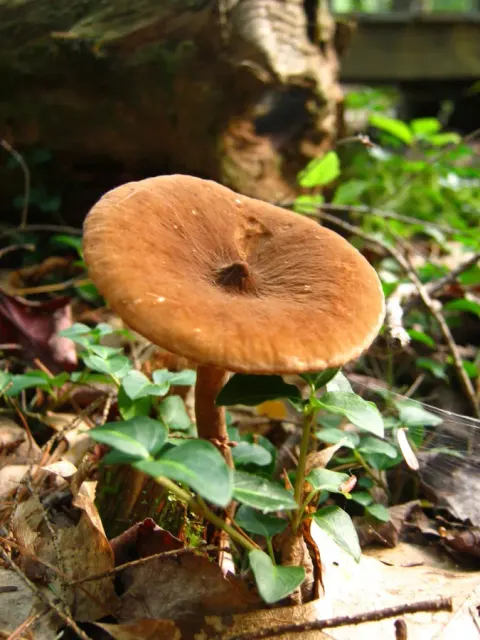
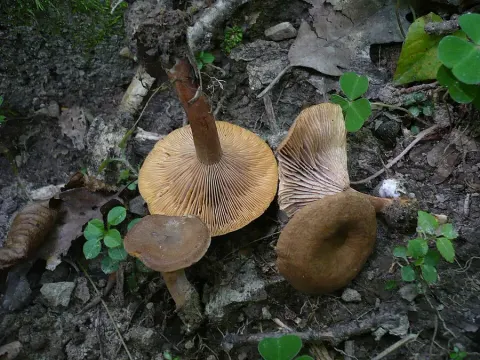
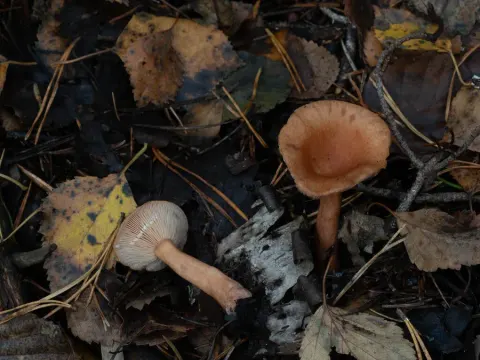
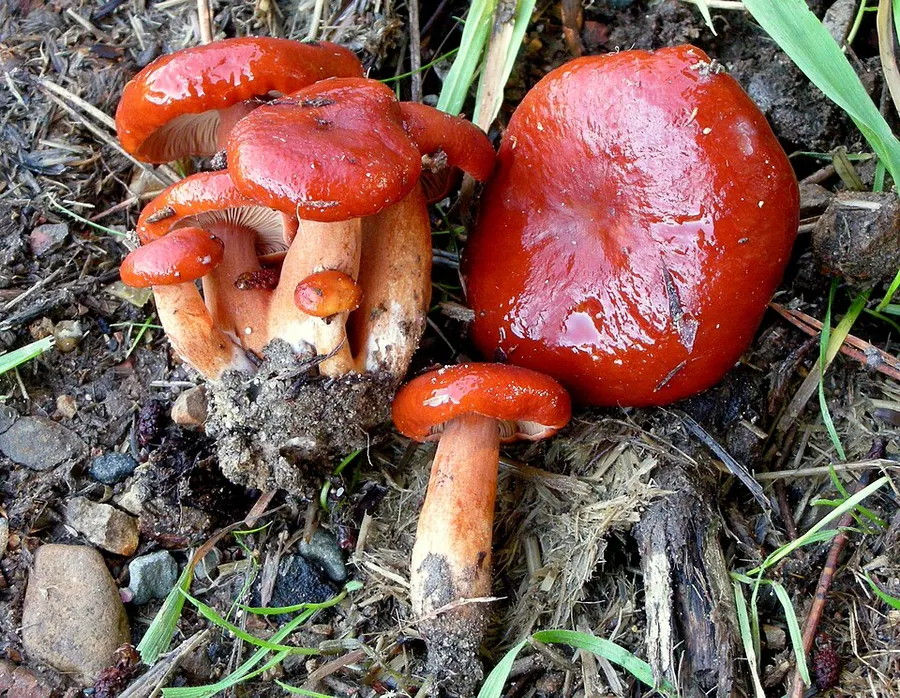
The cap is 3 – 7 cm wide, convex, eventually becoming shallowly depressed in the center. The margin of the cap is curved inward then arched, with short translucent striations (grooves) at maturity. The cap surface is slimy to sticky, smooth, not zonate. It is scarlet when young, but becomes orange to yellowish-orange and duller when older. The attachment of the gills to the stem is adnate (squarely attached) to decurrent (running down the length of the stem); the gills are moderately broad, with spacing close to subdistant (with visible spaces between the gills). They are whitish or colored similar to the cap but paler. The stem is 4 – 9 cm long, 5 – 15 mm thick, and thicker near the base. The smooth stem surface can be either moist or dry depending on the moisture in the environment. It is hollow, fragile, and colored like the cap. The flesh is thin, fragile, pale pinkish-buff to dull orangish-buff. The mushroom's odor is not distinctive, and the taste slowly becomes acrid. The latex is white, and does not change color with continued exposure to air. It does not stain the tissues, and tastes acrid. The spore print is white. The species is considered inedible and its consumption is not recommended. The spores are 7.5–9 by 6.5–7.5 μm, with an ellipsoid shape. Their surfaces are ornamented with warts and short ridges that do not form a reticulum (a network of raised net-like ridges on the surface), with ridges up to 1.0 μm high. The spores are hyaline (translucent), and amyloid—they absorb iodine when stained with Melzer's reagent. The basidia (spore-bearing cells) are four-spored, and measure 42 by 9 μm.

Sebagian uraian ditampilkan dalam bahasa sumber; terjemahannya belum tersedia atau belum lolos pemeriksaan.

Rujukan: [1]

Pengukuran mengikuti objek, spesimen atau kultur, dan metode yang disebutkan sumber. Baca uraian asli untuk konteks lengkap.

02 / Kehidupan

Habitat dan peran ekologis

Like all spesies dalam genus Lactarius, L. subflammeus adalah mikoriza, membentuk asosiasi yang saling menguntungkan dengan pohon. Jamur dan tumbuhan membentuk struktur yang disebut ektomikorrizae, lapisan khusus dari hifa di permukaan akar yang dari hifa memanjang ke tanah dan ke sel kortis luar akar. The fruit bodies of L. subflammeus grow scattered to grouped under conifers or in mixed conifer-hardwood forests near pine and spruce, from August to December. Jamur ini tersebar luas di Pasifik Barat Laut, di mana sangat umum di hutan konifer. Habitat dari jenis lokasi adalah pasir pantai di bawah pohon pinus. U.S. states dari mana jamur telah dikumpulkan termasuk Washington, Idaho, Oregon, California, dan Colorado. Daerah jamur ini membentang ke utara ke Kanada, di mana ia telah ditemukan di dekat hutan pesisir Inggris Columbia in Victoria, yang didominasi oleh Douglas fir (Pseudotsuga menziesii).

Sebagian uraian ditampilkan dalam bahasa sumber; terjemahannya belum tersedia atau belum lolos pemeriksaan.

Rujukan: [1]

Habitat atau konteks temuan
hutan
Substrat
Informasi belum tersedia pada sumber rilis ini.
Peran atau konteks
Mitra tumbuhan
Temukan hubungan serupa
03 / Siklus hidup

Reproduksi

The flesh is thin, fragile, pale pinkish-buff to dull orangish-buff. The mushroom's odor is not distinctive, and the taste slowly becomes acrid. The latex is white, and does not change color with continued exposure to air. It does not stain the tissues, and tastes acrid. The spore print is white. The species is considered inedible and its consumption is not recommended. The spores are 7.5–9 by 6.5–7.5 μm, with an ellipsoid shape. Their surfaces are ornamented with warts and short ridges that do not form a reticulum (a network of raised net-like ridges on the surface), with ridges up to 1.0 μm high. The spores are hyaline (translucent), and amyloid—they absorb iodine when stained with Melzer's reagent.

Sebagian uraian ditampilkan dalam bahasa sumber; terjemahannya belum tersedia atau belum lolos pemeriksaan.

Rujukan: [1]

04 / Batas informasi

Catatan identitas dan cakupan

  • Nama diterima mengikuti Catalogue of Life Base2026-09-11; uraian mempertahankan konsep dan nama sumber aslinya.
  • Original geographic, specimen and life-cycle scope retained; source import awaits individual editorial review.
  • Impor dan terjemahan otomatis belum diperiksa editorial per profil. Struktur reproduktif yang disebutkan tidak membuktikan seluruh siklus hidup diketahui.
  • Pengukuran pada uraian mengikuti spesimen, kultur, dan metode sumber; angka tidak diperluas ke semua populasi.

Catatan distribusi dalam narasi mengikuti sumbernya. Dokumentasi spesimen atau foto mengikuti catatan sumber. Bukti wilayah Indonesia dan penilaian konservasi tidak disimpulkan dari gambar.

05 / Dokumentasi

Melihat dengan konteks

Dokumentasi Lactarius subflammeus dari Wikimedia Commons. Fruit bodies of the fungus Lactarius subflammeus Hesler & A.H. Sm. Specimens photographed in Point Reyes National Seashore, Marin Co., California, USA. Identifikasi mengikuti record berkas sumber.

Jenis
Fotografi
Kredit
This image was created by user Ron Pastorino (Ronpast) at Mushroom Observer , a source for mycological images. You can contact this user here .
Sumber media
Buka entri sumber

Gambar menunjukkan objek menurut identifikasi sumber, bukan verifikasi independen spesimen oleh Fungi. Tidak ada skala baru yang ditambahkan.

06 / Rujukan

Sumber profil

  1. [1] Lactarius subflammeus — Wikipedia (en)Bagian sumber: Frozen revision 1341958685
    Tanggal penghimpunan sumber: 2026-10-12
    Teks sumber: CC BY-SA4.0 · Wikipedia contributors
  2. [2] Catalogue of Life Base2026-09-11 — Lactarius subflammeusBagian sumber: ColDP NameUsage.tsv ID 3RS9W; accepted species; source 2073
    Tanggal penghimpunan sumber: 2026-10-12
  3. [3] Dokumentasi visual — Lactarius subflammeusBagian sumber: Individual media record; identification follows the source, not independent determination
    Tanggal penghimpunan sumber: 2026-10-12
    Media sumber: CC BY-SA 3.0 · This image was created by user Ron Pastorino (Ronpast) at Mushroom Observer , a source for mycological images. You can contact this user here .

Adaptasi teks: CC BY-SA 4.0. Wikipedia contributors — Lactarius subflammeus — Wikipedia (en)

Uraian asli dan riwayat sumber

Riwayat atau halaman sumber

Ringkasan sumber

Lactarius subflammeus, commonly known as the orange milk cap, is a North American milkcap mushroom in the family Russulaceae. The slimy to sticky fruiting bodies have scarlet caps that soon fade to bright orange; the typically longer-than-wide orange stipe contrasts with whitish gills. When cut it exudes white, acrid latex, and it is considered inedible. Described in 1979 by Lexemuel Ray Hesler and Alexander H. Smith, it belongs to Lactarius sect. Russularia and fruits in late summer to autumn as an ectomycorrhizal associate of conifer forests, especially in the Pacific Northwest; NatureServe currently assigns no global status rank.

Revisi sumber

Morfologi sumber

The cap is 3 – 7 cm wide, convex, eventually becoming shallowly depressed in the center. The margin of the cap is curved inward then arched, with short translucent striations (grooves) at maturity. The cap surface is slimy to sticky, smooth, not zonate. It is scarlet when young, but becomes orange to yellowish-orange and duller when older. The attachment of the gills to the stem is adnate (squarely attached) to decurrent (running down the length of the stem); the gills are moderately broad, with spacing close to subdistant (with visible spaces between the gills). They are whitish or colored similar to the cap but paler. The stem is 4 – 9 cm long, 5 – 15 mm thick, and thicker near the base. The smooth stem surface can be either moist or dry depending on the moisture in the environment. It is hollow, fragile, and colored like the cap. The flesh is thin, fragile, pale pinkish-buff to dull orangish-buff. The mushroom's odor is not distinctive, and the taste slowly becomes acrid. The latex is white, and does not change color with continued exposure to air. It does not stain the tissues, and tastes acrid. The spore print is white. The species is considered inedible and its consumption is not recommended. The spores are 7.5–9 by 6.5–7.5 μm, with an ellipsoid shape. Their surfaces are ornamented with warts and short ridges that do not form a reticulum (a network of raised net-like ridges on the surface), with ridges up to 1.0 μm high. The spores are hyaline (translucent), and amyloid—they absorb iodine when stained with Melzer's reagent. The basidia (spore-bearing cells) are four-spored, and measure 42 by 9 μm.

Revisi sumber

Ekologi sumber

Like all species in the genus Lactarius, L. subflammeus is mycorrhizal, forming mutualistic associations with trees. The fungus and the plant forms structures called ectomycorrhizae, a specialized sheath of hyphae on the surface of the root from which hyphae extend into the soil and into the outer cortical cells of the root. The fruit bodies of L. subflammeus grow scattered to grouped under conifers or in mixed conifer-hardwood forests near pine and spruce, from August to December. The fungus is widely distributed in the Pacific Northwest, where it is very common in conifer forests. The habitat of the type locality was coastal sand dunes under pine. U.S. states from which the fungus has been collected include Washington, Idaho, Oregon, California, and Colorado. The mushroom's range extends north into Canada, where it has been found near Victoria, British Columbia in coastal forests dominated by Douglas fir (Pseudotsuga menziesii).

Revisi sumber

Struktur reproduksi sumber

The flesh is thin, fragile, pale pinkish-buff to dull orangish-buff. The mushroom's odor is not distinctive, and the taste slowly becomes acrid. The latex is white, and does not change color with continued exposure to air. It does not stain the tissues, and tastes acrid. The spore print is white. The species is considered inedible and its consumption is not recommended. The spores are 7.5–9 by 6.5–7.5 μm, with an ellipsoid shape. Their surfaces are ornamented with warts and short ridges that do not form a reticulum (a network of raised net-like ridges on the surface), with ridges up to 1.0 μm high. The spores are hyaline (translucent), and amyloid—they absorb iodine when stained with Melzer's reagent.

Revisi sumber

Rujukan halaman ini

Fungi. Lactarius subflammeus. Rilis data fungi-2026-10-12-expansion-2. https://fungi-atlas.mgadib.chatgpt.site/jamur/lactarius-subflammeus/.

Status: impor sumber; pemeriksaan editorial per profil belum selesai. Untuk klaim biologis, gunakan rujukan pada bagian terkait dan periksa konteks sumber aslinya.