01 / Morfologi

Ciri dan struktur

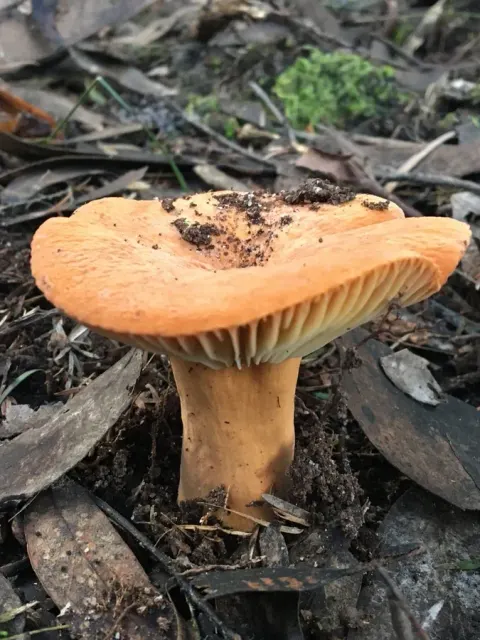
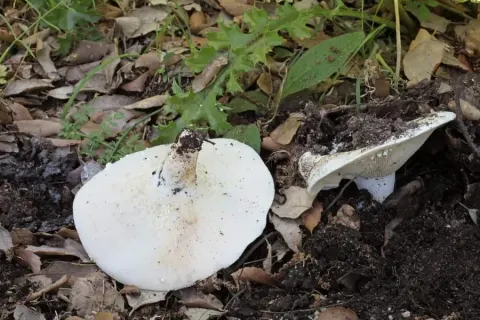
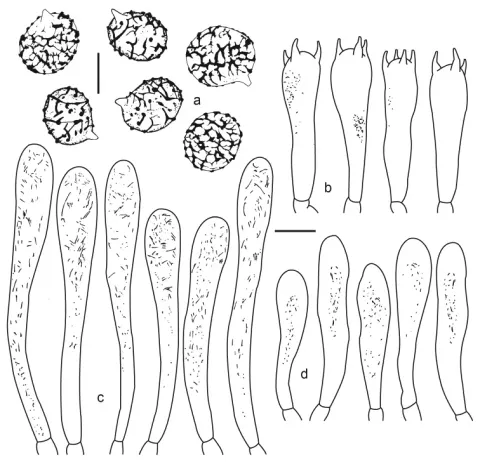
The fruit body of L. volemus has a fleshy and firm cap with a velvety or smooth surface and a shape that changes with maturity: it starts off convex, with edges curved inwards, then later grows flat with a depression in the middle. With a typical diameter of 5 to 11 cm (2– in), its colour ranges from apricot to tawny. The cap colouration, however, is somewhat variable, as has been noted in Asian, European, and North American specimens. The stem, whose height varies between 4 and 12 cm ( and 5 in), and which is typically between 1 and 1.5 cm thick, has a slightly lighter colouration than the cap. It is firm, with a velvety or smooth surface that sometimes has depressions running longitudinally up and down its length. The gills are adnate to slightly decurrent, brittle, narrow, quite closely spaced and sometimes forked. Normally a pale golden yellow colour, the gills turn brown when bruised. Interspersed between the gills are lamellulae, short gills that do not extend to the stem. The flesh is whitish and firm. The mushroom smells somewhat fishy; one source suggests the odour is "like a dead shad, which anglers will tell you is probably the most malodorous freshwater fish". The odour is concentrated when the fruit bodies are dried. One of the mushroom's most distinctive features is the abundant latex, so plentiful that a small nick on the gills will cause it to "weep" the milky substance. The latex tends to impart brown stains on whatever it contacts. The spore print is whitish. The spores are roughly spherical, translucent (hyaline), and typically measure 7.5–10.0 by 7.5–9.0 μm.

Sebagian uraian ditampilkan dalam bahasa sumber; terjemahannya belum tersedia atau belum lolos pemeriksaan.

Rujukan: [1]

Pengukuran mengikuti objek, spesimen atau kultur, dan metode yang disebutkan sumber. Baca uraian asli untuk konteks lengkap.

02 / Kehidupan

Habitat dan peran ekologis

Like all milk caps, L. volemus membentuk ectomycorrhizae, asosiasi simbiotik yang saling menguntungkan dengan berbagai spesies pohon. Dalam hubungan ini, jamur hifa tumbuh di sekitar akar tanaman dan di antara sel-sel kortisnya, tetapi tidak benar-benar menembus mereka. hifa memanjang ke luar ke dalam tanah, meningkatkan luas permukaan untuk menyerap untuk membantu tanaman menyerap nutrisi dari tanah. It is found growing at the base of both coniferous and broad-leaved trees, although it is more common in deciduous woods. Kadang-kadang juga dapat ditemukan di tempat tidur rumput. The fruit bodies, which appear between summer and autumn, are common. They can ditemukan tumbuh secara solitari atau dalam kelompok, dan lebih banyak di cuaca hangat dan lembab. Lactifluus volemus ditemukan di daerah beriklim hangat dan juga beberapa wilayah subtropis dan tropis di Belahan Daratan Utara. Jamur ini tersebar luas di seluruh Eropa, meskipun menurun di beberapa negara, dan telah menjadi cukup langka di Belanda (dan Flanders) untuk dianggap punah secara lokal. Hal ini dikenal dari Asia, termasuk Cina (Gunung Qingling, Provinsi Guizhou, dan Provinsi Yunnan), Jepang, India, Korea, Nepal, dan Vietnam.

Sebagian uraian ditampilkan dalam bahasa sumber; terjemahannya belum tersedia atau belum lolos pemeriksaan.

Rujukan: [1]

Habitat atau konteks temuan
Informasi belum tersedia pada sumber rilis ini.
Substrat
Informasi belum tersedia pada sumber rilis ini.
Peran atau konteks
Mitra tumbuhan
Temukan hubungan serupa
03 / Siklus hidup

Reproduksi

The spore print is whitish. The spores are roughly spherical, translucent (hyaline), and typically measure 7.5–10.0 by 7.5–9.0 μm.

Sebagian uraian ditampilkan dalam bahasa sumber; terjemahannya belum tersedia atau belum lolos pemeriksaan.

Rujukan: [1]

Sinonim menurut acuan taksonomi rilis: Agaricus ichoratus; Agaricus lactifluus; Agaricus lactifluus var. aureus; Agaricus lactifluus var. dulcis; Agaricus volemus; Amanita lactiflua; Galorrheus ichoratus; Galorrheus volemus; Hypophyllum ichoratum; Lactarius ichoratus; Lactarius lactifluus; Lactarius testaceus; Lactarius volemus; Lactarius volemus var. albus; Lactarius volemus var. asiaticus; Lactarius volemus var. euvolemus; Lactarius volemus var. flavus; Lactarius volemus var. subrugosus; Lactifluus ichoratus
04 / Batas informasi

Catatan identitas dan cakupan

  • Nama diterima mengikuti Catalogue of Life Base2026-09-11; uraian mempertahankan konsep dan nama sumber aslinya.
  • Original geographic, specimen and life-cycle scope retained; source import awaits individual editorial review.
  • Impor dan terjemahan otomatis belum diperiksa editorial per profil. Struktur reproduktif yang disebutkan tidak membuktikan seluruh siklus hidup diketahui.
  • Pengukuran pada uraian mengikuti spesimen, kultur, dan metode sumber; angka tidak diperluas ke semua populasi.

Catatan distribusi dalam narasi mengikuti sumbernya. Dokumentasi spesimen atau foto mengikuti catatan sumber. Bukti wilayah Indonesia dan penilaian konservasi tidak disimpulkan dari gambar.

05 / Dokumentasi

Melihat dengan konteks

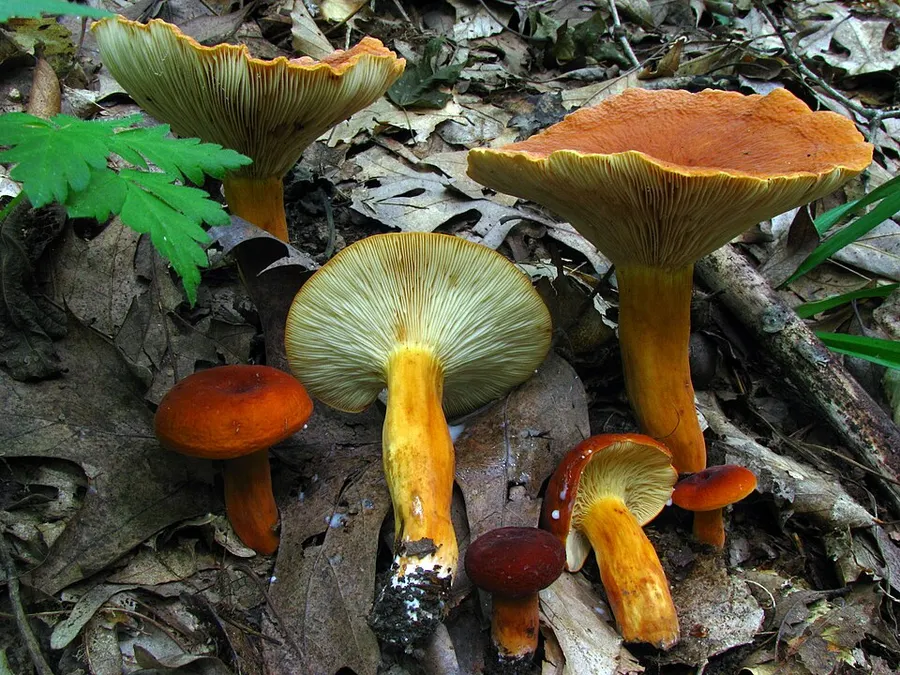
Dokumentasi Lactifluus volemus dari Wikimedia Commons. The "milk mushroom" Lactarius volemus (Fr.) Fr. Specimens photographed in Wayne National Forest, Athens Co., Ohio, USA. Identifikasi mengikuti record berkas sumber.

Jenis
Fotografi
Kredit
This image was created by user Dan Molter (shroomydan) at Mushroom Observer , a source for mycological images. You can contact this user here .
Sumber media
Buka entri sumber

Gambar menunjukkan objek menurut identifikasi sumber, bukan verifikasi independen spesimen oleh Fungi. Tidak ada skala baru yang ditambahkan.

06 / Rujukan

Sumber profil

  1. [1] Lactifluus volemus — Wikipedia (en)Bagian sumber: Frozen revision 1363925837
    Tanggal penghimpunan sumber: 2026-10-12
    Teks sumber: CC BY-SA4.0 · Wikipedia contributors
  2. [2] Catalogue of Life Base2026-09-11 — Lactifluus volemusBagian sumber: ColDP NameUsage.tsv ID 3RSNB; accepted species; source 2073
    Tanggal penghimpunan sumber: 2026-10-12
  3. [3] Dokumentasi visual — Lactifluus volemusBagian sumber: Individual media record; identification follows the source, not independent determination
    Tanggal penghimpunan sumber: 2026-10-12
    Media sumber: CC BY-SA 3.0 · This image was created by user Dan Molter (shroomydan) at Mushroom Observer , a source for mycological images. You can contact this user here .

Adaptasi teks: CC BY-SA 4.0. Wikipedia contributors — Lactifluus volemus — Wikipedia (en)

Uraian asli dan riwayat sumber

Riwayat atau halaman sumber

Ringkasan sumber

Lactifluus volemus, formerly known as Lactarius volemus, and commonly known as the weeping milk cap or bradley, is a species of fungus in the family Russulaceae. Phylogenetic analysis suggests that L. volemus represents several species or subspecies, rather than a single taxon. The colour of the mushroom varies from apricot to tawny, and the cap may be up to 11 cm ( in) wide. The pale golden yellow gills on the underside of the cap are closely spaced and sometimes forked. One of the mushroom's most distinctive features is the large amount of latex it exudes when the gills are damaged, leading to some of its common names, e.g. voluminous-latex milky.

Revisi sumber

Morfologi sumber

The fruit body of L. volemus has a fleshy and firm cap with a velvety or smooth surface and a shape that changes with maturity: it starts off convex, with edges curved inwards, then later grows flat with a depression in the middle. With a typical diameter of 5 to 11 cm (2– in), its colour ranges from apricot to tawny. The cap colouration, however, is somewhat variable, as has been noted in Asian, European, and North American specimens. The stem, whose height varies between 4 and 12 cm ( and 5 in), and which is typically between 1 and 1.5 cm thick, has a slightly lighter colouration than the cap. It is firm, with a velvety or smooth surface that sometimes has depressions running longitudinally up and down its length. The gills are adnate to slightly decurrent, brittle, narrow, quite closely spaced and sometimes forked. Normally a pale golden yellow colour, the gills turn brown when bruised. Interspersed between the gills are lamellulae, short gills that do not extend to the stem. The flesh is whitish and firm. The mushroom smells somewhat fishy; one source suggests the odour is "like a dead shad, which anglers will tell you is probably the most malodorous freshwater fish". The odour is concentrated when the fruit bodies are dried. One of the mushroom's most distinctive features is the abundant latex, so plentiful that a small nick on the gills will cause it to "weep" the milky substance. The latex tends to impart brown stains on whatever it contacts. The spore print is whitish. The spores are roughly spherical, translucent (hyaline), and typically measure 7.5–10.0 by 7.5–9.0 μm.

Revisi sumber

Ekologi sumber

Like all milk caps, L. volemus forms ectomycorrhizae, mutually beneficial symbiotic associations with various tree species. In this association, the fungal hyphae grow around the root of the plant and between its cortical cells, but do not actually penetrate them. The hyphae extend outward into the soil, increasing the surface area for absorption to help the plant absorb nutrients from the soil. It is found growing at the base of both coniferous and broad-leaved trees, although it is more common in deciduous woods. It may also sometimes be found in peat moss beds. The fruit bodies, which appear between summer and autumn, are common. They can be found growing solitarily or in groups, and are more abundant in warm and humid weather. Lactifluus volemus is found in warm temperate regions and as well as some subtropical and tropical regions of the Northern Hemisphere. The fungus is widely distributed throughout Europe, although it is in decline in some countries, and has become rare enough in the Netherlands (and Flanders) to be considered locally extinct. It is known from Asia, including China (Qinling Mountains, Guizhou Province, and Yunnan Province), Japan, India, Korea, Nepal, and Vietnam.

Revisi sumber

Struktur reproduksi sumber

The spore print is whitish. The spores are roughly spherical, translucent (hyaline), and typically measure 7.5–10.0 by 7.5–9.0 μm.

Revisi sumber

Rujukan halaman ini

Fungi. Lactifluus volemus. Rilis data fungi-2026-10-12-expansion-2. https://fungi-atlas.mgadib.chatgpt.site/jamur/lactifluus-volemus/.

Status: impor sumber; pemeriksaan editorial per profil belum selesai. Untuk klaim biologis, gunakan rujukan pada bagian terkait dan periksa konteks sumber aslinya.