Ciri dan struktur
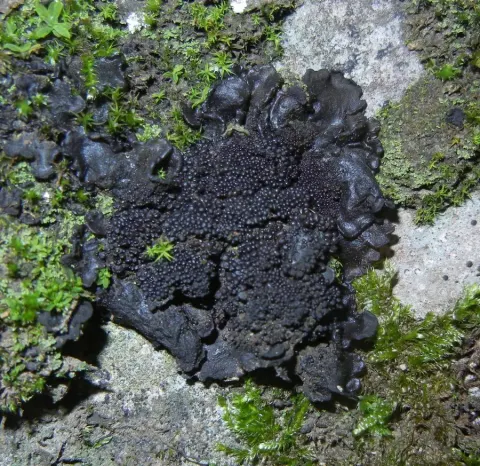
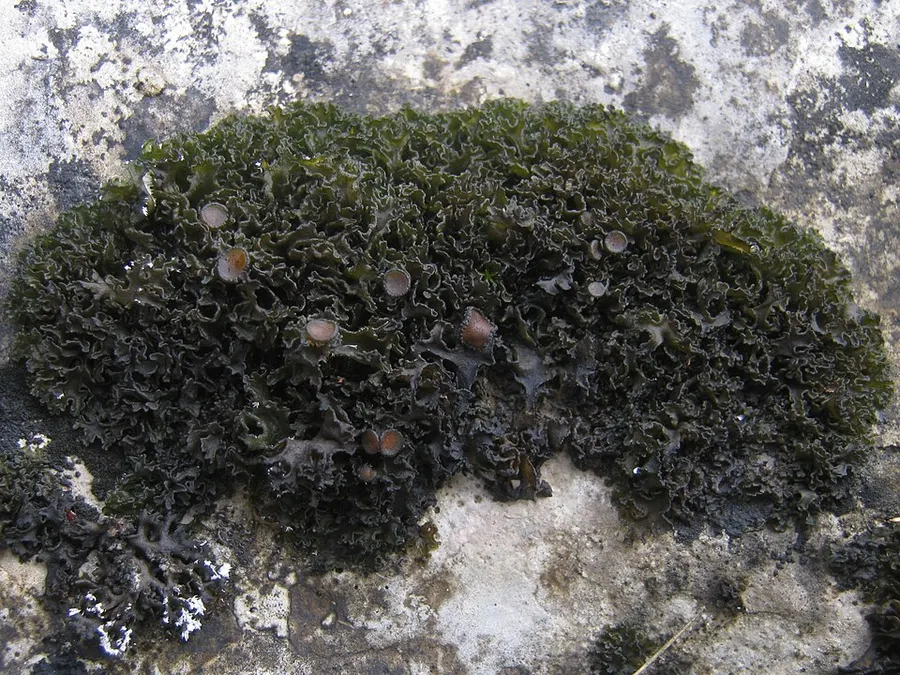
The thallus of Lathagrium cristatum forms foliose rosettes usually 2–5 cm across, occasionally reaching 10 cm. It is rounded, semicircular or irregular in outline, and in older colonies the central parts often die away so that only a ring of live remains. The lobes are rather thin and narrow, up to about 3 mm wide, radiating outwards and characteristically concave. They branch irregularly and may lie close together or remain more or less separate. The lobe margins are raised and wavy, ranging from nearly entire to distinctly cut or , and often show a sharply toothed outline. The upper surface is dark olive-green to brown, becoming almost black in older or drier thalli and is generally lacking vegetative propagules, with isidia reported only very rarely in some material. The underside bears rounded attachment structures () that coalesce into conspicuous white tufts. Fruiting bodies (apothecia) are frequently abundant but can be absent in some thalli. They are mainly confined to the lobe margins, where they form dense clusters of flat, disc-like structures up to 5 mm in diameter, either directly attached to the thallus or raised on short stalks; each has an even rim formed from the thallus tissue (a ). The asci typically contain four to six, rarely up to eight, spores. The ascospores are ellipsoidal with somewhat pointed ends, measuring about 18–32 × 8–13 micrometres (μm), and are somewhat , with several internal cross-walls running in both transverse and longitudinal directions. In addition to apothecia, the species also produces asexual propagules. Conidiomata are common and tend to occur along the lobe margins in small, wart-like swellings.
Habitat dan peran ekologis
Lathagrium cristatum has an extensive geographic range and is considered a widespread Holarctic lichen. It is recorded across North America, Europe, northern Africa, and Asia (including Siberia and the Himalayas). Its occurrences span a wide climatic range, from arid lowland deserts to arctic and alpine zones, provided suitable substrate and moisture are present. For example, in the Sonoran region of southwestern North America it is found in scattered mountain localities (Arizona, Baja California and adjacent areas), even appearing on the Channel Islands of California. In contrast, it also reaches high latitudes and elevations, inhabiting alpine and subarctic environments in areas like Siberia and northern Europe. Within more temperate regions it is often common; in Great Britain and Ireland, for instance, this lichen occurs throughout the islands on suitable calcareous substrates. In Finland it is considered rare and is known mainly from the south-western, eastern and northern parts of the country. This species is chiefly saxicolous, typically growing on hard calcareous rock such as limestone or dolomite. Colonies form foliose, rosette-like patches firmly attached to rock, often in exposed sites that receive intermittent water flow from rain.
- Habitat atau konteks temuan
- Informasi belum tersedia pada sumber rilis ini.
- Substrat
- Informasi belum tersedia pada sumber rilis ini.
- Peran atau konteks
- Pembentuk liken
Reproduksi
The thallus of Lathagrium cristatum forms foliose rosettes usually 2–5 cm across, occasionally reaching 10 cm. It is rounded, semicircular or irregular in outline, and in older colonies the central parts often die away so that only a ring of live remains. The lobes are rather thin and narrow, up to about 3 mm wide, radiating outwards and characteristically concave. They branch irregularly and may lie close together or remain more or less separate. The lobe margins are raised and wavy, ranging from nearly entire to distinctly cut or , and often show a sharply toothed outline. The upper surface is dark olive-green to brown, becoming almost black in older or drier thalli and is generally lacking vegetative propagules, with isidia reported only very rarely in some material.
Catatan identitas dan cakupan
- Nama diterima mengikuti Catalogue of Life Base2026-09-11; uraian mempertahankan konsep dan nama sumber aslinya.
- Original geographic, specimen and life-cycle scope retained; source import awaits individual editorial review.
- Impor dan terjemahan otomatis belum diperiksa editorial per profil. Struktur reproduktif yang disebutkan tidak membuktikan seluruh siklus hidup diketahui.
- Pengukuran pada uraian mengikuti spesimen, kultur, dan metode sumber; angka tidak diperluas ke semua populasi.
Catatan distribusi dalam narasi mengikuti sumbernya. Dokumentasi spesimen atau foto mengikuti catatan sumber. Bukti wilayah Indonesia dan penilaian konservasi tidak disimpulkan dari gambar.
Melihat dengan konteks
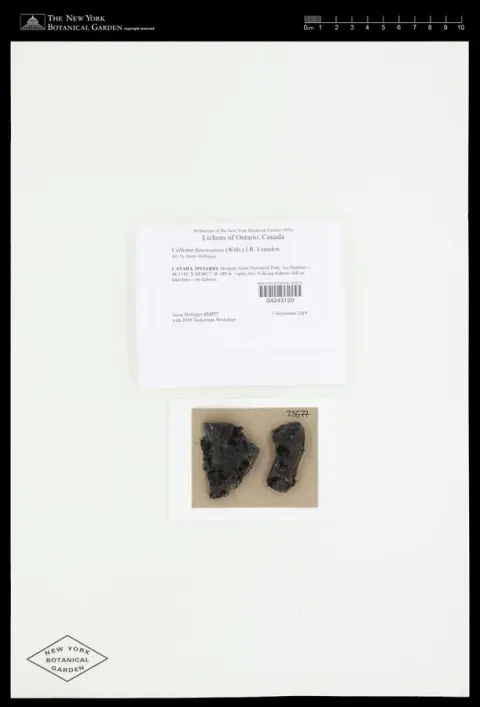
Dokumentasi Lathagrium cristatum dari Wikimedia Commons. For more information about this, see the observation page at Mushroom Observer. Identifikasi mengikuti record berkas sumber.
- Jenis
- Fotografi
- Kredit
- This image was created by user zaca at Mushroom Observer , a source for mycological images. You can contact this user here .
- Lisensi
- CC BY-SA 3.0
- Sumber media
- Buka entri sumber
Sumber profil
- [1] Lathagrium cristatum — Wikipedia (en)
- [2] Catalogue of Life Base2026-09-11 — Lathagrium cristatum
- [3] Dokumentasi visual — Lathagrium cristatum
Rujukan halaman ini
Fungi. Lathagrium cristatum. Rilis data fungi-2026-10-12-expansion-2. https://fungi-atlas.mgadib.chatgpt.site/jamur/lathagrium-cristatum/.
Status: impor sumber; pemeriksaan editorial per profil belum selesai. Untuk klaim biologis, gunakan rujukan pada bagian terkait dan periksa konteks sumber aslinya.