01 / Morfologi

Ciri dan struktur

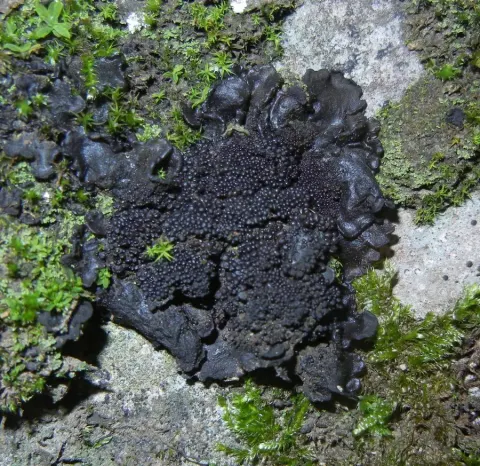
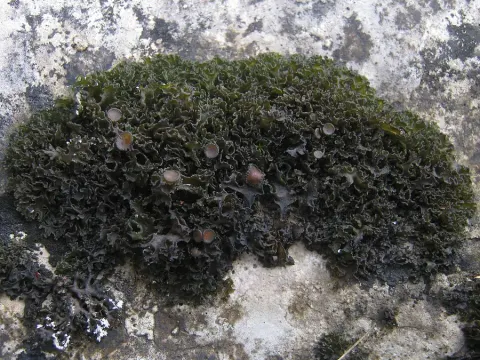
Lathagrium fuscovirens has a foliose thallus 3–5 cm across that is more or less rounded or irregular in outline and lies closely attached to the substrate. It is deeply lobed, with relatively few extended lobes 2–6 mm wide that are often repeatedly branched. The lobe margins are somewhat rounded, wavy, and slightly ascending, but they are never swollen. The upper surface is dark olive-green to nearly black, becoming paler and somewhat translucent when wet. It usually bears conspicuous blister-like bumps, and may sometimes have a greyish or bluish tinge. Small rounded isidia occur on both the upper surface and the lobe margins. These are often numerous and may partly cover the thallus, giving it a scurfy appearance. Apothecia may be numerous or sparse. Their discs are 0.5–1.5 mm wide and are flat, sometimes with a somewhat thick ; the surface may be smooth or bear isidia. The ascospores measure 15–24 by 6.5–13 μm and are ovoid to ellipsoid and somewhat , usually with three transverse septa and one longitudinal septum. All standard chemical spot tests (K, KC, C, P) are negative, and the lichen is not known to contain any lichen products.

Sebagian uraian ditampilkan dalam bahasa sumber; terjemahannya belum tersedia atau belum lolos pemeriksaan.

Rujukan: [1]

Pengukuran mengikuti objek, spesimen atau kultur, dan metode yang disebutkan sumber. Baca uraian asli untuk konteks lengkap.

02 / Kehidupan

Habitat dan peran ekologis

Lathagrium fuscovirens grows on hard calcareous rock and on walls, in habitats ranging from exposed sites to moister situations. It is only occasionally recorded from asbestos roofs. In Great Britain and Ireland, it is frequent overall, although it is rare across most of Scotland. It has also been recorded from Austria, Finland, Sweden, Turkey, Russia (northwest Caucasus), and Ukraine. In North America, it occurs in Eastern Canada, and is widespread in the United States, including Alaska, the Pacific Northwest, the Rocky Mountains, and in eastern temperate, Midwest, and northeast regions. It is also found in Africa. A 2018 microbiome study sampled Lathagrium fuscovirens on exposed dry rocks at Kesselfallklamm in Austria. In that study, the lichen's cyanobacterial photobiont was identified as a Nostoc lineage, and its associated bacterial community resembled that of Lathagrium cristatum from the same dry, exposed rocky habitat.

Sebagian uraian ditampilkan dalam bahasa sumber; terjemahannya belum tersedia atau belum lolos pemeriksaan.

Rujukan: [1]

Habitat atau konteks temuan
Informasi belum tersedia pada sumber rilis ini.
Substrat
Informasi belum tersedia pada sumber rilis ini.
Peran atau konteks
Pembentuk liken
Temukan hubungan serupa
03 / Siklus hidup

Reproduksi

Lathagrium fuscovirens has a foliose thallus 3–5 cm across that is more or less rounded or irregular in outline and lies closely attached to the substrate. It is deeply lobed, with relatively few extended lobes 2–6 mm wide that are often repeatedly branched. The lobe margins are somewhat rounded, wavy, and slightly ascending, but they are never swollen. The upper surface is dark olive-green to nearly black, becoming paler and somewhat translucent when wet. It usually bears conspicuous blister-like bumps, and may sometimes have a greyish or bluish tinge. Small rounded isidia occur on both the upper surface and the lobe margins. These are often numerous and may partly cover the thallus, giving it a scurfy appearance.

Sebagian uraian ditampilkan dalam bahasa sumber; terjemahannya belum tersedia atau belum lolos pemeriksaan.

Rujukan: [1]

Sinonim menurut acuan taksonomi rilis: Collema crispum var. prasinum; Collema flaccidum var. tuniforme; Collema furvum f. tuniforme; Collema fuscovirens; Collema granuliferum f. meizolobum; Collema prasinum; Collema subplicatile f. meizolobum; Collema tuniforme; Eucollema furvum f. tuniforme; Lichen furvus tuniforme; Lichen fuscovirens; Lichen pulcher; Lichen tuniformis
04 / Batas informasi

Catatan identitas dan cakupan

  • Nama diterima mengikuti Catalogue of Life Base2026-09-11; uraian mempertahankan konsep dan nama sumber aslinya.
  • Original geographic, specimen and life-cycle scope retained; source import awaits individual editorial review.
  • Impor dan terjemahan otomatis belum diperiksa editorial per profil. Struktur reproduktif yang disebutkan tidak membuktikan seluruh siklus hidup diketahui.
  • Pengukuran pada uraian mengikuti spesimen, kultur, dan metode sumber; angka tidak diperluas ke semua populasi.

Catatan distribusi dalam narasi mengikuti sumbernya. Dokumentasi spesimen atau foto mengikuti catatan sumber. Bukti wilayah Indonesia dan penilaian konservasi tidak disimpulkan dari gambar.

05 / Dokumentasi

Melihat dengan konteks

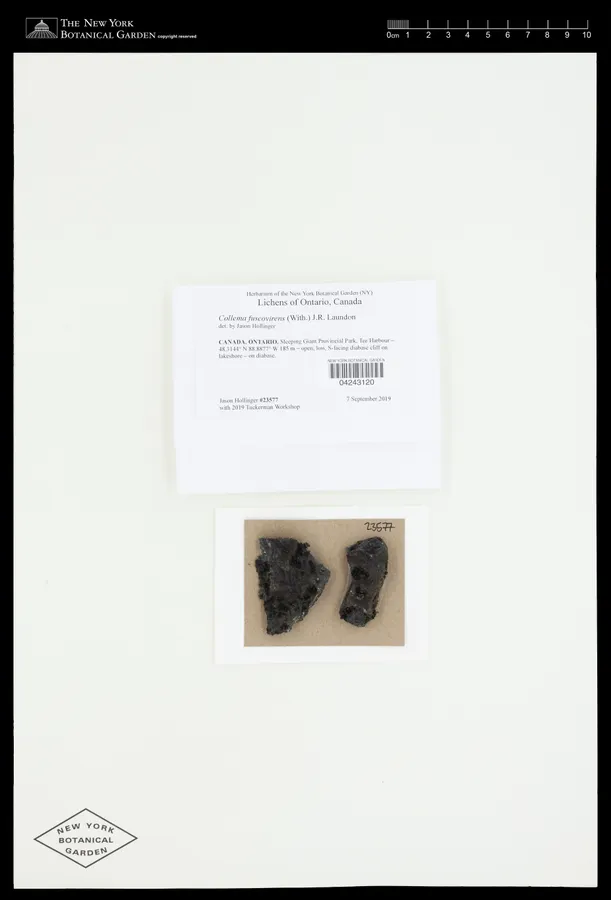
Voucher herbarium Lathagrium fuscovirens (04243120), The New York Botanical Garden. Identifikasi mengikuti record spesimen sumber. Foto bahan, kemasan, atau label herbarium sebagaimana tersedia pada record institusi; bukan foto lapangan atau penentuan spesimen independen.

Jenis
Voucher herbarium
Kredit
The New York Botanical Garden
Lisensi
CC BY 4.0
Sumber media
Buka entri sumber

Gambar menunjukkan objek menurut identifikasi sumber, bukan verifikasi independen spesimen oleh Fungi. Tidak ada skala baru yang ditambahkan.

06 / Rujukan

Sumber profil

  1. [1] Lathagrium fuscovirens — Wikipedia (en)Bagian sumber: Frozen revision 1345422147
    Tanggal penghimpunan sumber: 2026-10-12
    Teks sumber: CC BY-SA4.0 · Wikipedia contributors
  2. [2] Catalogue of Life Base2026-09-11 — Lathagrium fuscovirensBagian sumber: ColDP NameUsage.tsv ID 3SJ3Y; accepted species; source 2073
    Tanggal penghimpunan sumber: 2026-10-12
  3. [3] Dokumentasi visual — Lathagrium fuscovirensBagian sumber: Individual media record; identification follows the source, not independent determination
    Tanggal penghimpunan sumber: 2026-10-12
    Media sumber: CC BY 4.0 · The New York Botanical Garden

Adaptasi teks: CC BY-SA 4.0. Wikipedia contributors — Lathagrium fuscovirens — Wikipedia (en)

Uraian asli dan riwayat sumber

Riwayat atau halaman sumber

Ringkasan sumber

Lathagrium fuscovirens, the crumpled rock jelly, is a species of lichen-forming fungus in the family Collemataceae. It forms dark olive-green to blackish, leaf-like growths up to 5 cm across that have a jelly-like texture when wet. Small bead-like propagules called isidia are often abundant on its surface. The species grows on hard limestone and similar calcareous rock, and is found across much of Europe, parts of North America including eastern Canada and the western and eastern United States, and in Africa and western Asia.

Revisi sumber

Morfologi sumber

Lathagrium fuscovirens has a foliose thallus 3–5 cm across that is more or less rounded or irregular in outline and lies closely attached to the substrate. It is deeply lobed, with relatively few extended lobes 2–6 mm wide that are often repeatedly branched. The lobe margins are somewhat rounded, wavy, and slightly ascending, but they are never swollen. The upper surface is dark olive-green to nearly black, becoming paler and somewhat translucent when wet. It usually bears conspicuous blister-like bumps, and may sometimes have a greyish or bluish tinge. Small rounded isidia occur on both the upper surface and the lobe margins. These are often numerous and may partly cover the thallus, giving it a scurfy appearance. Apothecia may be numerous or sparse. Their discs are 0.5–1.5 mm wide and are flat, sometimes with a somewhat thick ; the surface may be smooth or bear isidia. The ascospores measure 15–24 by 6.5–13 μm and are ovoid to ellipsoid and somewhat , usually with three transverse septa and one longitudinal septum. All standard chemical spot tests (K, KC, C, P) are negative, and the lichen is not known to contain any lichen products.

Revisi sumber

Ekologi sumber

Lathagrium fuscovirens grows on hard calcareous rock and on walls, in habitats ranging from exposed sites to moister situations. It is only occasionally recorded from asbestos roofs. In Great Britain and Ireland, it is frequent overall, although it is rare across most of Scotland. It has also been recorded from Austria, Finland, Sweden, Turkey, Russia (northwest Caucasus), and Ukraine. In North America, it occurs in Eastern Canada, and is widespread in the United States, including Alaska, the Pacific Northwest, the Rocky Mountains, and in eastern temperate, Midwest, and northeast regions. It is also found in Africa. A 2018 microbiome study sampled Lathagrium fuscovirens on exposed dry rocks at Kesselfallklamm in Austria. In that study, the lichen's cyanobacterial photobiont was identified as a Nostoc lineage, and its associated bacterial community resembled that of Lathagrium cristatum from the same dry, exposed rocky habitat.

Revisi sumber

Struktur reproduksi sumber

Lathagrium fuscovirens has a foliose thallus 3–5 cm across that is more or less rounded or irregular in outline and lies closely attached to the substrate. It is deeply lobed, with relatively few extended lobes 2–6 mm wide that are often repeatedly branched. The lobe margins are somewhat rounded, wavy, and slightly ascending, but they are never swollen. The upper surface is dark olive-green to nearly black, becoming paler and somewhat translucent when wet. It usually bears conspicuous blister-like bumps, and may sometimes have a greyish or bluish tinge. Small rounded isidia occur on both the upper surface and the lobe margins. These are often numerous and may partly cover the thallus, giving it a scurfy appearance.

Revisi sumber

Rujukan halaman ini

Fungi. Lathagrium fuscovirens. Rilis data fungi-2026-10-12-expansion-2. https://fungi-atlas.mgadib.chatgpt.site/jamur/lathagrium-fuscovirens/.

Status: impor sumber; pemeriksaan editorial per profil belum selesai. Untuk klaim biologis, gunakan rujukan pada bagian terkait dan periksa konteks sumber aslinya.