Ciri dan struktur
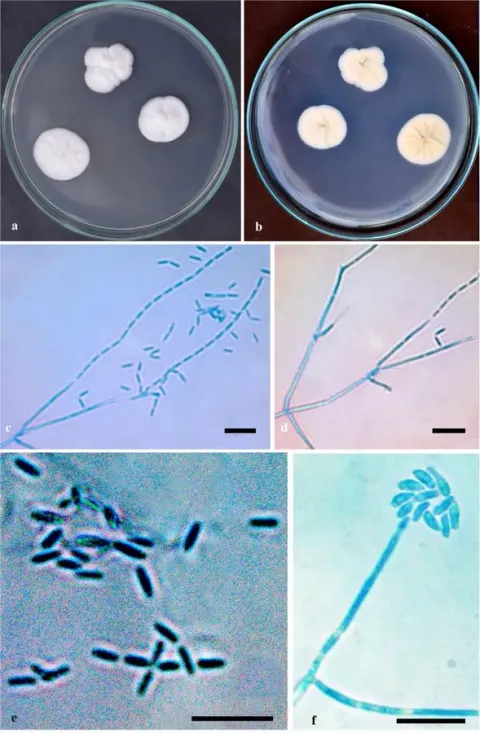
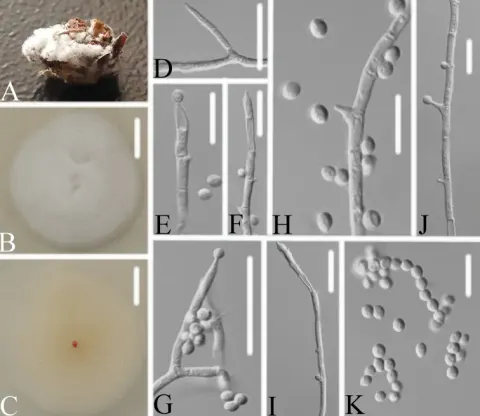
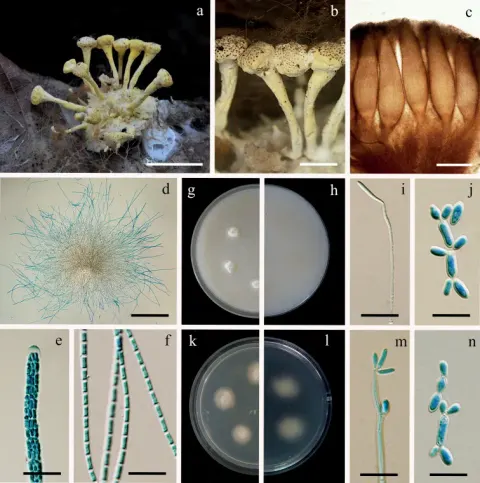
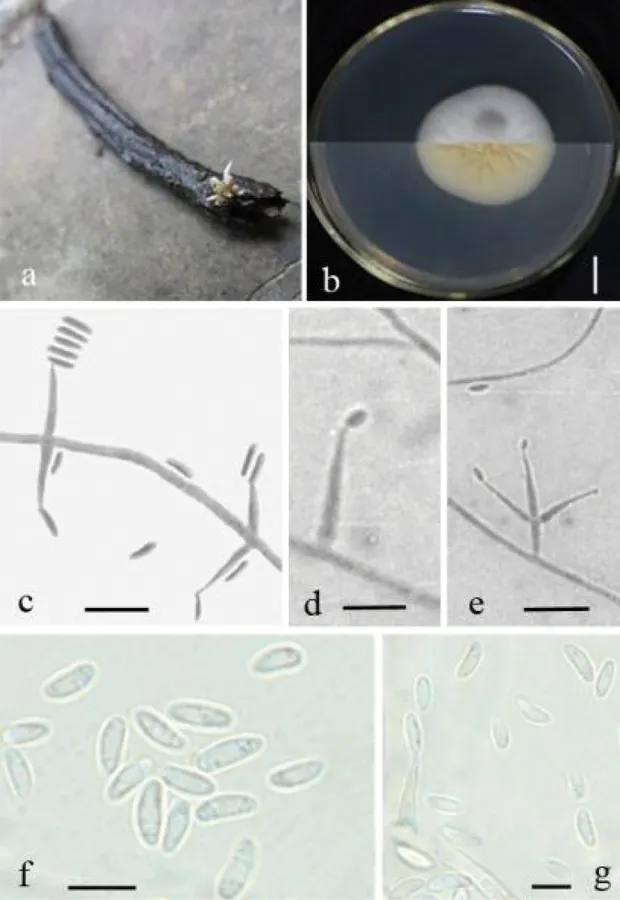
Characterised by phialides gradually tapering towards the apex, solitary or 2–3 whorls, 9–14.4 × 1.4–1.8 µm. Conidia cylindric, aseptate, 3.6–6.3 × 0.9–1.8 μm. Colony on PDA 15 mm in diameter after 7 days, 33 mm in diameter after 14 days at 25 °C, colony circular, white, cottony, umbonate, with radiating surface texture from above, with clear radial crack and primrose-yellow from reverse. Mycelium 0.9–1.8 μm wide, hyaline, smooth, septated, branched. Conidiophores usually arising from aerial hyphae, sporulate abundant. Phialides gradually tapering towards the apex, solitary or 2–3 whorls, 9–14.4 × 1.4–1.8 µm. Conidia cylindric, aseptate, 3.6–6.3 × 0.9–1.8 μm. In culture, both phialides and conidia are of similar general shape and size to those found on the host stemborer.
Habitat dan peran ekologis
Stemborer (Lepidoptera) hidden amongst wooden sticks. Hidden amongst pieces of wood in humid forests of southwest China.
- Habitat atau konteks temuan
- hutan
- Substrat
- Informasi belum tersedia pada sumber rilis ini.
- Peran atau konteks
- Belum dikategorikan pada rilis ini.
Reproduksi
Characterised by phialides gradually tapering towards the apex, solitary or 2–3 whorls, 9–14.4 × 1.4–1.8 µm. Conidia cylindric, aseptate, 3.6–6.3 × 0.9–1.8 μm. Colony on PDA 15 mm in diameter after 7 days, 33 mm in diameter after 14 days at 25 °C, colony circular, white, cottony, umbonate, with radiating surface texture from above, with clear radial crack and primrose-yellow from reverse. Mycelium 0.9–1.8 μm wide, hyaline, smooth, septated, branched. Conidiophores usually arising from aerial hyphae, sporulate abundant. Phialides gradually tapering towards the apex, solitary or 2–3 whorls, 9–14.4 × 1.4–1.8 µm. Conidia cylindric, aseptate, 3.6–6.3 × 0.9–1.8 μm. In culture, both phialides and conidia are of similar general shape and size to those found on the host stemborer.
Catatan identitas dan cakupan
- Nama diterima mengikuti Catalogue of Life Base2026-09-11; uraian mempertahankan konsep dan nama sumber aslinya.
- Preserve original treatment localities, hosts and substrate scope. Materials examined describe documented specimens, not the full global range.
- Impor dan terjemahan otomatis belum diperiksa editorial per profil. Struktur reproduktif yang disebutkan tidak membuktikan seluruh siklus hidup diketahui.
- Pengukuran pada uraian mengikuti spesimen, kultur, dan metode sumber; angka tidak diperluas ke semua populasi.
Catatan distribusi dalam narasi mengikuti sumbernya. Dokumentasi spesimen atau foto mengikuti catatan sumber. Bukti wilayah Indonesia dan penilaian konservasi tidak disimpulkan dari gambar.
Melihat dengan konteks
Lecanicillium cauligalbarum. a Synnemata emerged from the corpse of a stemborer (Lepidoptera) b Culture plate, showing the front (upper) and the back (lower) of the colony, cultured on PDA medium c–e Phialides solitary or in 2–3 whorls f–g Conidia. Scale bars: 10 mm (b, c, e), 5 μm (d, f, g).
- Jenis
- Pelat ilmiah
- Kredit
- Ye-Ming Zhou, Jun-Rui Zhi, Mao Ye, Zhi-Yuan Zhang, Wen-Bo Yue, Xiao Zou
- Lisensi
- CC BY 4.0
- Sumber media
- Buka entri sumber
Sumber profil
- [1] Lecanicillium cauligalbarum sp. nov. (Cordycipitaceae, Hypocreales), a novel fungus isolated from a stemborer in the Yao Ren National Forest Mountain Park, Guizhou — Lecanicillium cauligalbarum
- [2] Catalogue of Life Base2026-09-11 — Lecanicillium cauligalbarum
- [3] Dokumentasi visual — Lecanicillium cauligalbarum
Rujukan halaman ini
Fungi. Lecanicillium cauligalbarum. Rilis data fungi-2026-10-12-expansion-2. https://fungi-atlas.mgadib.chatgpt.site/jamur/lecanicillium-cauligalbarum/.
Status: impor sumber; pemeriksaan editorial per profil belum selesai. Untuk klaim biologis, gunakan rujukan pada bagian terkait dan periksa konteks sumber aslinya.