01 / Morfologi

Ciri dan struktur

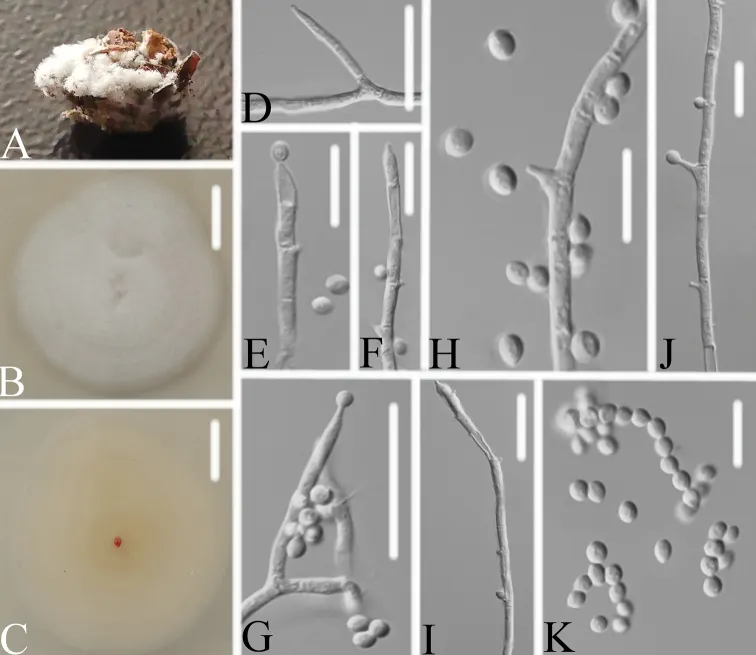
Differs from P. coccorum by having longer conidiogenous pegs located in the terminal or lateral conidiophores, and smaller subglobose or ellipsoidal conidia. Colonies on PDA, 3.9–4.1 cm diam. in 14 d at 25 °C, white, consisting of a basal felt and cottony, floccose hyphal overgrowth, reverse pale yellowish. Prostrate hyphae smooth, septate, hyaline, 1.3–1.9 μm diam. Erect or procumbent conidiophores usually arising from aerial hyphae, barely differentiated from vegetative hyphae, usually branched. Conidiogenous cells polyphialidic, terminal and intercalary, bearing numerous short-cylindrical, 1.8–3.5 μm long and 0.7–1.3 μm wide conidiogenous pegs, in whorls often below the septa. The terminal or lateral conidiogenous cells cylindrical, 5.9–12.0 × 1.8–2.2 μm. Conidia in chains, hyaline, smooth-walled, subglobose or ellipsoidal, one-celled, 2.3–3.6 × 1.7–3.3 μm. Chlamydospores and synnemata not observed. Size and shape of phialides and conidia similar in culture on PDA, OA agar and on natural substrate. Sexual state not observed.

Sebagian uraian ditampilkan dalam bahasa sumber; terjemahannya belum tersedia atau belum lolos pemeriksaan.

Rujukan: [1]

Pengukuran mengikuti objek, spesimen atau kultur, dan metode yang disebutkan sumber. Baca uraian asli untuk konteks lengkap.

02 / Kehidupan

Habitat dan peran ekologis

Duyun City, Qiannan Buyi and Miao Autonomous Prefecture, Guizhou Province, China.

Sebagian uraian ditampilkan dalam bahasa sumber; terjemahannya belum tersedia atau belum lolos pemeriksaan.

Rujukan: [1]

Habitat atau konteks temuan
Informasi belum tersedia pada sumber rilis ini.
Substrat
Informasi belum tersedia pada sumber rilis ini.
Peran atau konteks
Belum dikategorikan pada rilis ini.
Temukan hubungan serupa
03 / Siklus hidup

Reproduksi

Differs from P. coccorum by having longer conidiogenous pegs located in the terminal or lateral conidiophores, and smaller subglobose or ellipsoidal conidia. Colonies on PDA, 3.9–4.1 cm diam. in 14 d at 25 °C, white, consisting of a basal felt and cottony, floccose hyphal overgrowth, reverse pale yellowish. Prostrate hyphae smooth, septate, hyaline, 1.3–1.9 μm diam. Erect or procumbent conidiophores usually arising from aerial hyphae, barely differentiated from vegetative hyphae, usually branched. Conidiogenous cells polyphialidic, terminal and intercalary, bearing numerous short-cylindrical, 1.8–3.5 μm long and 0.7–1.3 μm wide conidiogenous pegs, in whorls often below the septa. The terminal or lateral conidiogenous cells cylindrical, 5.9–12.0 × 1.8–2.2 μm.

Sebagian uraian ditampilkan dalam bahasa sumber; terjemahannya belum tersedia atau belum lolos pemeriksaan.

Rujukan: [1]

04 / Batas informasi

Catatan identitas dan cakupan

  • Nama diterima mengikuti Catalogue of Life Base2026-09-11; uraian mempertahankan konsep dan nama sumber aslinya.
  • Preserve original treatment localities, hosts and substrate scope. Materials examined describe documented specimens, not the full global range.
  • Impor dan terjemahan otomatis belum diperiksa editorial per profil. Struktur reproduktif yang disebutkan tidak membuktikan seluruh siklus hidup diketahui.
  • Pengukuran pada uraian mengikuti spesimen, kultur, dan metode sumber; angka tidak diperluas ke semua populasi.

Catatan distribusi dalam narasi mengikuti sumbernya. Dokumentasi spesimen atau foto mengikuti catatan sumber. Bukti wilayah Indonesia dan penilaian konservasi tidak disimpulkan dari gambar.

05 / Dokumentasi

Melihat dengan konteks

Pleurodesmospora lepidopterorum A infected pupa (Lepidoptera) B, C top (B) and underside (C) of a colony cultured on PDA medium at 14 d D–J conidiogenous pegs and conidia K conidia in chains. Scale bars: 10 mm (B, C) 10 μm (D–K).

Jenis
Pelat ilmiah
Kredit
Wan-Hao Chen, Yan-Feng Han, Jian-Dong Liang, Wei-Yi Tian, Zong-Qi Liang
Lisensi
CC BY 4.0
Sumber media
Buka entri sumber

Gambar menunjukkan objek menurut identifikasi sumber, bukan verifikasi independen spesimen oleh Fungi. Tidak ada skala baru yang ditambahkan.

06 / Rujukan

Sumber profil

  1. [1] Multi-gene phylogenetic evidence indicates that Pleurodesmospora belongs in Cordycipitaceae (Hypocreales, Hypocreomycetidae) and Pleurodesmospora lepidopterorum sp. nov. on pupa from China — Pleurodesmospora lepidopterorumBagian sumber: PMC8124063_section_8
    Tanggal penghimpunan sumber: 2026-10-12
    Teks sumber: CC BY 4.0 · Chen WH, Han YF, Liang JD, Tian WY, Liang ZQ.
  2. [2] Catalogue of Life Base2026-09-11 — Pleurodesmospora lepidopterorumBagian sumber: ColDP NameUsage.tsv ID 9ZDQ5; accepted species; source 2073
    Tanggal penghimpunan sumber: 2026-10-12
  3. [3] Dokumentasi visual — Pleurodesmospora lepidopterorumBagian sumber: Individual media record; identification follows the source, not independent determination
    Tanggal penghimpunan sumber: 2026-10-12
    Media sumber: CC BY 4.0 · Wan-Hao Chen, Yan-Feng Han, Jian-Dong Liang, Wei-Yi Tian, Zong-Qi Liang

Adaptasi teks: CC BY 4.0. Chen WH, Han YF, Liang JD, Tian WY, Liang ZQ. — Multi-gene phylogenetic evidence indicates that Pleurodesmospora belongs in Cordycipitaceae (Hypocreales, Hypocreomycetidae) and Pleurodesmospora lepidopterorum sp. nov. on pupa from China — Pleurodesmospora lepidopterorum

Uraian asli dan riwayat sumber

Riwayat atau halaman sumber

Ringkasan sumber

Differs from P. coccorum by having longer conidiogenous pegs located in the terminal or lateral conidiophores, and smaller subglobose or ellipsoidal conidia. Colonies on PDA, 3.9–4.1 cm diam. in 14 d at 25 °C, white, consisting of a basal felt and cottony, floccose hyphal overgrowth, reverse pale yellowish. Prostrate hyphae smooth, septate, hyaline, 1.3–1.9 μm diam. Erect or procumbent conidiophores usually arising from aerial hyphae, barely differentiated from vegetative hyphae, usually branched.

Revisi sumber

Morfologi sumber

Differs from P. coccorum by having longer conidiogenous pegs located in the terminal or lateral conidiophores, and smaller subglobose or ellipsoidal conidia. Colonies on PDA, 3.9–4.1 cm diam. in 14 d at 25 °C, white, consisting of a basal felt and cottony, floccose hyphal overgrowth, reverse pale yellowish. Prostrate hyphae smooth, septate, hyaline, 1.3–1.9 μm diam. Erect or procumbent conidiophores usually arising from aerial hyphae, barely differentiated from vegetative hyphae, usually branched. Conidiogenous cells polyphialidic, terminal and intercalary, bearing numerous short-cylindrical, 1.8–3.5 μm long and 0.7–1.3 μm wide conidiogenous pegs, in whorls often below the septa. The terminal or lateral conidiogenous cells cylindrical, 5.9–12.0 × 1.8–2.2 μm. Conidia in chains, hyaline, smooth-walled, subglobose or ellipsoidal, one-celled, 2.3–3.6 × 1.7–3.3 μm. Chlamydospores and synnemata not observed. Size and shape of phialides and conidia similar in culture on PDA, OA agar and on natural substrate. Sexual state not observed.

Revisi sumber

Ekologi sumber

Duyun City, Qiannan Buyi and Miao Autonomous Prefecture, Guizhou Province, China.

Revisi sumber

Struktur reproduksi sumber

Differs from P. coccorum by having longer conidiogenous pegs located in the terminal or lateral conidiophores, and smaller subglobose or ellipsoidal conidia. Colonies on PDA, 3.9–4.1 cm diam. in 14 d at 25 °C, white, consisting of a basal felt and cottony, floccose hyphal overgrowth, reverse pale yellowish. Prostrate hyphae smooth, septate, hyaline, 1.3–1.9 μm diam. Erect or procumbent conidiophores usually arising from aerial hyphae, barely differentiated from vegetative hyphae, usually branched. Conidiogenous cells polyphialidic, terminal and intercalary, bearing numerous short-cylindrical, 1.8–3.5 μm long and 0.7–1.3 μm wide conidiogenous pegs, in whorls often below the septa. The terminal or lateral conidiogenous cells cylindrical, 5.9–12.0 × 1.8–2.2 μm.

Revisi sumber

Rujukan halaman ini

Fungi. Pleurodesmospora lepidopterorum. Rilis data fungi-2026-10-12-expansion-2. https://fungi-atlas.mgadib.chatgpt.site/jamur/pleurodesmospora-lepidopterorum/.

Status: impor sumber; pemeriksaan editorial per profil belum selesai. Untuk klaim biologis, gunakan rujukan pada bagian terkait dan periksa konteks sumber aslinya.