Ciri dan struktur
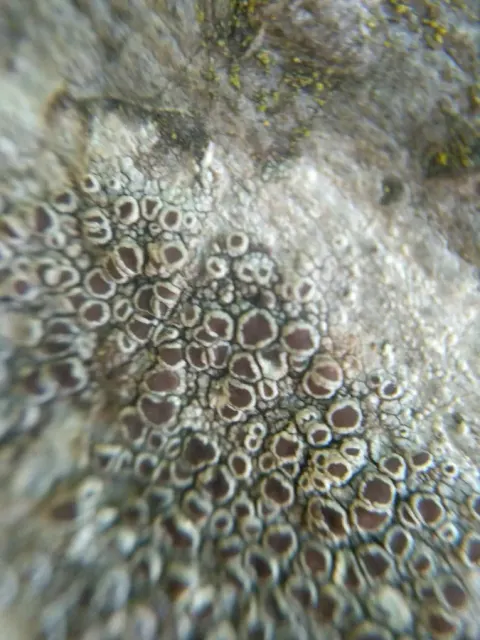
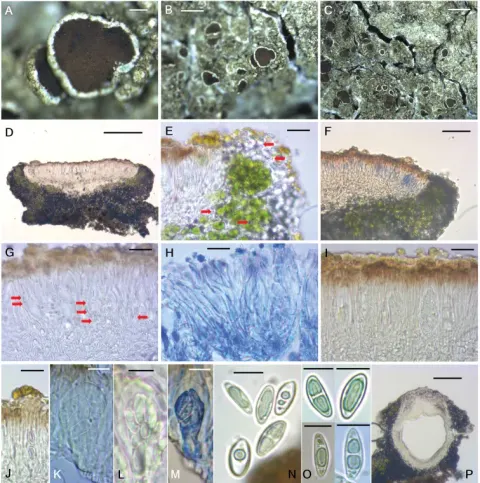
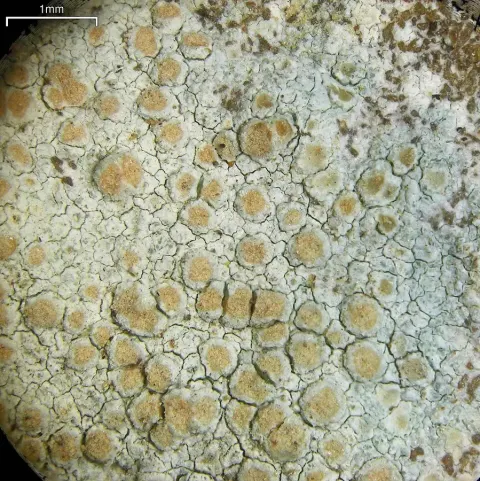
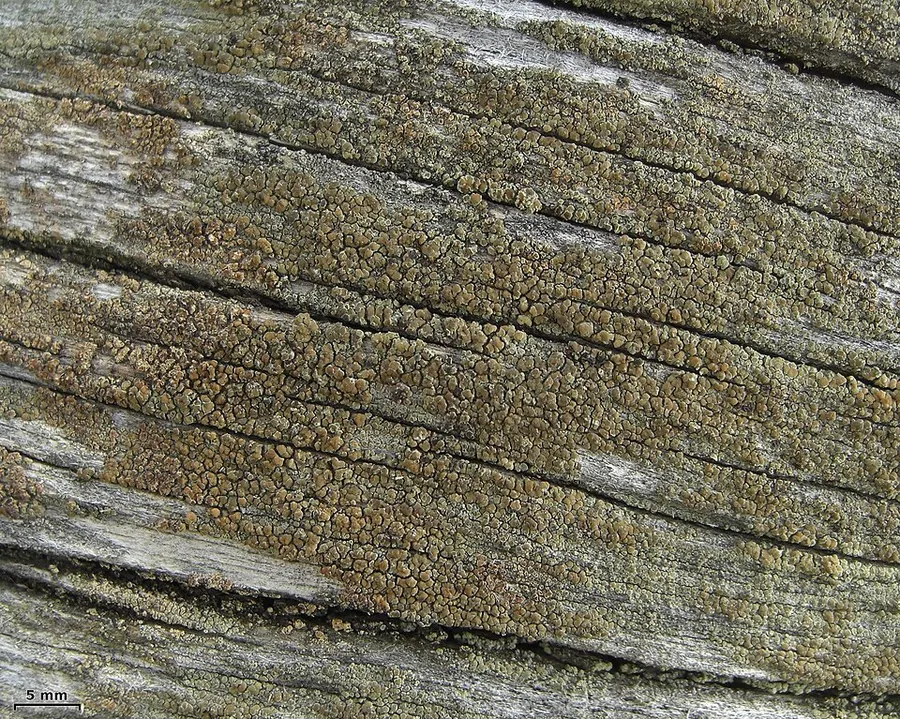
Lecanora albellula is a crustose lichen, meaning it grows tightly against its surface like a crust. Its main body (thallus) consists of small, scattered warty bumps or forms a continuous warty-cracked surface. These rounded wart-like measure 0.05–0.15 mm across, range from moderately to strongly convex, and vary in colour from yellowish-green to ochre or greyish-beige. Sometimes, a greyish-white foundation layer () can be seen around individual thalli. The thallus can reach up to 4 cm in width and ranges from 50 to 600 μm in thickness. The surface is or slightly shiny. The photobiont (algal) cells within the thallus are and measure 8–20 μm in diameter. The thallus of L. albellula is often inconspicuous, consisting of scattered granules or being immersed in bark, making it difficult to distinguish in the field. The reproductive structures (apothecia) are round to irregular in shape and usually appear in dense clusters, though they occasionally grow alone or in small groups. They attach to the surface with a constricted base and measure 0.35–0.40 mm across on average, reaching up to 0.6–0.9 mm. The of each apothecium is light ochre to reddish-brown in colour, with a matt appearance and a fine whitish . The disc is flat to moderately convex, rarely strongly convex. Each apothecium has a rim (margin) that is initially slightly raised but becomes level with the disc or disappears in older specimens. This margin is yellowish-beige to ochre (matching the colour of the thallus warts when present) and has a matt appearance, often with an irregular or knobby texture. The (outer layer of the apothecium) has a cortex that is best developed in its lower part, measuring 10–30 μm thick.
Habitat dan peran ekologis
Lecanora albellula is found in coniferous and mixed coniferous forests, where it grows primarily on bark and wood. In the Sonoran Desert region of North America, it occurs at elevations between 1950 and 3500 m. Within this region, the species shows different habitat preferences in different areas. In California and Baja California, it grows on Abies concolor (white fir), conifer logs, and dead pine trees (snags). In the eastern part of its range (Arizona, Colorado, and Utah), it can be found on a wider variety of coniferous trees, including Abies concolor, Abies lasiocarpa (subalpine fir), Picea engelmannii (Engelmann spruce), various species of Pinus (pine trees), and Pseudotsuga menziesii (Douglas fir). Its North American range extends north to Alaska. While molecular studies have revealed that many specimens previously identified as L. albellula from North America represent a different species (provisionally known as "Lecanora sp. D"), true L. albellula does occur in North America alongside this similar species. The lichen shows a strong preference for temperate to subalpine climatic conditions in both continents. In Europe, it is particularly well-documented in mixed montane forests of Picea and Fagus above 900 m elevation, where it grows on both bark and wood.
- Habitat atau konteks temuan
- hutan
- Substrat
- kulit kayu
- Peran atau konteks
- Pembentuk liken
Reproduksi
The reproductive structures (apothecia) are round to irregular in shape and usually appear in dense clusters, though they occasionally grow alone or in small groups. They attach to the surface with a constricted base and measure 0.35–0.40 mm across on average, reaching up to 0.6–0.9 mm. The of each apothecium is light ochre to reddish-brown in colour, with a matt appearance and a fine whitish . The disc is flat to moderately convex, rarely strongly convex. Each apothecium has a rim (margin) that is initially slightly raised but becomes level with the disc or disappears in older specimens. This margin is yellowish-beige to ochre (matching the colour of the thallus warts when present) and has a matt appearance, often with an irregular or knobby texture.
Catatan identitas dan cakupan
- Nama diterima mengikuti Catalogue of Life Base2026-09-11; uraian mempertahankan konsep dan nama sumber aslinya.
- Original geographic, specimen and life-cycle scope retained; source import awaits individual editorial review.
- Impor dan terjemahan otomatis belum diperiksa editorial per profil. Struktur reproduktif yang disebutkan tidak membuktikan seluruh siklus hidup diketahui.
- Pengukuran pada uraian mengikuti spesimen, kultur, dan metode sumber; angka tidak diperluas ke semua populasi.
Catatan distribusi dalam narasi mengikuti sumbernya. Dokumentasi spesimen atau foto mengikuti catatan sumber. Bukti wilayah Indonesia dan penilaian konservasi tidak disimpulkan dari gambar.
Melihat dengan konteks
Dokumentasi Lecanora albellula dari Wikimedia Commons. Meadow Lake, Lemhi Mountains, Idaho, 20130604 (or close to L. albellula -- this is a very complicated group with lots of undescribed species apparently) Identifikasi mengikuti record berkas sumber.
- Jenis
- Fotografi
- Kredit
- Jason Hollinger
- Lisensi
- CC BY 2.0
- Sumber media
- Buka entri sumber
Sumber profil
- [1] Lecanora albellula — Wikipedia (en)
- [2] Catalogue of Life Base2026-09-11 — Lecanora albellula
- [3] Dokumentasi visual — Lecanora albellula
Rujukan halaman ini
Fungi. Lecanora albellula. Rilis data fungi-2026-10-12-expansion-2. https://fungi-atlas.mgadib.chatgpt.site/jamur/lecanora-albellula/.
Status: impor sumber; pemeriksaan editorial per profil belum selesai. Untuk klaim biologis, gunakan rujukan pada bagian terkait dan periksa konteks sumber aslinya.