Ciri dan struktur
Lecanora parasymmicta differs from L. symmicta, the most similar species, by its areolate-rimose thallus (vs. areolate to leprose thallus), blackish hypothallus (vs. hypothallus indistinct), larger apothecia (up to 1.7 mm diam. vs. up to 1 mm diam.), absence of thalline excipulum from the beginning (vs. presence of thalline excipulum when young at least), narrower paraphyses (1–1.5 μm vs. 2–2.5 μm), larger ascospores (11–18 × 4–7 μm vs. 9–15.5 × 4–5 μm), smaller pycnoconidia (12–21 × 0.5–0.8 μm vs. 18–25 × 0.5–1.0 μm), chemical reactions (thallus K± slightly yellow, C–, KC– and UV– vs. K–, C± orange, KC± slightly yellow, UV+ dull orange), and the presence of placodiolic acid (vs. presence of arthothelin and ±thiophanic acid). Thallus corticolous, crustose, areolate to rimose but not leprose, light olivish gray to light gray, margin determinate, not pruinose, 60–200 μm thick; cortex hyaline, 5–10 μm thick; medulla often intermixed with algae and even with bark layer, small crystals in cortex or between algae, dissolving in K; photobiont coccoid, cells globose to ellipsoid, 5–15 μm. Hypothallus blackish. Apothecia abundant, rounded, often contiguous or even coalescent, emerging on the surface of thallus and sessile when mature but margin generally attached to thallus surface, constricted at the base, 0.3–1.7 mm diam. Disc flat in the beginning and soon convex, smooth or becoming rugose by apothecia adjoining, not pruinose or slightly pruinose, pale yellow in the beginning and slightly darker when mature, sometimes with dark spots (algae), 180–400 μm thick; biatorine. Thalline excipulum absent from the beginning, proper excipulum present and sometimes slightly paler than disc, more distinctive when young, hyaline but yellowish brown to pale brown at periphery with granules which dissolving in K, periphery color same to epihymenium, ca. 90 μm wide laterally and 70–80 μm wide at periphery, disappearing to the base.
Habitat dan peran ekologis
The species occurs on the bark of Ligustrum obtusifolium, Maackia fauriei, and Malus sieboldii. The species is currently known from the type collections.
- Habitat atau konteks temuan
- Informasi belum tersedia pada sumber rilis ini.
- Substrat
- Informasi belum tersedia pada sumber rilis ini.
- Peran atau konteks
- Pembentuk liken
Reproduksi
Lecanora parasymmicta differs from L. symmicta, the most similar species, by its areolate-rimose thallus (vs. areolate to leprose thallus), blackish hypothallus (vs. hypothallus indistinct), larger apothecia (up to 1.7 mm diam. vs. up to 1 mm diam.), absence of thalline excipulum from the beginning (vs. presence of thalline excipulum when young at least), narrower paraphyses (1–1.5 μm vs. 2–2.5 μm), larger ascospores (11–18 × 4–7 μm vs. 9–15.5 × 4–5 μm), smaller pycnoconidia (12–21 × 0.5–0.8 μm vs. 18–25 × 0.5–1.0 μm), chemical reactions (thallus K± slightly yellow, C–, KC– and UV– vs. K–, C± orange, KC± slightly yellow, UV+ dull orange), and the presence of placodiolic acid (vs. presence of arthothelin and ±thiophanic acid).
Catatan identitas dan cakupan
- Nama diterima mengikuti Catalogue of Life Base2026-09-11; uraian mempertahankan konsep dan nama sumber aslinya.
- Preserve original treatment localities, hosts and substrate scope. Materials examined describe documented specimens, not the full global range.
- Impor dan terjemahan otomatis belum diperiksa editorial per profil. Struktur reproduktif yang disebutkan tidak membuktikan seluruh siklus hidup diketahui.
- Pengukuran pada uraian mengikuti spesimen, kultur, dan metode sumber; angka tidak diperluas ke semua populasi.
Catatan distribusi dalam narasi mengikuti sumbernya. Dokumentasi spesimen atau foto mengikuti catatan sumber. Bukti wilayah Indonesia dan penilaian konservasi tidak disimpulkan dari gambar.
Melihat dengan konteks
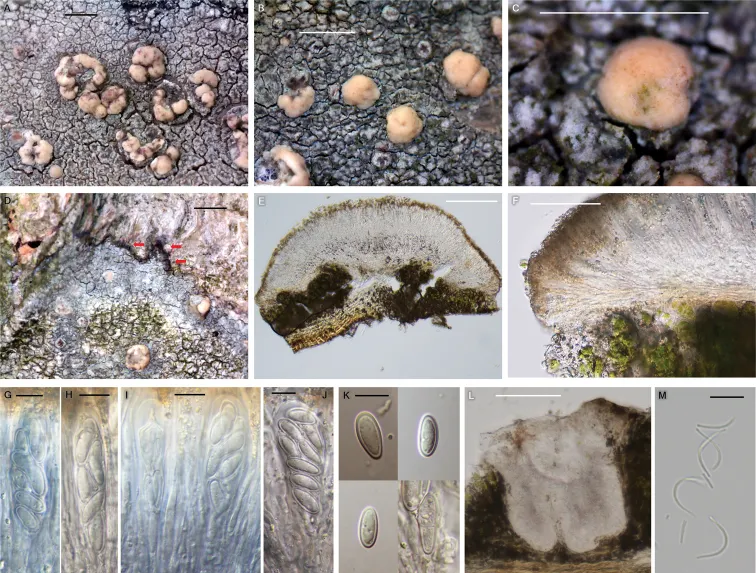
Lecanora parasymmicta morphology (BDNA-L-0001235, paratype in A BDNA-L-0001220, holotype in B–M) A–C habitus and apothecia, thalline margin of apothecia consistently absent from the beginning D blackish hypothallus (red arrows) E apothecia in vertical section F biatorine apothecia without thalline margin G–J clavate asci with eight spores K ascospores constantly simple but rarely 1-septate L immersed pycnidia M thread-like, curved pycnoconidia. Scale bars: 1 mm (A–D); 200 μm (E); 50 μm (F); 10 μm (G–K); 100 μm (L); 10 μm (M).
- Jenis
- Pelat ilmiah
- Kredit
- Beeyoung Gun Lee, Jae-Seoun Hur
- Lisensi
- CC BY 4.0
- Sumber media
- Buka entri sumber
Sumber profil
- [1] Two new lecanoroid lichen species from the forested wetlands of South Korea, with a key for Korean Protoparmeliopsis species — Lecanora parasymmicta
- [2] Catalogue of Life Base2026-09-11 — Lecanora parasymmicta
- [3] Dokumentasi visual — Lecanora parasymmicta
Rujukan halaman ini
Fungi. Lecanora parasymmicta. Rilis data fungi-2026-10-12-expansion-2. https://fungi-atlas.mgadib.chatgpt.site/jamur/lecanora-parasymmicta/.
Status: impor sumber; pemeriksaan editorial per profil belum selesai. Untuk klaim biologis, gunakan rujukan pada bagian terkait dan periksa konteks sumber aslinya.