01 / Morfologi

Ciri dan struktur

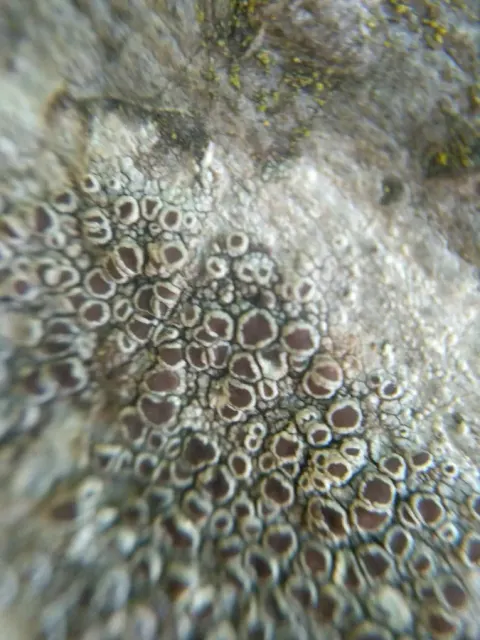
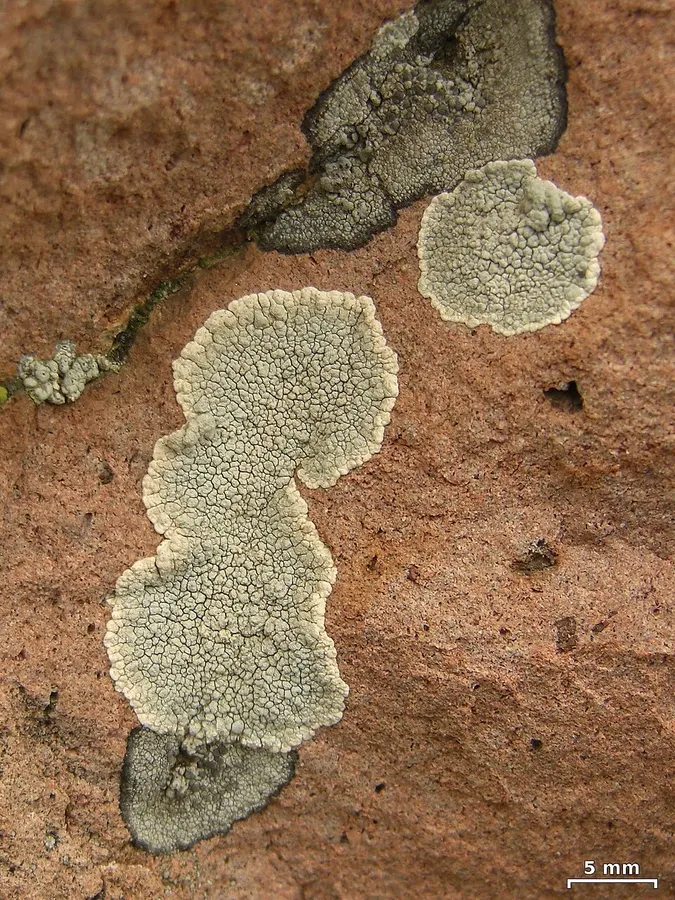
Lecanora subcarnea forms a continuous crustose thallus (the lichen body) that is finely cracked to form small, often slightly raised (individual sections) with (scalloped) margins. The thallus varies from white or pale grey to pale yellow or yellowish grey, and its surface ranges from coarsely granular to warted. A distinct white, fibrous (the initial fungal growth margin) often borders the thallus. The apothecia (disc‑shaped fruiting bodies) are typically clustered and measure (0.2–) 0.4–1 (–1.7) mm in diameter. They begin immersed in the thallus and become or slightly raised, developing a that remains entire and is the same colour as—or gradually paler than—the thallus, though it may become excluded with age. The itself is pinkish to pale grey‑brown, convex to almost spherical (), and usually covered by a dense coating of white to bluish (powdery) crystals. The (the uppermost layer above the hymenium) is brown and , while the hymenium (the spore‑bearing layer) is 35–55 μm tall. Paraphyses (sterile supporting filaments) are 1.5–2 μm wide, unbranched or sparsely branched near their tips, with apical cells up to 3.5 μm across. are broadly ellipsoid, typically measuring 10–14 by 6–8 μm. Standard spot tests on the thallus are C–, K+ (yellow), Pd+ (orange → red). There is no fluorescence under ultraviolet light (UV–). These chemical reactions are characteristic of secondary metabolites such as atranorin, chloroatranorin and protocetraric acid.

Sebagian uraian ditampilkan dalam bahasa sumber; terjemahannya belum tersedia atau belum lolos pemeriksaan.

Rujukan: [1]

Pengukuran mengikuti objek, spesimen atau kultur, dan metode yang disebutkan sumber. Baca uraian asli untuk konteks lengkap.

02 / Kehidupan

Habitat dan peran ekologis

In the United Kingdom, Lecanora subcarnea occurs locally in sheltered cracks of silica‑rich rocks that have a high base content, and only occasionally on limestone near lakes or within woodland sites. It has been reliably reported from Westmorland in England, northern Wales, central and eastern Scotland, and the Channel Islands; earlier records from south‑west England, Pembrokeshire and, possibly, Ireland have since been shown to be incorrect.

Sebagian uraian ditampilkan dalam bahasa sumber; terjemahannya belum tersedia atau belum lolos pemeriksaan.

Rujukan: [1]

Habitat atau konteks temuan
hutan
Substrat
Informasi belum tersedia pada sumber rilis ini.
Peran atau konteks
Pembentuk liken
Temukan hubungan serupa
03 / Siklus hidup

Reproduksi

The apothecia (disc‑shaped fruiting bodies) are typically clustered and measure (0.2–) 0.4–1 (–1.7) mm in diameter. They begin immersed in the thallus and become or slightly raised, developing a that remains entire and is the same colour as—or gradually paler than—the thallus, though it may become excluded with age. The itself is pinkish to pale grey‑brown, convex to almost spherical (), and usually covered by a dense coating of white to bluish (powdery) crystals. The (the uppermost layer above the hymenium) is brown and , while the hymenium (the spore‑bearing layer) is 35–55 μm tall. Paraphyses (sterile supporting filaments) are 1.5–2 μm wide, unbranched or sparsely branched near their tips, with apical cells up to 3.5 μm across.

Sebagian uraian ditampilkan dalam bahasa sumber; terjemahannya belum tersedia atau belum lolos pemeriksaan.

Rujukan: [1]

Sinonim menurut acuan taksonomi rilis: Lecanora glaucoma f. subcarnea; Lecanora rimosa var. subcarnea; Lecanora rupicola var. subcarnea; Lecanora sordida var. subcarnea; Lecidea subcarnea; Lichen subcarneus; Parmelia glaucoma var. subcarnea; Parmelia rimosa var. subcarnea; Parmelia sordida var. subcarnea; Parmelia subcarnea; Patellaria angulosa subcarneus; Patellaria rupicola var. subcarnea; Verrucaria subcarnea; Zeora sordida var. subcarnea; Zeora subcarnea
04 / Batas informasi

Catatan identitas dan cakupan

  • Nama diterima mengikuti Catalogue of Life Base2026-09-11; uraian mempertahankan konsep dan nama sumber aslinya.
  • Original geographic, specimen and life-cycle scope retained; source import awaits individual editorial review.
  • Impor dan terjemahan otomatis belum diperiksa editorial per profil. Struktur reproduktif yang disebutkan tidak membuktikan seluruh siklus hidup diketahui.
  • Pengukuran pada uraian mengikuti spesimen, kultur, dan metode sumber; angka tidak diperluas ke semua populasi.

Catatan distribusi dalam narasi mengikuti sumbernya. Dokumentasi spesimen atau foto mengikuti catatan sumber. Bukti wilayah Indonesia dan penilaian konservasi tidak disimpulkan dari gambar.

05 / Dokumentasi

Melihat dengan konteks

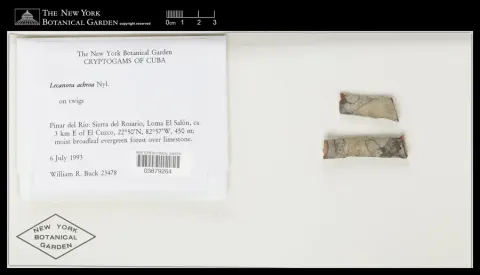
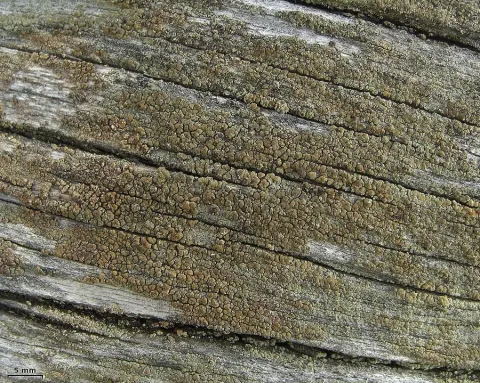
Dokumentasi Lecanora subcarnea dari Wikimedia Commons. The lichen Lecanora subcarnea (Lilj.) Ach.; specimen photographed in Identifikasi mengikuti record berkas sumber.

Jenis
Fotografi
Kredit
Jason Hollinger
Sumber media
Buka entri sumber

Gambar menunjukkan objek menurut identifikasi sumber, bukan verifikasi independen spesimen oleh Fungi. Tidak ada skala baru yang ditambahkan.

06 / Rujukan

Sumber profil

  1. [1] Lecanora subcarnea — Wikipedia (en)Bagian sumber: Frozen revision 1286737014
    Tanggal penghimpunan sumber: 2026-10-12
    Teks sumber: CC BY-SA4.0 · Wikipedia contributors
  2. [2] Catalogue of Life Base2026-09-11 — Lecanora subcarneaBagian sumber: ColDP NameUsage.tsv ID 3ST3K; accepted species; source 2073
    Tanggal penghimpunan sumber: 2026-10-12
  3. [3] Dokumentasi visual — Lecanora subcarneaBagian sumber: Individual media record; identification follows the source, not independent determination
    Tanggal penghimpunan sumber: 2026-10-12
    Media sumber: CC BY-SA 3.0 · Jason Hollinger

Adaptasi teks: CC BY-SA 4.0. Wikipedia contributors — Lecanora subcarnea — Wikipedia (en)

Uraian asli dan riwayat sumber

Riwayat atau halaman sumber

Ringkasan sumber

Lecanora subcarnea is a species of crustose lichen in the family Lecanoraceae, first described in 1792 as Lichen subcarneus by Swedish botanist Samuel Liljeblad and later transferred to the genus Lecanora by Erik Acharius in 1810. The lichen forms a continuous white to pale yellowish-grey thallus with small , distinctive pinkish to pale grey-brown apothecia (fruiting bodies) covered in white powdery crystals, and produces chemical compounds including atranorin and protocetraric acid that yield characteristic reactions in spot tests.

Revisi sumber

Morfologi sumber

Lecanora subcarnea forms a continuous crustose thallus (the lichen body) that is finely cracked to form small, often slightly raised (individual sections) with (scalloped) margins. The thallus varies from white or pale grey to pale yellow or yellowish grey, and its surface ranges from coarsely granular to warted. A distinct white, fibrous (the initial fungal growth margin) often borders the thallus. The apothecia (disc‑shaped fruiting bodies) are typically clustered and measure (0.2–) 0.4–1 (–1.7) mm in diameter. They begin immersed in the thallus and become or slightly raised, developing a that remains entire and is the same colour as—or gradually paler than—the thallus, though it may become excluded with age. The itself is pinkish to pale grey‑brown, convex to almost spherical (), and usually covered by a dense coating of white to bluish (powdery) crystals. The (the uppermost layer above the hymenium) is brown and , while the hymenium (the spore‑bearing layer) is 35–55 μm tall. Paraphyses (sterile supporting filaments) are 1.5–2 μm wide, unbranched or sparsely branched near their tips, with apical cells up to 3.5 μm across. are broadly ellipsoid, typically measuring 10–14 by 6–8 μm. Standard spot tests on the thallus are C–, K+ (yellow), Pd+ (orange → red). There is no fluorescence under ultraviolet light (UV–). These chemical reactions are characteristic of secondary metabolites such as atranorin, chloroatranorin and protocetraric acid.

Revisi sumber

Ekologi sumber

In the United Kingdom, Lecanora subcarnea occurs locally in sheltered cracks of silica‑rich rocks that have a high base content, and only occasionally on limestone near lakes or within woodland sites. It has been reliably reported from Westmorland in England, northern Wales, central and eastern Scotland, and the Channel Islands; earlier records from south‑west England, Pembrokeshire and, possibly, Ireland have since been shown to be incorrect.

Revisi sumber

Struktur reproduksi sumber

The apothecia (disc‑shaped fruiting bodies) are typically clustered and measure (0.2–) 0.4–1 (–1.7) mm in diameter. They begin immersed in the thallus and become or slightly raised, developing a that remains entire and is the same colour as—or gradually paler than—the thallus, though it may become excluded with age. The itself is pinkish to pale grey‑brown, convex to almost spherical (), and usually covered by a dense coating of white to bluish (powdery) crystals. The (the uppermost layer above the hymenium) is brown and , while the hymenium (the spore‑bearing layer) is 35–55 μm tall. Paraphyses (sterile supporting filaments) are 1.5–2 μm wide, unbranched or sparsely branched near their tips, with apical cells up to 3.5 μm across.

Revisi sumber

Rujukan halaman ini

Fungi. Lecanora subcarnea. Rilis data fungi-2026-10-12-expansion-2. https://fungi-atlas.mgadib.chatgpt.site/jamur/lecanora-subcarnea/.

Status: impor sumber; pemeriksaan editorial per profil belum selesai. Untuk klaim biologis, gunakan rujukan pada bagian terkait dan periksa konteks sumber aslinya.