Ciri dan struktur
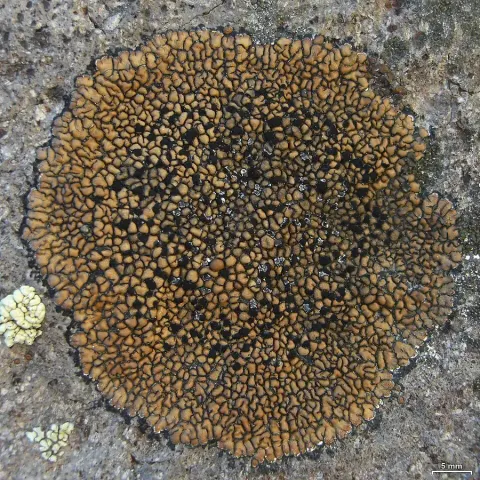
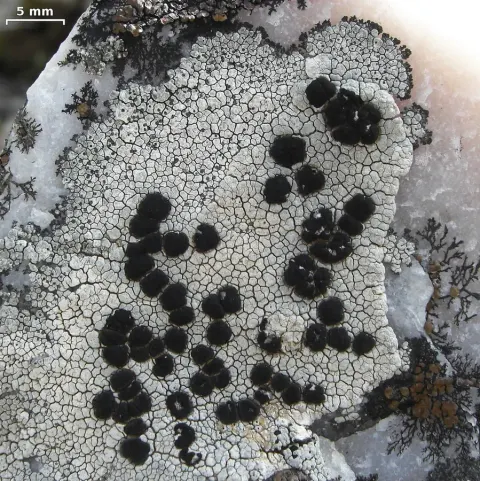
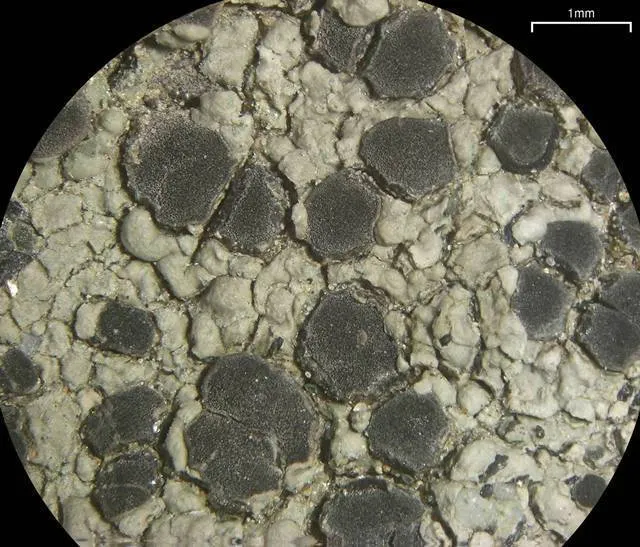
Lecidea fuscoatra forms a thin crust that breaks into many small, tile-like patches (an thallus). The surface is shiny and whitish grey to pale yellow-brown or grey-brown, each patch usually up to about 3 mm across and flat to slightly rounded. A black border of fungal tissue (the prothallus) may outline the patches. Just above the pigmented outer skin lies a thin layer of dead, colourless cells (an epinecral layer), and the inner white layer (medulla) does not turn blue with iodine. The fruiting bodies are small black discs (apothecia) 0.5–2(–3) mm wide that are typically sunk into, or seated between, the patches; they are flat to slightly domed and may be dusted with a grey frost (). The disc keeps a slightly raised, persistent rim (the ) that, under the microscope, is built from chains of rounded cells—brown on the outside, colourless within—and it gives a pink reaction in the C test. The uppermost film on the disc () is olive-green to olive-brown and becomes more olivaceous in KOH; the spore-bearing layer (hymenium) is 40–60 μm tall; and the tissue beneath () is dark brown to black and often forms a short, stalk-like base. The supporting threads (paraphyses) are mostly unbranched, 1.5–2 μm thick, with tips to 3(–5) μm that can be tinged olive-brown. The spore sacs (asci) measure 45–55 × 8–15 μm and contain eight spores. The ascospores are colourless, ellipsoid to narrowly ellipsoid, usually 11–16.5 × 4.5–6.5 μm. Asexual spores (conidia) are very slender rods, typically measuring 7–10 × 0.5–0.8 μm. In standard spot tests on the thallus, C (bleach) is positive red, while K (potassium hydroxide), KC, Pd (para-phenylenediamine), and UV are negative.
Habitat dan peran ekologis
Lecidea fuscoatra is widespread, reported from Europe, North Africa, North America, and Asia. Within Europe it is more frequent on natural, generally acidic rocks (e.g., granite and sandstone) and is relatively common in boreal regions. It has also been recorded growing on hornfels in the Sudety Mountains of Poland. In Galicia (north-west Spain), L. fuscoatra has been recorded on granite church masonry exposed to marine aerosols, for example at the Church of Santa María das Areas (Fisterra), where it occurs on both vertical walls (apse) and horizontal elements, showing that the species readily colonises worked stone in coastal settings.
- Habitat atau konteks temuan
- Informasi belum tersedia pada sumber rilis ini.
- Substrat
- Informasi belum tersedia pada sumber rilis ini.
- Peran atau konteks
- Pembentuk liken
Reproduksi
The fruiting bodies are small black discs (apothecia) 0.5–2(–3) mm wide that are typically sunk into, or seated between, the patches; they are flat to slightly domed and may be dusted with a grey frost (). The disc keeps a slightly raised, persistent rim (the ) that, under the microscope, is built from chains of rounded cells—brown on the outside, colourless within—and it gives a pink reaction in the C test. The uppermost film on the disc () is olive-green to olive-brown and becomes more olivaceous in KOH; the spore-bearing layer (hymenium) is 40–60 μm tall; and the tissue beneath () is dark brown to black and often forms a short, stalk-like base. The supporting threads (paraphyses) are mostly unbranched, 1.5–2 μm thick, with tips to 3(–5) μm that can be tinged olive-brown.
Catatan identitas dan cakupan
- Nama diterima mengikuti Catalogue of Life Base2026-09-11; uraian mempertahankan konsep dan nama sumber aslinya.
- Original geographic, specimen and life-cycle scope retained; source import awaits individual editorial review.
- Impor dan terjemahan otomatis belum diperiksa editorial per profil. Struktur reproduktif yang disebutkan tidak membuktikan seluruh siklus hidup diketahui.
- Pengukuran pada uraian mengikuti spesimen, kultur, dan metode sumber; angka tidak diperluas ke semua populasi.
Catatan distribusi dalam narasi mengikuti sumbernya. Dokumentasi spesimen atau foto mengikuti catatan sumber. Bukti wilayah Indonesia dan penilaian konservasi tidak disimpulkan dari gambar.
Melihat dengan konteks
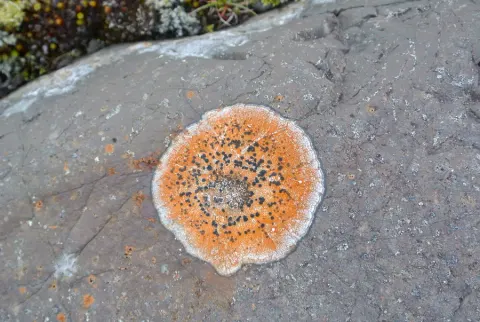
Dokumentasi Lecidea fuscoatra menurut asosiasi foto pada record takson iNaturalist. Kredit: Jason Hollinger. Identitas mengikuti sumber; bukan penentuan spesimen independen.
- Jenis
- Fotografi
- Kredit
- (c) Jason Hollinger, some rights reserved (CC BY-SA)
- Lisensi
- CC BY-SA 4.0
- Sumber media
- Buka entri sumber
Dokumentasi tambahan
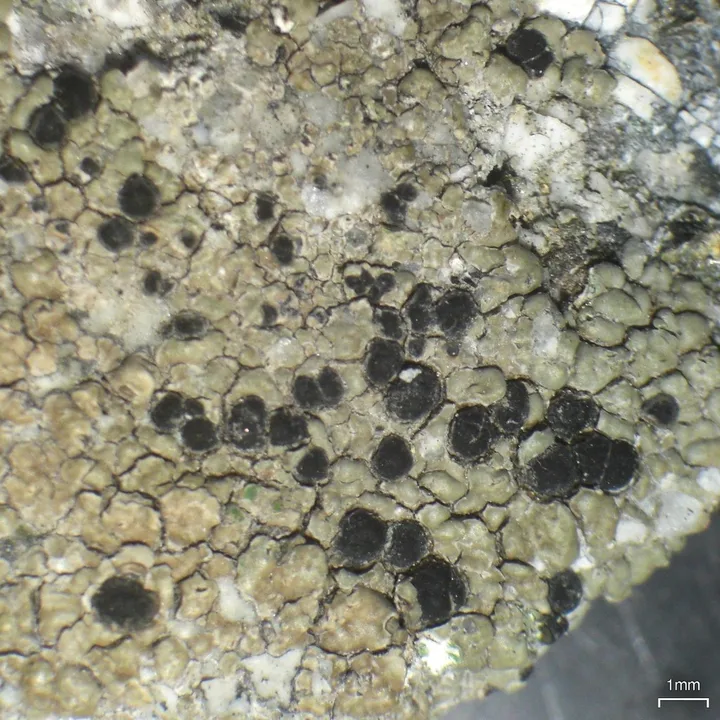
Foto yang diasosiasikan dengan Lecidea fuscoatra pada iNaturalist. Identifikasi mengikuti sumber; bukan penentuan spesimen independen.
Kredit dan penggunaan
(c) Jason Hollinger, some rights reserved (CC BY-SA)
Ukuran dan format gambar disesuaikan tanpa pemotongan, retus, atau penambahan skala. Lisensi sumber dipertahankan.
Sumber profil
- [1] Lecidea fuscoatra — Wikipedia (en)
- [2] Catalogue of Life Base2026-09-11 — Lecidea fuscoatra
- [3] Dokumentasi visual — Lecidea fuscoatra
- [4] Dokumentasi visual — Lecidea fuscoatra
Rujukan halaman ini
Fungi. Lecidea fuscoatra. Rilis data fungi-2026-10-12-expansion-2. https://fungi-atlas.mgadib.chatgpt.site/jamur/lecidea-fuscoatra/.
Status: impor sumber; pemeriksaan editorial per profil belum selesai. Untuk klaim biologis, gunakan rujukan pada bagian terkait dan periksa konteks sumber aslinya.