01 / Morfologi

Ciri dan struktur

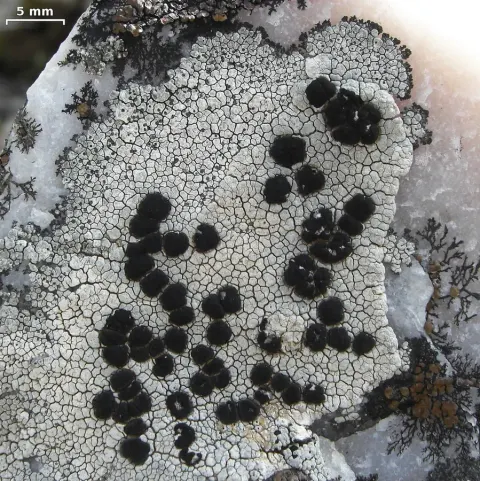
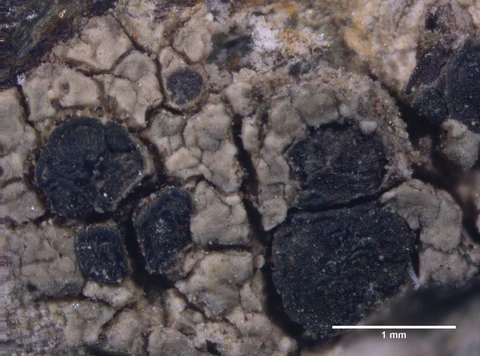
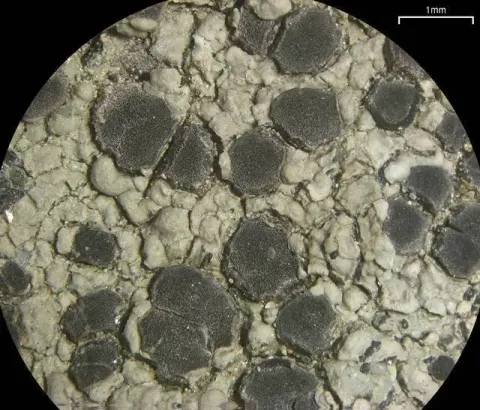
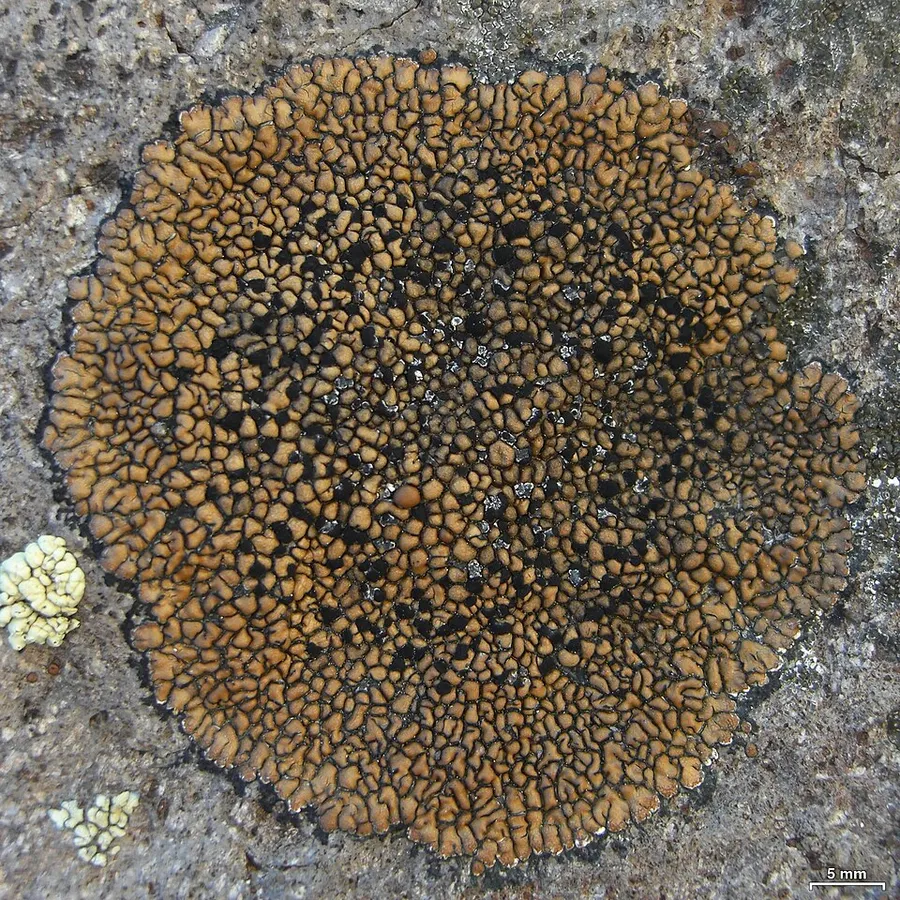
Lecidea perlatolica forms a crust-like thallus that breaks into small, tile-like patches (). A dark border of fungal tissue (the ) may be absent or show as a thin black to black-green line between patches. The areoles can touch or sit a little apart; those at the edge often develop narrow, lobed outlines. Individual areoles are flat to strongly domed, and in well-developed specimens can look like tiny scales or even short stalked bumps; they measure about 0.9–1.5 (rarely up to 3) mm across and 0.4–0.8 mm tall. The upper surface is pale to medium brown (occasionally darker toward the center), smooth and shiny to faintly roughened, and sometimes edged by a narrow pale or dark rim that may curl slightly downward. The outer skin () is stratified into three thin layers, the uppermost being a translucent sheet of dead, compacted cells. Beneath this lies a green and a white inner layer (the medulla), which turns a vivid violet when stained with iodine. In some specimens with scale-like areoles, a dark lower surface can be seen. The fruiting bodies (apothecia) are black, round to slightly irregular with a subtly narrowed base, usually 0.7–1.4(–2.3) mm in diameter. Their tops are flat to gently convex and may be or carry a faint dusting (); a black rim typically remains visible. Around the rim, the outermost tissue grades to a green-black zone, while the thin surface layer over the disc itself is bright green under the microscope. The spore-bearing layer (hymenium) is clear, 40–60 μm tall, and gives a blue reaction with iodine. Its supporting threads (paraphyses) are mostly simple, only rarely forked or connected to neighbors.

Sebagian uraian ditampilkan dalam bahasa sumber; terjemahannya belum tersedia atau belum lolos pemeriksaan.

Rujukan: [1]

Pengukuran mengikuti objek, spesimen atau kultur, dan metode yang disebutkan sumber. Baca uraian asli untuk konteks lengkap.

02 / Kehidupan

Habitat dan peran ekologis

Lecidea perlatolica grows on acidic rock in open, well-lit sites within the montane to subalpine zones, at elevations between about 1830 and 3350 m. It has been recorded from the western United States: California (Butte, El Dorado, Inyo, Los Angeles, Mono, San Bernardino, Tulare, and Tuolumne counties), Utah, and Nevada.

Sebagian uraian ditampilkan dalam bahasa sumber; terjemahannya belum tersedia atau belum lolos pemeriksaan.

Rujukan: [1]

Habitat atau konteks temuan
Informasi belum tersedia pada sumber rilis ini.
Substrat
Informasi belum tersedia pada sumber rilis ini.
Peran atau konteks
Pembentuk liken
Temukan hubungan serupa
03 / Siklus hidup

Reproduksi

The fruiting bodies (apothecia) are black, round to slightly irregular with a subtly narrowed base, usually 0.7–1.4(–2.3) mm in diameter. Their tops are flat to gently convex and may be or carry a faint dusting (); a black rim typically remains visible. Around the rim, the outermost tissue grades to a green-black zone, while the thin surface layer over the disc itself is bright green under the microscope. The spore-bearing layer (hymenium) is clear, 40–60 μm tall, and gives a blue reaction with iodine. Its supporting threads (paraphyses) are mostly simple, only rarely forked or connected to neighbors. The tissues below the hymenium range from colorless to medium brown. The asci (the spore sacs) are club-shaped, 40–65 × 13–16 μm, and usually contain eight spores.

Sebagian uraian ditampilkan dalam bahasa sumber; terjemahannya belum tersedia atau belum lolos pemeriksaan.

Rujukan: [1]

04 / Batas informasi

Catatan identitas dan cakupan

  • Nama diterima mengikuti Catalogue of Life Base2026-09-11; uraian mempertahankan konsep dan nama sumber aslinya.
  • Original geographic, specimen and life-cycle scope retained; source import awaits individual editorial review.
  • Impor dan terjemahan otomatis belum diperiksa editorial per profil. Struktur reproduktif yang disebutkan tidak membuktikan seluruh siklus hidup diketahui.
  • Pengukuran pada uraian mengikuti spesimen, kultur, dan metode sumber; angka tidak diperluas ke semua populasi.

Catatan distribusi dalam narasi mengikuti sumbernya. Dokumentasi spesimen atau foto mengikuti catatan sumber. Bukti wilayah Indonesia dan penilaian konservasi tidak disimpulkan dari gambar.

05 / Dokumentasi

Melihat dengan konteks

Dokumentasi Lecidea perlatolica dari Wikimedia Commons. Deadwood Peak, Mokelumne Wilderness, California, 20140628, #6508 pers. herb. Medulla was UV+, but TLC is required for definitive ID. Identifikasi mengikuti record berkas sumber.

Jenis
Fotografi
Kredit
Jason Hollinger
Lisensi
CC BY 2.0
Sumber media
Buka entri sumber

Gambar menunjukkan objek menurut identifikasi sumber, bukan verifikasi independen spesimen oleh Fungi. Tidak ada skala baru yang ditambahkan.

06 / Rujukan

Sumber profil

  1. [1] Lecidea perlatolica — Wikipedia (en)Bagian sumber: Frozen revision 1353396962
    Tanggal penghimpunan sumber: 2026-10-12
    Teks sumber: CC BY-SA4.0 · Wikipedia contributors
  2. [2] Catalogue of Life Base2026-09-11 — Lecidea perlatolicaBagian sumber: ColDP NameUsage.tsv ID 6P6SK; accepted species; source 2073
    Tanggal penghimpunan sumber: 2026-10-12
  3. [3] Dokumentasi visual — Lecidea perlatolicaBagian sumber: Individual media record; identification follows the source, not independent determination
    Tanggal penghimpunan sumber: 2026-10-12
    Media sumber: CC BY 2.0 · Jason Hollinger

Adaptasi teks: CC BY-SA 4.0. Wikipedia contributors — Lecidea perlatolica — Wikipedia (en)

Uraian asli dan riwayat sumber

Riwayat atau halaman sumber

Ringkasan sumber

Lecidea perlatolica is a species of saxicolous (rock-dwelling) crustose lichen in the family Lecideaceae. It occurs in the southwestern United States and is named after perlatolic acid, the main lichen product it makes. This lichen grows on acidic rocks in mountain and subalpine areas, typically at elevations between 1830 and 3350 m. The species forms small, brownish, tile-like patches on rock surfaces and has been found in California, Nevada, and Utah.

Revisi sumber

Morfologi sumber

Lecidea perlatolica forms a crust-like thallus that breaks into small, tile-like patches (). A dark border of fungal tissue (the ) may be absent or show as a thin black to black-green line between patches. The areoles can touch or sit a little apart; those at the edge often develop narrow, lobed outlines. Individual areoles are flat to strongly domed, and in well-developed specimens can look like tiny scales or even short stalked bumps; they measure about 0.9–1.5 (rarely up to 3) mm across and 0.4–0.8 mm tall. The upper surface is pale to medium brown (occasionally darker toward the center), smooth and shiny to faintly roughened, and sometimes edged by a narrow pale or dark rim that may curl slightly downward. The outer skin () is stratified into three thin layers, the uppermost being a translucent sheet of dead, compacted cells. Beneath this lies a green and a white inner layer (the medulla), which turns a vivid violet when stained with iodine. In some specimens with scale-like areoles, a dark lower surface can be seen. The fruiting bodies (apothecia) are black, round to slightly irregular with a subtly narrowed base, usually 0.7–1.4(–2.3) mm in diameter. Their tops are flat to gently convex and may be or carry a faint dusting (); a black rim typically remains visible. Around the rim, the outermost tissue grades to a green-black zone, while the thin surface layer over the disc itself is bright green under the microscope. The spore-bearing layer (hymenium) is clear, 40–60 μm tall, and gives a blue reaction with iodine. Its supporting threads (paraphyses) are mostly simple, only rarely forked or connected to neighbors.

Revisi sumber

Ekologi sumber

Lecidea perlatolica grows on acidic rock in open, well-lit sites within the montane to subalpine zones, at elevations between about 1830 and 3350 m. It has been recorded from the western United States: California (Butte, El Dorado, Inyo, Los Angeles, Mono, San Bernardino, Tulare, and Tuolumne counties), Utah, and Nevada.

Revisi sumber

Struktur reproduksi sumber

The fruiting bodies (apothecia) are black, round to slightly irregular with a subtly narrowed base, usually 0.7–1.4(–2.3) mm in diameter. Their tops are flat to gently convex and may be or carry a faint dusting (); a black rim typically remains visible. Around the rim, the outermost tissue grades to a green-black zone, while the thin surface layer over the disc itself is bright green under the microscope. The spore-bearing layer (hymenium) is clear, 40–60 μm tall, and gives a blue reaction with iodine. Its supporting threads (paraphyses) are mostly simple, only rarely forked or connected to neighbors. The tissues below the hymenium range from colorless to medium brown. The asci (the spore sacs) are club-shaped, 40–65 × 13–16 μm, and usually contain eight spores.

Revisi sumber

Rujukan halaman ini

Fungi. Lecidea perlatolica. Rilis data fungi-2026-10-12-expansion-2. https://fungi-atlas.mgadib.chatgpt.site/jamur/lecidea-perlatolica/.

Status: impor sumber; pemeriksaan editorial per profil belum selesai. Untuk klaim biologis, gunakan rujukan pada bagian terkait dan periksa konteks sumber aslinya.