01 / Morfologi

Ciri dan struktur

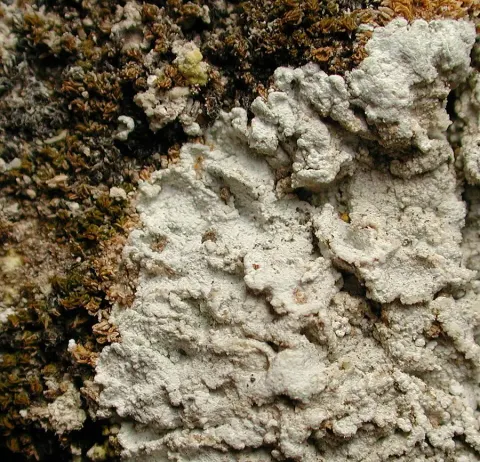
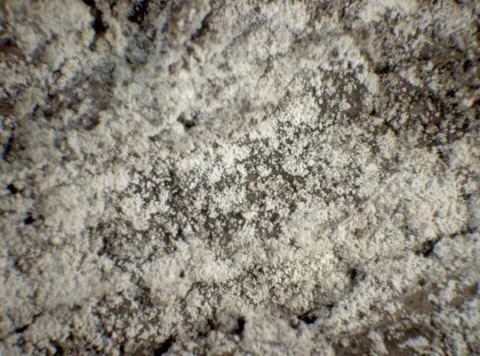
The thallus of Lepraria incana is leprose (powdery), and greenish grey in colour, often with blue tinge. It has a diffuse margin with neither distinct lobes, nor a distinct cortex, forming continuous patches with diameters up to about 8 cm, or forming smaller colonies of poorly developed patches or areoles. The thallus consists of abundant powdery soredia (little balls of algae wrapped in fungus hyphae) up to 50 μm in diameter. A medulla is sometimes present, but if so, it is usually poorly developed. Consoredia (diaspores made of aggregated soredia) are sometimes present, and they measure up to 110 μm. Overall, the appearance of the lichen can be quite variable, as sometimes it forms more or less loose cotton-like cushions, while other times it consists only of soredia that can be sparse or dense. The photobiont partner of the lichen is a spherical (coccoid) member of the green algal phylum Chlorophyta, with a diameter of up to 18 μm. In terms of secondary chemicals, Lepraria incana contains divaricatic acid, zeorin, and nordivaricatic acid (trace amounts). Some specimens have trace amounts of atranorin, although this may be a contaminant. It also contains anthraquinones such as parietin, fallacinal, parietinic acid, and citreorosein. A chemical analysis on specimens of the lichen from Japan revealed several terpenes, including pavoninin-2, terpecurcumin Q, ergosterol acetate, taxuspine C, and lantadene A methyl ester. The thallus has a bluish tinge when viewed under ultraviolet light. The expected results of standard lichen spot tests on this species are K− or + (producing a faint yellow colour), C−, KC−, and Pd−.

Sebagian uraian ditampilkan dalam bahasa sumber; terjemahannya belum tersedia atau belum lolos pemeriksaan.

Rujukan: [1]

Pengukuran mengikuti objek, spesimen atau kultur, dan metode yang disebutkan sumber. Baca uraian asli untuk konteks lengkap.

02 / Kehidupan

Habitat dan peran ekologis

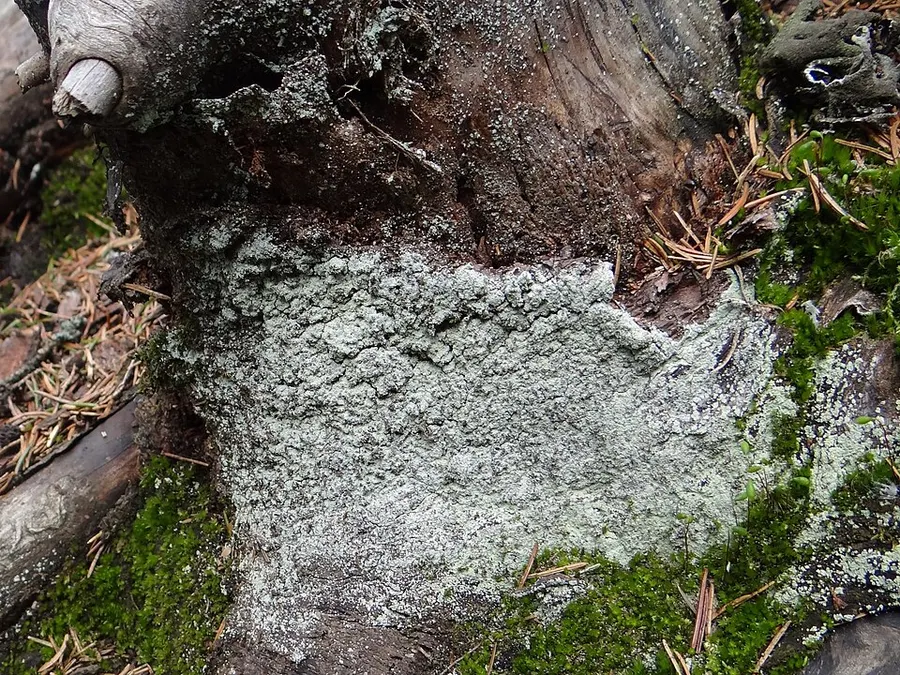
Lepraria incana most commonly occurs on bark on the base of trees. It prefers old bark that is generally more than 20 years old. The lichen grows well on coniferous bark, although it prefers the bark of oak (genus Quercus). It has been judged to be well-adapted to rugose (wrinkled) bark and cork accumulation, as seen in the old stem parts of Pseudotsuga and Quercus. One study found that the probability of the lichen occurring increased with increasing bark crevice depth and decreasing tree bark pH (i.e., tending towards acidic), although another study noted its occurrence on the smooth bark of Abies. In Finland, the most common bark substrates for the lichen are from trees in the genera Picea, Tilia, and Pinus. Less frequently, it is encountered on rotten wood, soil, and rocks. In Belarus, it is the most common of nine species of Lepraria found there, accounting for nearly half of hundreds of herbarium specimens examined. There, it is most common on Picea abies and Pinus sylvestris. Similarly, it is almost always present, and sometimes dominant, in epiphytic lichen communities on common oak (Quercus rubra) in Lithuanian oak woods. In Latvia, it is most common on Quercus robur and Tilia cordata in dry deciduous forests, while in Estonia it is common in old spruce-dominated forests on account of the shade, relatively high humidity, and low pH of spruce bark.

Sebagian uraian ditampilkan dalam bahasa sumber; terjemahannya belum tersedia atau belum lolos pemeriksaan.

Rujukan: [1]

Habitat atau konteks temuan
hutan
Substrat
kulit kayu
Peran atau konteks
Pembentuk liken
Temukan hubungan serupa
03 / Siklus hidup

Reproduksi

The thallus of Lepraria incana is leprose (powdery), and greenish grey in colour, often with blue tinge. It has a diffuse margin with neither distinct lobes, nor a distinct cortex, forming continuous patches with diameters up to about 8 cm, or forming smaller colonies of poorly developed patches or areoles. The thallus consists of abundant powdery soredia (little balls of algae wrapped in fungus hyphae) up to 50 μm in diameter. A medulla is sometimes present, but if so, it is usually poorly developed. Consoredia (diaspores made of aggregated soredia) are sometimes present, and they measure up to 110 μm. Overall, the appearance of the lichen can be quite variable, as sometimes it forms more or less loose cotton-like cushions, while other times it consists only of soredia that can be sparse or dense.

Sebagian uraian ditampilkan dalam bahasa sumber; terjemahannya belum tersedia atau belum lolos pemeriksaan.

Rujukan: [1]

Sinonim menurut acuan taksonomi rilis: Crocynia tephra; Lecidea incana; Lepra incana; Patellaria incana; Phytoconis incana; Pulveraria incana; Verrucaria incana
04 / Batas informasi

Catatan identitas dan cakupan

  • Nama diterima mengikuti Catalogue of Life Base2026-09-11; uraian mempertahankan konsep dan nama sumber aslinya.
  • Original geographic, specimen and life-cycle scope retained; source import awaits individual editorial review.
  • Impor dan terjemahan otomatis belum diperiksa editorial per profil. Struktur reproduktif yang disebutkan tidak membuktikan seluruh siklus hidup diketahui.
  • Pengukuran pada uraian mengikuti spesimen, kultur, dan metode sumber; angka tidak diperluas ke semua populasi.

Catatan distribusi dalam narasi mengikuti sumbernya. Dokumentasi spesimen atau foto mengikuti catatan sumber. Bukti wilayah Indonesia dan penilaian konservasi tidak disimpulkan dari gambar.

05 / Dokumentasi

Melihat dengan konteks

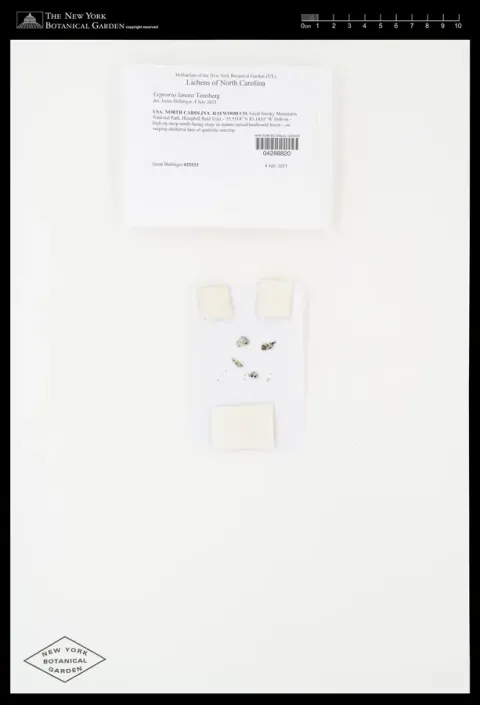
Dokumentasi Lepraria incana dari Wikimedia Commons. Lepraria incana Identifikasi mengikuti record berkas sumber.

Jenis
Fotografi
Kredit
Jerzy Opioła
Sumber media
Buka entri sumber

Gambar menunjukkan objek menurut identifikasi sumber, bukan verifikasi independen spesimen oleh Fungi. Tidak ada skala baru yang ditambahkan.

06 / Rujukan

Sumber profil

  1. [1] Lepraria incana — Wikipedia (en)Bagian sumber: Frozen revision 1348863747
    Tanggal penghimpunan sumber: 2026-10-12
    Teks sumber: CC BY-SA4.0 · Wikipedia contributors
  2. [2] Catalogue of Life Base2026-09-11 — Lepraria incanaBagian sumber: ColDP NameUsage.tsv ID 3TGGY; accepted species; source 2073
    Tanggal penghimpunan sumber: 2026-10-12
  3. [3] Dokumentasi visual — Lepraria incanaBagian sumber: Individual media record; identification follows the source, not independent determination
    Tanggal penghimpunan sumber: 2026-10-12
    Media sumber: CC BY-SA 3.0 · Jerzy Opioła

Adaptasi teks: CC BY-SA 4.0. Wikipedia contributors — Lepraria incana — Wikipedia (en)

Uraian asli dan riwayat sumber

Riwayat atau halaman sumber

Ringkasan sumber

Lepraria incana is a species of dust lichen in the family Stereocaulaceae. First described scientifically by Johann Jacob Dillenius in 1741, and then formally by Carl Linnaeus in 1753, it is the type species of the genus Lepraria. The thallus of this species is green to greyish-green, and powdery – as if made of tiny granules. These granules are soredia, which are asexual reproductive structures. Like most members of genus Lepraria, the lichen has few distinguishing features, lacking both a medulla and sexual reproductive structures (apothecia).

Revisi sumber

Morfologi sumber

The thallus of Lepraria incana is leprose (powdery), and greenish grey in colour, often with blue tinge. It has a diffuse margin with neither distinct lobes, nor a distinct cortex, forming continuous patches with diameters up to about 8 cm, or forming smaller colonies of poorly developed patches or areoles. The thallus consists of abundant powdery soredia (little balls of algae wrapped in fungus hyphae) up to 50 μm in diameter. A medulla is sometimes present, but if so, it is usually poorly developed. Consoredia (diaspores made of aggregated soredia) are sometimes present, and they measure up to 110 μm. Overall, the appearance of the lichen can be quite variable, as sometimes it forms more or less loose cotton-like cushions, while other times it consists only of soredia that can be sparse or dense. The photobiont partner of the lichen is a spherical (coccoid) member of the green algal phylum Chlorophyta, with a diameter of up to 18 μm. In terms of secondary chemicals, Lepraria incana contains divaricatic acid, zeorin, and nordivaricatic acid (trace amounts). Some specimens have trace amounts of atranorin, although this may be a contaminant. It also contains anthraquinones such as parietin, fallacinal, parietinic acid, and citreorosein. A chemical analysis on specimens of the lichen from Japan revealed several terpenes, including pavoninin-2, terpecurcumin Q, ergosterol acetate, taxuspine C, and lantadene A methyl ester. The thallus has a bluish tinge when viewed under ultraviolet light. The expected results of standard lichen spot tests on this species are K− or + (producing a faint yellow colour), C−, KC−, and Pd−.

Revisi sumber

Ekologi sumber

Lepraria incana most commonly occurs on bark on the base of trees. It prefers old bark that is generally more than 20 years old. The lichen grows well on coniferous bark, although it prefers the bark of oak (genus Quercus). It has been judged to be well-adapted to rugose (wrinkled) bark and cork accumulation, as seen in the old stem parts of Pseudotsuga and Quercus. One study found that the probability of the lichen occurring increased with increasing bark crevice depth and decreasing tree bark pH (i.e., tending towards acidic), although another study noted its occurrence on the smooth bark of Abies. In Finland, the most common bark substrates for the lichen are from trees in the genera Picea, Tilia, and Pinus. Less frequently, it is encountered on rotten wood, soil, and rocks. In Belarus, it is the most common of nine species of Lepraria found there, accounting for nearly half of hundreds of herbarium specimens examined. There, it is most common on Picea abies and Pinus sylvestris. Similarly, it is almost always present, and sometimes dominant, in epiphytic lichen communities on common oak (Quercus rubra) in Lithuanian oak woods. In Latvia, it is most common on Quercus robur and Tilia cordata in dry deciduous forests, while in Estonia it is common in old spruce-dominated forests on account of the shade, relatively high humidity, and low pH of spruce bark.

Revisi sumber

Struktur reproduksi sumber

The thallus of Lepraria incana is leprose (powdery), and greenish grey in colour, often with blue tinge. It has a diffuse margin with neither distinct lobes, nor a distinct cortex, forming continuous patches with diameters up to about 8 cm, or forming smaller colonies of poorly developed patches or areoles. The thallus consists of abundant powdery soredia (little balls of algae wrapped in fungus hyphae) up to 50 μm in diameter. A medulla is sometimes present, but if so, it is usually poorly developed. Consoredia (diaspores made of aggregated soredia) are sometimes present, and they measure up to 110 μm. Overall, the appearance of the lichen can be quite variable, as sometimes it forms more or less loose cotton-like cushions, while other times it consists only of soredia that can be sparse or dense.

Revisi sumber

Rujukan halaman ini

Fungi. Lepraria incana. Rilis data fungi-2026-10-12-expansion-2. https://fungi-atlas.mgadib.chatgpt.site/jamur/lepraria-incana/.

Status: impor sumber; pemeriksaan editorial per profil belum selesai. Untuk klaim biologis, gunakan rujukan pada bagian terkait dan periksa konteks sumber aslinya.