01 / Morfologi

Ciri dan struktur

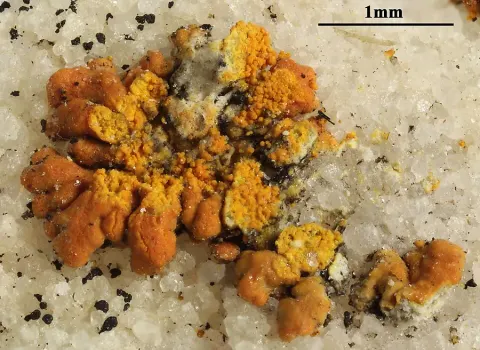
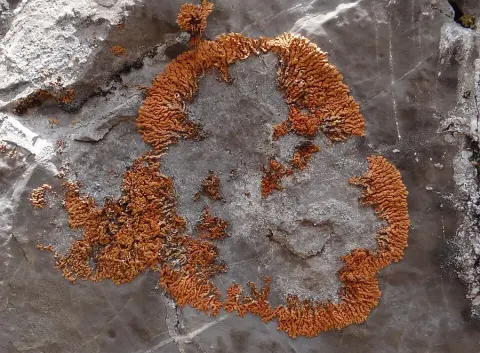
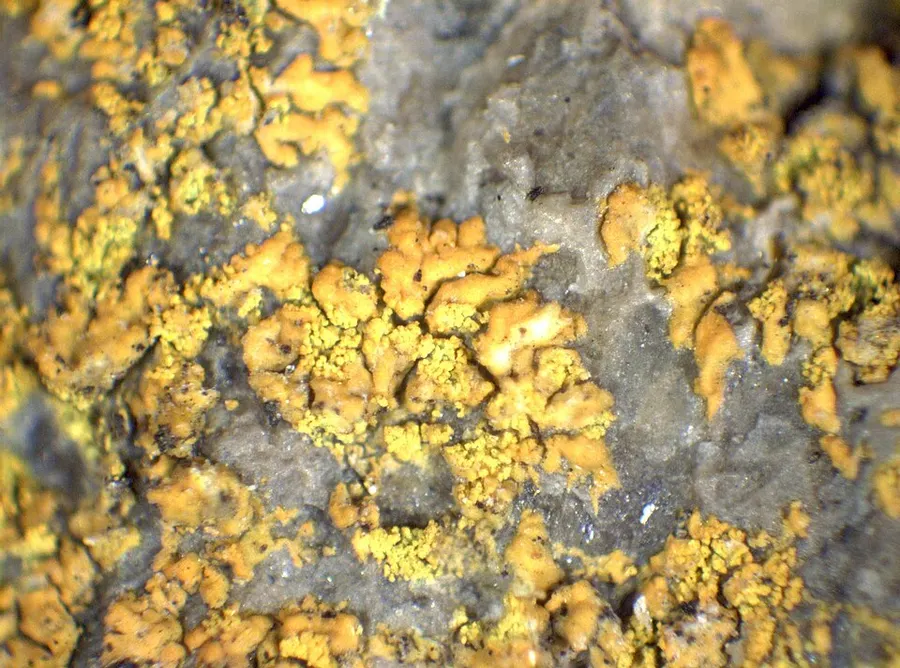
The thallus of Leproplaca obliterans is small and irregular in outline, with pale to dark orange that may be scattered or clustered and are often minutely lobed. A thin basal layer, the , the same colour as the thallus, extends into rock cracks in a dendritic pattern. Soralia develop near the centre of the thallus and are concave, eroded, and yellowish orange. Apothecia, when present, are usually concentrated near the centre, partly immersed or sitting flat on the surface (), with orange and a thin margin of similar or slightly paler colour; they remain small, reaching about 0.5 mm in diameter. Leproplaca obliterans can be confused with other sorediate orange members of the Teloschistaceae, especially Flavoplaca citrina and F. flavogranulosa. Compared with F. citrina, it has a more prominent prothallus, often shows more or less distinct marginal lobes, and develops initially round, concave soralia in the centres of the lobes rather than mainly marginal soralia. It differs from F. flavogranulosa in its darker orange thallus, the absence of coarse granules, and the rarity of apothecia and pycnidia. Its prothallus is formed of narrow bundles of hyphae and its soralia are initially round and concave rather than granular and marginal.

Sebagian uraian ditampilkan dalam bahasa sumber; terjemahannya belum tersedia atau belum lolos pemeriksaan.

Rujukan: [1]

Pengukuran mengikuti objek, spesimen atau kultur, dan metode yang disebutkan sumber. Baca uraian asli untuk konteks lengkap.

02 / Kehidupan

Habitat dan peran ekologis

Leproplaca obliterans grows on siliceous rock, especially on moist, shaded, overhanging granite surfaces, and has been described as characteristic of Caloplacetum obliterantis, a named lichen community defined around this species on silicate rock. The species has been recorded across much of Europe, especially in boreal, montane, and high-montane parts of the temperate zone, and it has also been reported from Southwest Asia, North America, and Australia.

Sebagian uraian ditampilkan dalam bahasa sumber; terjemahannya belum tersedia atau belum lolos pemeriksaan.

Rujukan: [1]

Habitat atau konteks temuan
Informasi belum tersedia pada sumber rilis ini.
Substrat
Informasi belum tersedia pada sumber rilis ini.
Peran atau konteks
Pembentuk liken
Temukan hubungan serupa
03 / Siklus hidup

Reproduksi

Leproplaca obliterans can be confused with other sorediate orange members of the Teloschistaceae, especially Flavoplaca citrina and F. flavogranulosa. Compared with F. citrina, it has a more prominent prothallus, often shows more or less distinct marginal lobes, and develops initially round, concave soralia in the centres of the lobes rather than mainly marginal soralia. It differs from F. flavogranulosa in its darker orange thallus, the absence of coarse granules, and the rarity of apothecia and pycnidia. Its prothallus is formed of narrow bundles of hyphae and its soralia are initially round and concave rather than granular and marginal.

Sebagian uraian ditampilkan dalam bahasa sumber; terjemahannya belum tersedia atau belum lolos pemeriksaan.

Rujukan: [1]

Sinonim menurut acuan taksonomi rilis: Caloplaca obliterans; Gasparrinia cirrochroa f. obliterans; Gasparrinia obliterans; Lecanora obliterans; Physcia cirrochroa var. obliterans; Physcia obliterans; Placodium cirrochroum f. obliterans; Placodium cirrochroum var. obliterans; Placodium obliterans
04 / Batas informasi

Catatan identitas dan cakupan

  • Nama diterima mengikuti Catalogue of Life Base2026-09-11; uraian mempertahankan konsep dan nama sumber aslinya.
  • Original geographic, specimen and life-cycle scope retained; source import awaits individual editorial review.
  • Impor dan terjemahan otomatis belum diperiksa editorial per profil. Struktur reproduktif yang disebutkan tidak membuktikan seluruh siklus hidup diketahui.
  • Pengukuran pada uraian mengikuti spesimen, kultur, dan metode sumber; angka tidak diperluas ke semua populasi.

Catatan distribusi dalam narasi mengikuti sumbernya. Dokumentasi spesimen atau foto mengikuti catatan sumber. Bukti wilayah Indonesia dan penilaian konservasi tidak disimpulkan dari gambar.

05 / Dokumentasi

Melihat dengan konteks

Dokumentasi Leproplaca obliterans dari Wikimedia Commons. The rck-dwelling crustose lichen Leproplaca obliterans Identifikasi mengikuti record berkas sumber.

Jenis
Fotografi
Kredit
Pier Luigi Nimis
Sumber media
Buka entri sumber

Gambar menunjukkan objek menurut identifikasi sumber, bukan verifikasi independen spesimen oleh Fungi. Tidak ada skala baru yang ditambahkan.

06 / Rujukan

Sumber profil

  1. [1] Leproplaca obliterans — Wikipedia (en)Bagian sumber: Frozen revision 1348864627
    Tanggal penghimpunan sumber: 2026-10-12
    Teks sumber: CC BY-SA4.0 · Wikipedia contributors
  2. [2] Catalogue of Life Base2026-09-11 — Leproplaca obliteransBagian sumber: ColDP NameUsage.tsv ID 6PDY3; accepted species; source 2073
    Tanggal penghimpunan sumber: 2026-10-12
  3. [3] Dokumentasi visual — Leproplaca obliteransBagian sumber: Individual media record; identification follows the source, not independent determination
    Tanggal penghimpunan sumber: 2026-10-12
    Media sumber: CC BY-SA 4.0 · Pier Luigi Nimis

Adaptasi teks: CC BY-SA 4.0. Wikipedia contributors — Leproplaca obliterans — Wikipedia (en)

Uraian asli dan riwayat sumber

Riwayat atau halaman sumber

Ringkasan sumber

Leproplaca obliterans is a species of rock-dwelling, crustose lichen-forming fungus in the family Teloschistaceae. First described by William Nylander in 1874, the lichen forms small orange crusts with yellowish orange soralia on shaded, moist siliceous rock, especially overhanging granite. It is found across much of Europe and has also been reported from Southwest Asia, North America, and Australia.

Revisi sumber

Morfologi sumber

The thallus of Leproplaca obliterans is small and irregular in outline, with pale to dark orange that may be scattered or clustered and are often minutely lobed. A thin basal layer, the , the same colour as the thallus, extends into rock cracks in a dendritic pattern. Soralia develop near the centre of the thallus and are concave, eroded, and yellowish orange. Apothecia, when present, are usually concentrated near the centre, partly immersed or sitting flat on the surface (), with orange and a thin margin of similar or slightly paler colour; they remain small, reaching about 0.5 mm in diameter. Leproplaca obliterans can be confused with other sorediate orange members of the Teloschistaceae, especially Flavoplaca citrina and F. flavogranulosa. Compared with F. citrina, it has a more prominent prothallus, often shows more or less distinct marginal lobes, and develops initially round, concave soralia in the centres of the lobes rather than mainly marginal soralia. It differs from F. flavogranulosa in its darker orange thallus, the absence of coarse granules, and the rarity of apothecia and pycnidia. Its prothallus is formed of narrow bundles of hyphae and its soralia are initially round and concave rather than granular and marginal.

Revisi sumber

Ekologi sumber

Leproplaca obliterans grows on siliceous rock, especially on moist, shaded, overhanging granite surfaces, and has been described as characteristic of Caloplacetum obliterantis, a named lichen community defined around this species on silicate rock. The species has been recorded across much of Europe, especially in boreal, montane, and high-montane parts of the temperate zone, and it has also been reported from Southwest Asia, North America, and Australia.

Revisi sumber

Struktur reproduksi sumber

Leproplaca obliterans can be confused with other sorediate orange members of the Teloschistaceae, especially Flavoplaca citrina and F. flavogranulosa. Compared with F. citrina, it has a more prominent prothallus, often shows more or less distinct marginal lobes, and develops initially round, concave soralia in the centres of the lobes rather than mainly marginal soralia. It differs from F. flavogranulosa in its darker orange thallus, the absence of coarse granules, and the rarity of apothecia and pycnidia. Its prothallus is formed of narrow bundles of hyphae and its soralia are initially round and concave rather than granular and marginal.

Revisi sumber

Rujukan halaman ini

Fungi. Leproplaca obliterans. Rilis data fungi-2026-10-12-expansion-2. https://fungi-atlas.mgadib.chatgpt.site/jamur/leproplaca-obliterans/.

Status: impor sumber; pemeriksaan editorial per profil belum selesai. Untuk klaim biologis, gunakan rujukan pada bagian terkait dan periksa konteks sumber aslinya.